
died 551·Feast July 4
St. Martha
Mother of Simeon Stylites the Younger
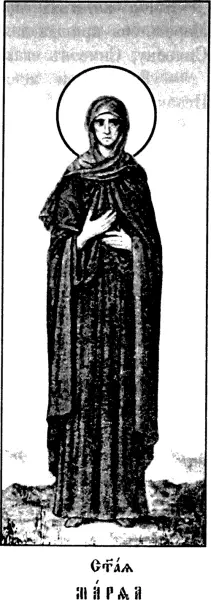
Overview
Martha was a Christian woman of Antioch, honored as the mother of Simeon Stylites the Younger, one of the celebrated pillar ascetics of the sixth century. As a girl she was betrothed by her parents to a young man, and she weighed leaving home altogether for a withdrawn and ascetic life; according to her Life, John the Baptist appeared to her and directed her to accept the marriage her parents had arranged. From that marriage her son Simeon was born. Her married life became a school of quiet holiness: she rose at midnight every night for prayer, kept up constant almsgiving, visited the poor and the orphans, and cared for the sick. In the last year of her life she was granted a vision of angels bearing candles, from whom she learned the hour of her own death, a revelation that spurred her to deeper prayer and more abundant charity. Her death came in 551, and she was laid to rest beside her son. Stories of her appearances after death, generally for the healing of the sick and the instruction of the faithful, spread among the monks of her son's monastery, and she is venerated in the Eastern Orthodox Church on July 4 and in the Catholic Church on July 5.
The Complete Life
Marriage Directed from Heaven
Martha came from Antioch, the great metropolis of Roman Syria, where her parents promised her in marriage to a young man of their own selection while she was still a girl. The prospect of marriage stirred in her a serious desire to leave home instead and withdraw from the world, a longing for the ascetic life that would one day be fulfilled in another form through her son. Her hagiographer relates that as she weighed this course, John the Baptist appeared to her and counseled her to follow her parents' arrangement and wed the man to whom they had pledged her. She obeyed. The marriage proved to be no obstacle to holiness but its setting: of this union Simeon Stylites the Younger was born, the boy who would grow up to stand upon the pillar at the Wondrous Mountain and become one of the most venerated ascetics of the age. Martha's early discernment, guided by the Forerunner, thus served a purpose larger than she could then see. Obedience to that heavenly counsel became the first of the many quiet victories of her life.
§ Biography
Prayer by Night, Mercy by Day
Martha's sanctity expressed itself in a disciplined rhythm of prayer and charity. Every night, it is said, she rose at midnight to pray, keeping a vigil that endured through the years of marriage and motherhood. Her days were given to the corporal works of mercy: she gave steady help to whoever lacked anything, went out to the poor and the orphaned, and nursed the ailing herself. This combination of hidden nocturnal prayer and active service made her household a model of Christian order, and it formed the soil in which her son's extraordinary vocation grew. The pattern of her life — unfailing intercession joined to unfailing kindness — is the reason later generations remembered her not merely as the mother of a famous saint but as a saint in her own right. Her example speaks especially to those whose holiness must be lived out amid family obligations rather than in the desert or on a pillar, showing that the same grace animates both callings. Night prayer and daytime almsgiving were, in her practice, a single and continuous act of worship.
§ Biography
The Foretold Death
In the final year of her life Martha received a mysterious grace. She saw a number of angels holding candles in their hands, and from them she learned the time of her approaching death. The vision cast no gloom over her final months; it drove her instead to still more fervent prayer and more generous deeds, and she filled her remaining time with redoubled charity. She died in the year 551 and was buried near her son, whose pillar stood as a beacon for pilgrims of the whole East. Devotion to her did not end at the grave: stories spread of visitations after her passing, usually bringing recovery to the ill or guidance to the faithful. The most celebrated of these apparitions came to an abbot of the monastery her son had founded; he kindled a lamp at her resting place and ordered that it never go out; Martha then appeared to tell him that every light he burned there was a plea for her intercession before the Lord. Her passing was thus not a defeat but the fulfillment of what the angels had announced.
§ Biography
The Record
- Canonization
- Pre-congregation; venerated in the Eastern Orthodox and Catholic churches
Prayer
Bibliography
Show 2 sources
- Nominis.fr Sainte Marthe
- Prolog: July 4 of the Western American Diocese of the Serbian Orthodox Church
Profile text adapted from the Wikipedia article, licensed CC BY-SA 4.0.
Pray with this saint every day
Save St. Martha to your favorites, read the full profile, and get feast-day reminders in the Saints app.
Get the Saints AppFree on the App Store for iPhone and iPad