
3rd century·Feast June 30
St. Martial
First bishop of Limoges, apostle of Aquitaine
Overview
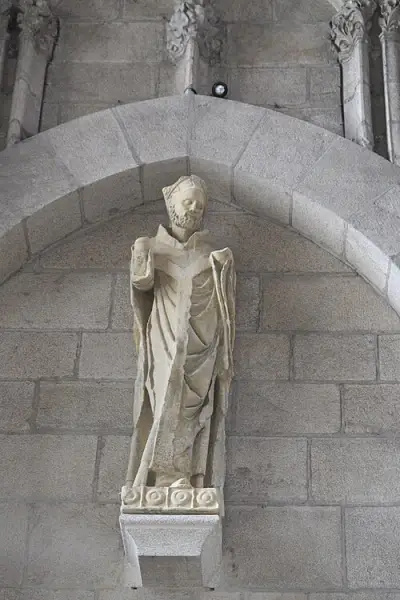
Martial of Limoges, whose name is also rendered Marcial, Martialis, or Marcialis, was the first bishop of Limoges and is honored as the Apostle of the Gauls and the Apostle of Aquitaine. Of somewhat uncertain origin, tradition places his origins in the East, and a medieval hymn that scholars hesitantly assign to Venantius Fortunatus points to highborn Jewish descent, of the tribe of Benjamin. According to Gregory of Tours, in the time of the Emperor Decius Pope Fabian sent seven bishops from Rome to preach the Gospel in Gaul, and to Martial fell the city of Limoges. The Golden Legend preserves the drama of his arrival: beaten and imprisoned after he entered the pagan temple, he was freed when a great light surrounded him at prayer and his bars and chains burst open, so that his own guards asked for baptism. He converted the inhabitants of the city and its region, and his memory has never ceased to be venerated there. He died at Limoges and found burial beyond the town's Roman walls; the grave grew into one of the great pilgrimage sites of western Christendom, served from the ninth century by the Benedictine Abbey of Saint-Martial with its library second only to Cluny. Legends later enlarged him into a disciple of Christ himself, claims exposed as forgeries, but the historical bishop remains the father of Limousin Christianity, invoked against epidemics and honored from Avignon to Brazil.
The Complete Life
From the Orient to the Gauls
The origins of Martial are wrapped in the same uncertainty that surrounds most of the missionary bishops of Gaul. His background cannot be fixed with confidence; tradition says only that he came from the East that Romans called the Orient. A medieval hymn, tentatively credited to Venantius Fortunatus, the poet-bishop of the sixth century, points to highborn Jewish descent; one of its lines, turned into English, declares that the tribe of Benjamin bore him with blood of distinction. If the verse reflects truth, Martial belonged to that diaspora of Jews who became the earliest and most effective missionaries of the Christian faith, carrying the Gospel of Israel's Messiah out into the Gentile world. His name, recorded in the old sources as Marcial, Martialis, and Marcialis, would become one of the most celebrated in the Frankish church, and the mystery of his birth only deepened the reverence of later ages, who could not leave him a mere missionary but felt compelled to imagine him standing at the Last Supper itself. The historical man, whoever he was, crossed the Mediterranean at some point in the middle of the third century and found his destiny in a Gallic town on the banks of the Vienne.
§ Life
One of the Seven Sent to Gaul
The framework of Martial's calling comes from Gregory of Tours, the great sixth-century historian of the Frankish church. In the days of the emperor Decius, so Gregory records, Pope Fabian dispatched a company of seven bishops from Rome for the evangelization of Gaul. The seven names have come down together: Gatianus was allotted Tours, Trophimus Arles, Paulus Narbonne, Saturninus Toulouse, Dionysius Paris, and Austromoine Clermont, while to Martial fell Limoges. The company was remembered as a second sending of the Apostles, each man bound for a city where his name would remain woven forever into local devotion. Martial's portion was Limoges, then a Roman town of Aquitaine whose pagan temples still commanded the loyalty of its people. The mission was dangerous by definition: to preach Christ meant to confront the civic religion face to face, in its own sacred places, before magistrates who counted the refusal of sacrifice an offense against the order of the state. Whatever the exact date of his arrival, the middle of the third century was a time of persecution and upheaval in the empire, and the seven bishops of the Decian mission labored in the shadow of martyrdom, of which more than one of their number would partake. Martial's share of the work was to plant the church of the Limousin, which has never forgotten him.
§ Life
Chains Broken at Limoges
His arrival, as the legend tells it, began with violence. Martial made his way to the temple of the local gods, and its priests answered the intrusion by beating the missionary and throwing him into prison. At his prayers the next morning, a radiance gathered about him; his fetters snapped and the bars of the cell gave way, and the guards who had locked him up, seeing what had happened, came to him asking for baptism. From those first converts the church of the city took its rise, and he brought its people over to the Christian faith, which has honored him there without interruption ever since. Later imagination enlarged the mission beyond all measure: in the tenth century, as his cult flourished, Martial was transported back to the age of the Apostles and described as Peter's own emissary to Gaul, a preacher said to have covered not just the Limoges region but the whole of Aquitaine, and a wonder-worker credited, among other signs, with bringing a dead man back to life by the touch of the staff that Peter had placed in his hands. The fourteenth century brought the cult a fresh intensity, and a record of 73 wonders was compiled between 1378 and 1388. His story also embraces Valerie of Limoges, the martyr of later memory who, in her legend, bore her severed head through the streets to her bishop.
§ Life
Death and the Tomb That Built an Abbey
Limoges was where Martial's earthly course ended, most likely during the third century, and Christians laid him to rest beyond the limits of the Roman town, as their custom demanded. Pilgrims came in ever-growing numbers to the first bishop's grave, and around it there arose one of the great sanctuaries of medieval France. In the ninth century the monks who kept the tomb found patronage in the Benedictine order, and the site became the Benedictine Abbey of Saint-Martial. The abbey rose to be a center of learning as well as devotion: its library was second only to that of Cluny, and its scriptorium produced and preserved manuscripts studied throughout Europe; the twelfth-century chronicler Geoffroy du Breuil of Vigeois worked in its library. The Miracula Martialis, an account of the miracles of the seventh, eighth, and ninth centuries at the saint's shrine, was written shortly after 854, evidence of the steady flow of pilgrims to the place where the historical bishop lay buried. The abbey itself came to a violent end: it was so thoroughly razed in the nineteenth century that only its scattered manuscripts remain, many of them now in the Bibliothèque Nationale de France. Archaeologists brought the original crypt back to light in excavations running from 1966 to 1970, and Romanesque capitals from the buildings surfaced again in 1994 to enter the city's museum.
§ Abbey
A Saint Between History and Legend
Martial is held to have been canonized Pre-Congregation, honored as a saint from the earliest times by the church he founded, with his feast kept on 30 June. Few saints, however, illustrate so vividly the tension between devotion and documentation. The crowds of pilgrims at his abbey stimulated the growth of an elaborate hagiography during the tenth century, which carried him backward into the apostolic age. The mythology culminated in the eleventh-century forgeries of Ademar of Chabannes: a Life issued under the name of Aurelian, the bishop who succeeded him, rested its case on three claims, baptism at Peter's hands, a place among the seventy-two disciples, and a seat at the Last Supper. When the Golden Legend gathered its tales in the thirteenth century, the Martial of legend dominated them: a wonder-worker expelling demons, restoring the dead to life, and baptizing whole crowds at once. The truth fought back slowly. In 1854 Mons. Buissas of Limoges asked Pope Pius IX to grant Martial the rank of a disciple of Christ, and the request was refused. Ademar's deception did not collapse quickly; only in the 1920s did scholars lay bare the whole fabric of his invention, which stretched to a fictitious church council and a counterfeit papal letter, and even then many traditionalist Catholics declined for several generations to accept the verdict. The Pre-Congregation saint, happily, needed none of it.
§ Hagiography
From Limousin to Brazil
The cult of Martial spread far beyond the city he evangelized. When ergotism swept Limoges in 994, the people turned to him in their distress, and he has been invoked ever since against epidemics generally and against the fire of the poisoned rye in particular, while prisoners claim him as their patron. Limoges, Avignon, and Cahors all stand under his protection, and through the Limousin he remains a beloved figure. In Bordeaux he was honored with special warmth: his pastoral staff reposed in the Basilica of Saint-Seurin and was borne through the streets whenever plague threatened, to draw down his aid. In Italy, the cathedral of Colle di Val d'Elsa is dedicated to him. At the papal palace in Avignon, his chapel served for deliberations during conclaves, and the Gothic church of Saint-Martial Temple was finished there in 1402; a fresco in the palace shows him receiving the pastoral staff from Saint Peter himself, the legend rendered in paint. The Cloisters in New York preserves a twelfth-century stained-glass window of Saint Martial founding the cathedral of Saint-Pierre. His relics repose in the church of St Michel des Lions in Limoges, where they were carried at the abbey's suppression. In Brazil, bonfires close the Festas Juninas in Maranhão in his honor, and the festivities of São Luís, held every year since 1928, draw thousands of celebrants.
§ Veneration
Timeline
- 250
In the time of Emperor Decius, Pope Fabian sent him from Rome to Limoges as one of seven missionary bishops for Gaul.
§ Life
- 854
The Miracula Martialis, an account of miracles of the seventh through ninth centuries, was written shortly after this year.
§ Hagiography
- 994
Limoges, in the grip of a terrible outbreak of ergot poisoning, called upon his intercession.
§ Veneration
- 1378
Amid a fourteenth-century revival of his cult, a record of 73 miracles began to be compiled, continuing until 1388.
§ Hagiography
- 1388
The miracle collection Miracula sancti Martialis anno 1388 patrata was completed.
§ Hagiography
- 1402
The Gothic church of Saint-Martial Temple in Avignon was completed.
§ Veneration
- 1854
Bishop Buissas of Limoges petitioned Pope Pius IX to honor Martial as a disciple of Christ and was turned down.
§ Hagiography
- 1966
The original crypt of the razed Abbey of Saint-Martial was exhumed over the following years beneath the Place de la République.
§ Abbey
- 1994
Twelve Romanesque carved capitals from the abbey were purchased for the Museum of the Bishopric of Limoges.
§ Abbey
- 2007
A monument to him was erected in São Luís, Maranhão, where his festivities have gathered thousands since 1928.
§ Veneration
The Record
- Major works
- Abbey of Saint-Martial at his tomb in Limoges·Evangelization of the Province of Limoges
- Patron of
- patron of prisoners·patron of Limoges·patron of Avignon·patron of Cahors·against epidemics·against ergotism
- Symbols
- raising the dead to life
- Canonization
- Canonized Pre-Congregation; feast kept on 30 June
Prayer
Bibliography
Show 5 sources
- Husenbeth, Frederick Charles. Emblems of Saints: By which They are Distinguished in Works of Art, Longman, Green, Longman, and Roberts, 1860, p. 111
- Clugnet, Léon (1910). "St. Martial". The Catholic Encyclopedia. Vol. 9. New York City: Robert Appleton Company.
- de Lasteyrie, Charles (1901). L'abbaye de Saint-Martial de Limoges (in French). Paris: A. Picard et fils.
- Venantius Fortunatus (1881) [circa 6th c. AD]. "Carmina Spuriora, III.14". In Friedrich Leo (ed.). Venanti Honori Clementiani Fortunati Presbyteri Italici Opera Poetica (in Latin). Berlin: Weidmann. p. 382.
- Bogin, Meg (1976). The Women Troubadours. Scarborough: Paddington Press. p. 149. ISBN 9780846701132.
Profile text adapted from the Wikipedia article, licensed CC BY-SA 4.0.
Pray with this saint every day
Save St. Martial to your favorites, read the full profile, and get feast-day reminders in the Saints app.
Get the Saints AppFree on the App Store for iPhone and iPad