
1579-1639·Feast November 3
St. Martin de Porres
Dominican Lay Brother
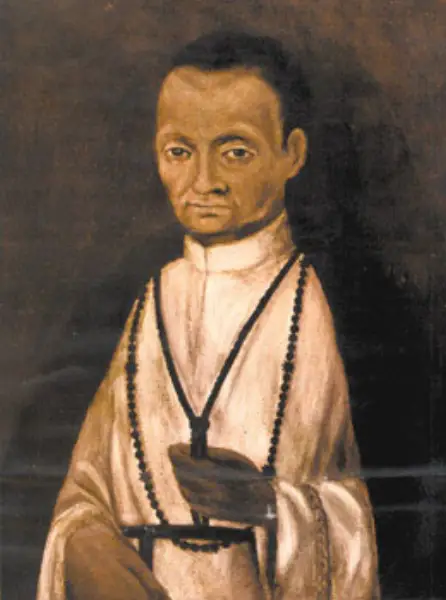
Overview
Martín de Porres Velázquez was born in Lima on 9 December 1579, the illegitimate son of a Spanish nobleman and of Ana Velázquez, once a slave of mixed African and Native ancestry. His father abandoned the family after the birth of a daughter, and Martin grew up in poverty, apprenticed to a barber-surgeon before he was in his teens. Because Peruvian law barred people of African and Native blood from full membership in religious orders, his only door was that of 'donado' — a volunteer doing menial work for the right to live and dress as a religious — and at fifteen he entered the Rosary convent of the Dominicans in Lima as a servant boy. Eight years on, in 1603, the prior allowed him to profess vows as a lay brother, a decision some friars met with racial abuse that Martin bore without complaint. Assigned to the infirmary at thirty-four, he remained there until his death: nursing sick friars, feeding some 160 poor people a day from his begging, founding a home for orphans and abandoned children, and caring for Spanish nobles and newly landed African slaves with the same tenderness. Accounts of his life report ecstasies, bilocation, instantaneous cures and an uncanny peace with animals. When Lima was struck by epidemic he was forbidden to keep bringing the sick in, and answered one rebuke with the words that obedience must not outrank charity. He died on 3 November 1639, and the crowds filing past his body snipped fragments of his habit as relics.
The Complete Life
Early Life
Martín de Porres Velázquez was born in Lima on 9 December 1579, the illegitimate son of a Spanish nobleman, Juan de Porres, and of Ana Velázquez, a freedwoman of mixed African and Native ancestry. His father abandoned the family after the birth of Martin's sister, and the boy grew up in poverty with his mother and sibling in Lima's multiracial underclass. He was apprenticed to a barber-surgeon — in that age a trade combining shaving, bloodletting and basic medicine — before he was in his teens, acquiring the medical skills he would exercise all his life. Peruvian law and custom barred people of African and Native blood from full membership in religious orders, so the only door open to him was that of donado, a volunteer who did menial work for the right to live and dress as a religious. At fifteen he presented himself at the Dominican convent of the Rosary in Lima.
§ Lifestyle
Lay Brother
Martin entered the Rosary convent in 1594 as a servant boy, working in the kitchen and the scullery. Eight years on, in 1603, the prior — moved by his evident virtue and against the racial norms of the day — allowed him to profess vows as a Dominican lay brother, a decision some friars met with racial abuse, all of which Martin bore with patience. From 1613 onward he worked in the infirmary and remained there for the rest of his life, twenty-six years: nursing sick friars, dressing wounds, and practicing the barber-surgeon's medicine he had learned as a boy. He nursed with a deliberate impartiality that scandalized convention: Spanish nobles and newly landed African slaves, friars and beggars, in the same beds and with the same tenderness. Asked for his bed by a beggar, he gave it; reproved, he answered that compassion is preferable to cleanliness.
§ Lifestyle
Service of the Poor
Martin's charity overflowed the convent walls. From his begging rounds he fed some 160 poor people a day, raising money even from the wealthy by his reputation. He founded a residence in Lima for orphans and abandoned children, and obtained from his superiors and donors the means to dow orphan girls and place boys in trades. When the convent fell into debt he made the offer remembered in his own words: that he, a poor mulatto, should be sold in payment. During epidemics he nursed the sick in their own homes, and his contemporaries credited him with miraculous knowledge, instantaneous cures, bilocation and levitation — the standard marvels of the hagiography of holiness — while insisting on his practical works. He also, famously, cared for the city's animals, the iconography of a dog, cat, bird and mouse eating from one dish being his emblem.
§ Lifestyle
Final Years
Martin lived an austere life — fasting, abstaining from meat, sleeping little, scourging himself — even while working ceaselessly in the infirmary. He was regarded by Lima's poor as their servant and by the friars as the house's treasure; even the vicious came to him. He died in Lima on 3 November 1639, aged fifty-nine, and his death provoked an extraordinary popular acclaim: the crowd that filed past his body cut pieces from his habit until almost none remained, relic-hunting by the poor of Lima themselves. He was buried in the convent of Santo Domingo, where his remains still draw pilgrims.
§ Introduction
Canonization
Martin's cause was long, as the causes of the poor and the racially marginal were. He was beatified by Pope Gregory XVI on 29 October 1837, nearly two centuries after his death. Canonization came only in the twentieth century: Pope John XXIII declared him a saint in Rome on 6 May 1962, in a ceremony the pope — who would open the Second Vatican Council within months — used to speak of the unity of the human family. His feast is kept on 3 November.
§ Death and commemoration
Legacy
Martin de Porres is among the most beloved saints of the Americas. He is the patron of black people, of mixed-race people, of the poor, of barbers and public health workers, of social justice and race relations — a patronage list that reads like a commentary on his life. For Latin America's African and indigenous descendants he is the proof of their place in the communion of saints; his iconography, the black lay brother with the broom, the animals and the rosary, is among the most widely reproduced in the Catholic world. Devotion to him spread from Lima across the Americas, the Philippines and Africa, and he has been taken up as a symbol by movements for racial justice within and beyond the Church.
§ References
Timeline
- 9 Dec 1579
Born in Lima, Viceroyalty of Peru, the illegitimate son of a Spanish nobleman and a freed slave.
§ Lifestyle
- 1581
His sister Juana de Porres was born, after which their father abandoned the family.
§ Lifestyle
- 1594
At fifteen, sought to enter the Dominican Convent of the Rosary in Lima, beginning as a servant boy.
§ Lifestyle
- 1603
At twenty-four, permitted to make profession as a Dominican lay brother.
§ Lifestyle
- 1613
At thirty-four, placed in charge of the convent infirmary, where he served until his death.
§ Lifestyle
- 3 Nov 1639
Died in Lima at fifty-nine; as his body was displayed, mourners snipped pieces of his habit as relics.
§ Death and commemoration
- 1763
Pope Clement XIII approved a decree recognizing the heroic character of his virtues.
§ Death and commemoration
- 29 Oct 1837
Beatified by Pope Gregory XVI.
§ Death and commemoration
- 8 Jun 1926
The cause for his canonization was opened.
§ Death and commemoration
- 6 May 1962
Canonized by Pope John XXIII in Rome.
§ Death and commemoration
In Their Own Words
Compassion, my dear Brother, is preferable to cleanliness.
I am only a poor mulatto, sell me.
The Record
- Major works
- Founded a residence for orphans and abandoned children in Lima
- Patron of
- Black people·Mixed-race people·Barbers·Innkeepers·Public health workers·Those seeking racial harmony·Animals
- Symbols
- Broom·Dog, cat and mouse eating from the same dish·Black scapular and capuce of the Dominican lay brother
- Canonization
- Beatified by Pope Gregory XVI on 29 October 1837; canonized by Pope John XXIII in Rome on 6 May 1962
Prayer
Bibliography
Show 12 sources
- 1 2 3 4 "Martin Porres" , Encyclopedia of World Biography .
- 1 2 3 "St. Martin de Porres, the first Black saint in the Americas" . African American Registry . Retrieved 22 April 2020 .
- ↑ Leonard Foley; Patrick McCloskey (2009). Saint of the Day: Lives, Lessons & Feasts . Franciscan Media. ISBN 978-0-86716-887-7 .
- 1 2 3 "St. Martin de Porres" . American Catholic . Archived from the original on 27 April 2015.
- 1 2 Fullerton, Anne. "Who was St. Martin de Porres?" . St. Martin de Porres School, Oakland, CA . Archived from the original on 19 October 2013.
- 1 2 3 Craughwell, Thomas J. (1 September 2016). "Patron Saints for Modern Challenges" . Franciscan Media . Retrieved 4 July 2019 .
- ↑ Biography in The Saint Martin De Porres Prayer Book , pp. 147–152.
- ↑ , Martin de Porres (depicted in figure 3 of the patent) is cited as a historical example of US patent 20060014125A1's methods being used successfully, though such claims are disputed by religious historians.
- 1 2 Granger, Fr. Arthur M. (OP) (1941). Vie du Bienheureux Martin de Porrès . St. Hyacinthe: Dominican Press.
- ↑ Index ac status causarum beatificationis servorum dei et canonizationis beatorum (in Latin). Typis polyglottis vaticanis. January 1953. p. 171.
- ↑ "St. Martin de Porres" . Dominican Province of St. Martin de Porres. Archived from the original on 24 April 2016.
- ↑ Dorcy, Sr. Mary Jean (1983). St. Dominic's Family: Over 300 Famous Dominicans . TAN Books. ISBN 978-1-5051-0346-5 .
Profile text adapted from the Wikipedia article, licensed CC BY-SA 4.0.
Pray with this saint every day
Save St. Martin de Porres to your favorites, read the full profile, and get feast-day reminders in the Saints app.
Get the Saints AppFree on the App Store for iPhone and iPad