
c. 518 – 580·Feast March 20
St. Martin of Braga
Archbishop, Monk, and Apostle to the Suevi
Overview
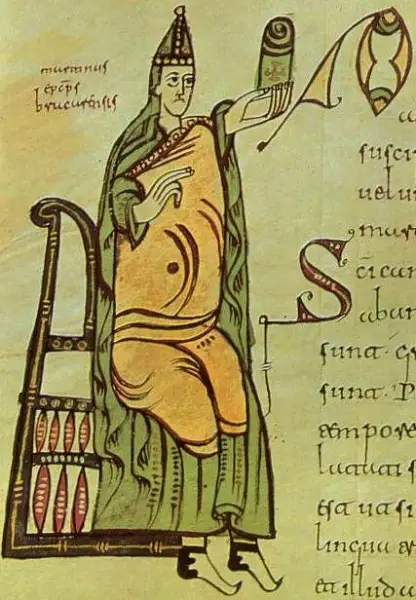
Martin of Braga, known in Latin as Martinus Bracarensis and in Portugal as Martinho de Dume, was an archbishop of Bracara Augusta in Gallaecia — now Braga in Portugal — as well as a missionary, monastic founder, and prolific ecclesiastical author. Born in Pannonia around 518, he journeyed east on pilgrimage and took up the monastic habit in the Holy Land; about 550 he crossed by sea into Hispania, making his home in the remote Suevic kingdom of Gallaecia. There he played the decisive role in converting the Suevi from Arianism to Chalcedonian Christianity, founding monasteries — the most famous at Dumium, near the Suevic capital — and reorganizing the church of the realm. He attended the First Council of Braga in 561 as bishop of his monastic see and presided over the Second Council of Braga in 572 as metropolitan. Gregory of Tours, his contemporary, praised his virtue and reckoned his learning unmatched in the world of his day. His translations from Greek, his canonical collection, and his moral treatises in the manner of Seneca made him one of the most original voices of sixth-century Iberia, and he is honored as the Apostle to the Suevi.
The Complete Life
From Pannonia to Gallaecia
Martin was born around 518 in Pannonia, in the heart of central Europe, far from the northwestern corner of Iberia where his life's work would be done. As a young man he made a pilgrimage to the Holy Land, and there he embraced the monastic life. Around the year 550 he made the sea crossing into Hispania, making his home in Gallaecia, the northwestern kingdom of the Suevi. His motives have been debated ever since: Roger Collins remarks that what drew him toward a region so distant for his era remains a mystery. One scholarly camp has cast him as an instrument of Byzantine diplomacy, pointing to the overlap between his voyage and the launch of the imperial reconquest of southeastern Hispania; another has seen a missionary dispatched to the Suevic royal house; certainty eludes both. Whatever drew him west, his arrival proved historically momentous, for the newcomer from Pannonia would become the religious father of the Suevic kingdom and one of the leading churchmen of sixth-century Europe. Whatever the truth of these conjectures, the journey itself reveals a man of uncommon resolve and wide horizons.
§ Life
Monk and Bishop of Dumium
Martin's monastic training had been formed on the ascetic ideal of the Desert Fathers of Egypt, and in Gallaecia he set about planting that tradition. He founded several monasteries, the most famous at Dumium, today's Dume, planted within reach of the Suevic royal seat at Braga, where the discipline of Egyptian monasticism could shape the clergy of the kingdom. He became bishop of this monastic bishopric, an unusual arrangement that joined the contemplative life to episcopal responsibility, and in that capacity he attended the First Council of Braga in 561. At some point before the Second Council of Braga he was raised to the metropolitan see of Braga itself, and as archbishop he chaired the second in 572, in the closing stretch of his life. In adapting the severe regulations of the Egyptian desert to his Iberian flock he deliberately softened their rigor, helping the people of Gallaecia to receive the monastic life; the historian Gregory of Tours, his contemporary, bears witness both to his virtue and to his unmatched learning. That blend of contemplative habit and episcopal charge became a hallmark of his churchmanship.
§ Life
Conversion of the Suevi
The achievement that gave Martin his title of Apostle to the Suevi was the conversion of the Suevic kingdom from Arianism to Chalcedonian Christianity. He pursued this work with a characteristically gentle hand: in converting the Suevi he avoided compulsion, preferring persuasion to force, and the rebuilding of the Suevic church's structure that followed owed more to his patient leadership than to decree. His approach to the ordinary people of the countryside is displayed in the treatise De correctione rusticorum, written at the request of his fellow bishop Polemius of Asturica, who sought advice on the conversion of rural pagans anxious about idolatry and sin. Martin answered with a sermon that catalogues the pagan practices of sixth-century Iberia yet treats them with notable tolerance, a disposition scholars attribute to his classical education in the East and to thinkers such as Seneca and Plato. He wrote it deliberately in a rustic style, seasoning his Latin with ungrammatical constructions and local vulgarisms — food for rustics, as he said, served in rustic speech — and to his lasting influence Portuguese and Galician name the days of the week from numbers and the liturgy rather than from pagan gods.
§ De correctione rusticorum
A Disciple of the Desert and of Seneca
Martin's spiritual teaching joined the ascetic inheritance of Egypt to the moral philosophy of the classical world. He turned a Greek anthology of 109 maxims of the Egyptian monks into Latin, issuing it as the Sententiae patrum Aegyptiorum, and at his instigation the monk Paschasius of Dumium, whom he instructed in Greek, rendered a larger collection dedicated to him as the Liber geronticon. His closing decade brought forth two brief moral works, De ira and Formula vitae honestae, both leaning hard on the writings of Seneca; the latter, addressed to Miro, king of the Sueves, set out the four cardinal virtues, and circulated so widely under Seneca's name that for centuries it was taken as proof of that philosopher's Christianity. Three further essays — against vanity, on pride, and an exhortation to humility — show his debt to John Cassian's catalogue of the vices. Laistner notes that his tracts are valuable evidence that some of Seneca's writings were still to be found in Iberia in the sixth century, preserved and Christianized by a monk-archbishop who saw no quarrel between pagan wisdom and the Gospel.
§ Moral treatises
Metropolitan of Braga
Martin's final years were spent consolidating the church of the Suevic kingdom as its metropolitan. The Second Council of Braga, over which he presided in 572, decreed that bishops were to gather their people for conversion, and to the acts of that council were appended the eighty-four canons known as the Canons of St. Martin, rendered by him from the Greek and Egyptian disciplinary texts of the East and handed to the Suevic church as its law. To the same collection belongs De Pascha, his instruction on computing the date of Easter, which fixed its observance between March 22 and April 21 and provided for its announcement during Advent. His literary activity continued to the end: the treatise on anger, the rule for an honest life addressed to King Miro, and the sermon on the reform of the rustics all belong to these closing years. He died in 580 at about sixty-two, having presided over a church transformed in a single generation from Arian mission field to an organized, council-governed province with a monastic clergy formed at Dumium. His pen never rested.
§ Councils and canons
Honored as Apostle to the Suevi
Martin's canonization belongs to the age before formal processes: his sanctity was acknowledged for bringing the people of Gallaecia into Chalcedonian communion, and the Church bestowed on him the title Apostle to the Suevi. His feast is kept on March 20, and he is venerated in both the Catholic Church and the Eastern Orthodox Church, the Russian Church having officially added the saints of Spain and Portugal to its liturgical calendar. His reputation among his contemporaries is fixed by Gregory of Tours, who testifies to his virtue and judges his self-taught learning peerless in his generation; the same historian attributes to him the verses gracing the south doorway of Saint Martin's church at Tours. Three of his poems survive: two inscriptions for buildings and a six-line epitaph on his own life, a rare instance of a bishop composing his own memorial. The devotion to his memory has endured in Portugal, where he is remembered above all as Martinho de Dume, the founder of its first monastery. That double verdict — sanctity and scholarship — has followed his memory ever since.
§ Introduction
A Literary Inheritance
Martin's authorship left a body of work unmatched among his Iberian contemporaries and a legacy that reached far beyond his province. His translations made the sayings of the Egyptian monks available to the Latin West through Paschasius of Dumium, and his canonical collection gave the Suevic church its law. De correctione rusticorum became one of the most studied texts of early medieval mission, prized by modern scholars both for its detailed catalogue of sixth-century Iberian pagan practice and for its unusually tolerant pastoral approach; its influence on the very language of western Iberia, in the numbering of the days of the week, endures in Portuguese to this day. His letters address the practical questions of a young church — the correct form of baptism against the Arian triple immersion in De trina mersione, the reform of rural religion to Bishop Polemius. His complete works were first printed at Seville in 1782 and later in Migne's Patrologia Latina, and modern critical editions by Barlow and others have restored the texts of the archbishop whom Gregory of Tours ranked second to none in learning in his lifetime.
§ Works
Timeline
- 518
Born in Pannonia in central Europe
§ Introduction
- 550
Travels by sea to Hispania and settles in Gallaecia after becoming a monk in the Holy Land
§ Life
- 561
Attends the First Council of Braga as bishop of the monastic see of Dumium
§ Life
- 570
Composes De Pascha, his explanation of the calculation of the date of Easter
§ Councils and canons
- 572
Presides over the Second Council of Braga as metropolitan bishop; his collection of canons is presented to the Suevic church
§ Councils and canons
- 580
Dies at Braga at about the age of sixty-two
§ Introduction
In Their Own Words
he so instructed himself in learning that he was considered second to none in his lifetime
I have had to touch upon a vast forest of past times and events in a treatise of very brief compass and to offer the rustics food seasoned with rustic speech.
The Record
- Major works
- Formula vitae honestae·De ira·De correctione rusticorum·De trina mersione·Sententiae patrum Aegyptiorum (translation)·Canons of St. Martin·De Pascha·Pro repellenda iactantia·De superbia·Exhortatio humilitatis·Monastery of Dumium
- Canonization
- Pre-congregation; canonized by popular acclaim for converting the Suevi to Chalcedonian Christianity
Prayer
Bibliography
Show 6 sources
- Ott, Michael. "St. Martin of Braga." The Catholic Encyclopedia. Vol. 9. New York: Robert Appleton Company, 1910.
- Collins, Early Medieval Spain: Unity in Diversity 400-1000, second edition (New York: St. Martins, 1995), p. 82.
- M.L.W. Laistner, Thought and Letters in Western Europe: A.D. 500 to 900, second edition (Ithaca: Cornell University, 1957), p. 117.
- Farmer, D. (2011). "Martin of Braga". The Oxford Dictionary of Saints. Oxford University Press.
- Barlow, Claude W., Martini episcopi Bracarensis opera omnia (New Haven, CT: Yale University Press, 1950).
- Fletcher, Richard A. (1999). The Barbarian Conversion: From Paganism to Christianity. University of California Press. p. 257. ISBN 978-0-520-21859-8.
Profile text adapted from the Wikipedia article, licensed CC BY-SA 4.0.
Pray with this saint every day
Save St. Martin of Braga to your favorites, read the full profile, and get feast-day reminders in the Saints app.
Get the Saints AppFree on the App Store for iPhone and iPad