
c. 1130 – 1203·Feast January 12
St. Martin of León
Augustinian Canon, Crusader, and Preacher
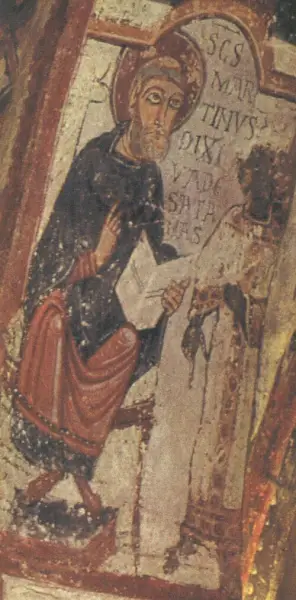
Overview
Martin of León was a Spanish priest and canon regular of the Augustinian Order, renowned for his biblical commentaries and sermons, and honored as a saint. Born at León around 1130, he withdrew from the world with his father Juan to the canonry of San Marcelo after his mother's death, and was educated there. After his father died he undertook a great pilgrimage to Rome and Constantinople, and studied at the University of Paris under Peter Lombard before returning to Spain to take the religious habit. Finding San Marcelo secularized by the bishops, he joined the collegiate church of San Isidoro in León, where his zealous observance, charity, and deep devotion to the Blessed Sacrament marked him out. He sojourned in Italy while Urban III held the papal throne, then joined the Third Crusade's passage to the Holy Land, serving the Hospitallers for two years. Death came to him gently on 12 January 1203; the necrology of San Isidoro noted the day, and the canons dedicated a chapel to him almost at once and kept his feast each year. His disciple Lucas of Tuy wrote his life, and his vast book of sermons, the Liber Sermonum, fills some fourteen hundred manuscript pages.
The Complete Life
A Son of León
Martin was born at León around the year 1130, into a family of means serious enough about the faith that father and son withdrew from the world together. After the death of his mother, Martin and his father Juan entered the canonry of San Marcelo in their native city, where the boy received his education among the canons. The household's shared vocation left its mark on him for life; when his father died, Martin's response was not to settle into a comfortable canonry but to set out on a grand pilgrimage that took in Rome and Constantinople, the two capitals of the Christian world of his day. He carried his studies further at the University of Paris, where he sat under Peter Lombard, the master whose Sentences had become the theological textbook of the schools. Back in Spain he professed the habit at San Marcelo; learning that its canons had been reduced to secular clergy by the bishops, he moved to San Isidoro, the collegiate church of the same city, the royal pantheon of León and a center of sacred learning.
§ Life
Canon of San Isidoro
At San Isidoro Martin found the setting for his mature vocation as a canon regular of the Augustinian Order. He distinguished himself among the religious of the collegiate church by his zealous observance of the rule, his charity toward others, and a deep devotion to the Blessed Sacrament that became the defining note of his spirituality. Alongside the common life he sustained an enormous literary labor: commentaries on several of the Epistles and on the Apocalypse, and numerous discourses on varied subjects, gathered in a book of sermons, the Liber Sermonum, which runs in manuscript to about 700 folios — some 1,400 pages — and contains 54 lengthy sermons. Modern scholars judge that these sermons served less as texts to be preached than as models for preachers, patterns of interpretation and exhortation for the clerical culture of late twelfth-century León. A recent study of his reading of the fall of Jerusalem places him among the differing voices that shaped crusade preaching, evidence that his Paris training and eastern experience fed directly into his homiletic work. The sheer scale of the collection testifies to a lifetime of daily composition.
§ Works
To the Holy Land with the Crusade
Martin's life included an unusual eastern chapter for a Leonese canon. He sojourned in Italy while Urban III held the papal throne, between 1185 and 1187, the years in which the news of Saladin's victory at the Horns of Hattin convulsed the West. From Italy he traveled to the Holy Land with the Third Crusade, and for a pair of years he labored under the Hospitallers, the military-religious order that cared for pilgrims and defended the remaining Christian holdings. What he saw and did in those years is not recorded in detail, but the episode reveals a restless, courageous spirit: a scholar in his late fifties who had studied under Peter Lombard now gave two years of his life to the Knights of Saint John in the crusader East. The experience found its echo in his writings, for modern scholarship identifies in his preaching a distinctive reading of the fall of Jerusalem, the catastrophe that had set the crusade in motion and that a biblical commentator of his generation could hardly leave uninterpreted. For a canon of León, such an eastern sojourn was an exceptional distinction.
§ Life
Death at San Isidoro
Martin closed his life in the community he had chosen decades before. He died at San Isidoro on 12 January 1203, of natural causes, and the precise date is preserved because the necrology of San Isidoro recorded it — a fact that tells its own story about the esteem in which the canons held him. The religious of the collegiate church did not wait for distant authorities to confirm his holiness: very early they dedicated a chapel to Martin within their church, where his tomb or memory became a place of devotion, and they celebrated his feast each year on the day of his death. His major shrine rests in the Basilica of San Isidoro at León to this day. Among his brethren was Lucas of Tuy, himself destined for fame as a chronicler, who wrote a biography of Martin under the title Vita sancti Martini, ensuring that the memory of the canon pilgrim, crusader and preacher would survive within the historiography of medieval León. A chapel and an annual feast, granted within living memory of his death, are the surest tokens of a local cult both early and sincere.
§ Life
Preacher and Author
Martin's literary remains are the substance of his legacy. He wrote commentaries on different Epistles and on the Apocalypse, and left numerous discourses on many varied subjects; his Liber Sermonum, with its 54 lengthy sermons filling roughly fourteen hundred pages of manuscript, stands as one of the substantial sermon collections of twelfth-century Spain. His complete works were first published by Espinosa at Seville in 1782, and subsequently taken into Migne's Patrologia Latina in volumes LXXXI, CCVIII and CCIX at Paris in 1855, which carried his writing into the libraries of the whole Church. Modern scholarship continues to engage him: a 2024 study by Alexander Marx in the journal Crusades examines Martin of León's reading of the fall of Jerusalem as evidence of the divergent voices at work in the preaching of the Third Crusade, confirming that his sermons repay close historical analysis. He is listed among the blessed and saints of the Augustinian canons, and the Catholic Encyclopedia preserves the memory of the canon of San Isidoro whose learning, charity and Eucharistic devotion made him a saint of the local Church of León.
§ Works
Timeline
- 1130
Born at León; after his mother's death he withdraws with his father Juan to the canonry of San Marcelo
§ Life
- 1185
Is in Italy during the pontificate of Pope Urban III, which spans 1185 to 1187
§ Life
- 12 Jan 1203
Dies of natural causes at San Isidoro in León; the necrology of the house records the date
§ Life
The Record
- Major works
- Commentaries on the Epistles·Commentary on the Apocalypse·Liber Sermonum (54 sermons, about 700 folios)
- Canonization
- Pre-congregation; venerated from shortly after his death at San Isidoro, León
Prayer
Bibliography
Show 4 sources
- Alexander Marx (2024), "Divergent voices in the preaching of the Third Crusade: Martin of León's reading of the fall of Jerusalem", Crusades, 23:1, 25–43. doi:10.1080/14765276.2024.2371795.
- His complete works were published first by Espinosa (Seville, 1782), Migne in Patrologia Latina, LXXXI, 53-64, CCVIII, CCIX (Paris, 1855).
- "Augustinian Canons: Blessed Martin of Leon".
- "Martin of Leon at the Catholic Encyclopedia".
Profile text adapted from the Wikipedia article, licensed CC BY-SA 4.0.
Pray with this saint every day
Save St. Martin of León to your favorites, read the full profile, and get feast-day reminders in the Saints app.
Get the Saints AppFree on the App Store for iPhone and iPad