
316/336 – 397·Feast November 11
St. Martin of Tours
Bishop, monk, and soldier who renounced war
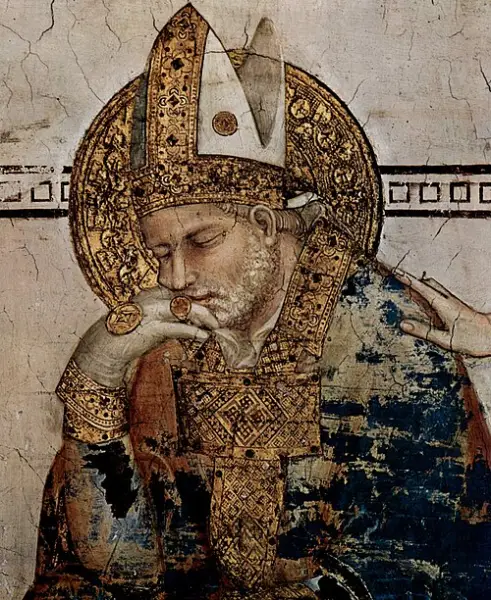
Overview
Martin of Tours was born in either 316 or 336 at Savaria in the province of Pannonia, the son of a senior officer in the Roman army. Raised at Ticinum in northern Italy, he attached himself to the Christian church as a boy against his parents' wishes and entered the cavalry in his mid-teens, as the son of a veteran was required to do. While stationed at Amiens in Gaul he met a half-naked beggar at the city gate and cut his military cloak in two to share it; a dream that night, in which Christ appeared wearing the given half, confirmed his faith, and he received baptism at about eighteen. He soon left the army, declaring that as a servant of Christ he could no longer fight. He placed himself under the guidance of Hilary of Poitiers, lived for a time as a hermit on an island in the Ligurian Sea, and in 361 founded a hermitage at Ligugé, among the earliest monastic settlements known in western Europe. Acclaimed bishop of Tours in 371, he preached through the countryside, founded the monastery of Marmoutier across the Loire, tore down rural temples, and pleaded in vain for the life of the heretic Priscillian. He died at Candes in 397.
The Complete Life
A Soldier's Son in Pannonia and Gaul
Martin entered the world at Savaria in the Diocese of Pannonia, a town identified with modern Szombathely in Hungary, in either 316 or 336, both dates preserved by hagiographical tradition. His father held the rank of tribune in the Roman military, and on retirement received land at Ticinum, today's Pavia in the north of Italy, and it was there that the boy grew up. At ten years old Martin began attending the Christian church against his parents' wishes and enrolled as a catechumen, a striking step in a family and an army still steeped in the old religion. Christianity had been legal since 313 but remained a minority faith, strongest in the cities of the eastern empire and weakest among soldiers devoted to Mithras. Martin, being a veteran's son, was obliged at fifteen to join a cavalry ala, and at eighteen he was stationed at Samarobriva, Roman Amiens, likely with an elite heavy cavalry unit attached to the emperor's person. There, approaching the city gates, he met a beggar in rags and cut his military cloak in half to clothe him. That night Christ appeared to him in a dream wearing the given half, and Martin was baptised. Ordered soon afterward to fight at Borbetomagus, he refused, was jailed for cowardice, and volunteered to stand unarmed before the enemy; the invaders sued for peace before the battle could test him.
§ Soldier
From the Eagles to the Hermitage
Released from service, Martin made his way to Caesarodunum, modern Tours, and attached himself to the orthodox teaching of Hilary of Poitiers, standing firm against the Arianism favored at the imperial court. When Hilary was driven into exile, Martin returned to Italy and, hearing in a dream a summons home, crossed the Alps into Pannonia, where he converted his mother and others, though his father remained unmoved. His zeal against the Arians in Illyricum earned him a public flogging and expulsion. Back in the west, Auxentius, the Arian archbishop of Milan, drove him from that city as well, and Martin found shelter on the island called Gallinaria in antiquity, today Isola d'Albenga, out in the Ligurian Sea. There he embraced the solitary life, living on herbs and wild roots, at times accompanied by a priest of great virtue and for a period by Hilary himself. With Hilary's restoration to his see in 361, Martin came to him and settled at a site south of Poitiers that became Ligugé. Disciples gathered around the hermit in their small huts, and the community grew into a center for evangelizing the country districts around Poitiers. Ligugé Abbey, which descends from that settlement, belongs to the Benedictine order and claims to stand as the most ancient monastery in western Europe whose beginnings are recorded.
§ Monk and hermit
Bishop of Tours and Apostle of the Countryside
In 371 Martin succeeded Litorius as the third bishop of Tours. The citizens lured him from Ligugé by pretending that someone lay sick and needed his ministry, then brought him to the church, where he reluctantly accepted consecration. One tradition says he took refuge among the geese of a barn to escape election, and their cackling betrayed him, a tale that explains why the goose became his emblem. As bishop he set about demolishing pagan temples, altars, and sculptures across his diocese, and once stood directly in the path of a sacred pine the villagers had agreed to fell, which miraculously missed him. He withdrew from the city to Marmoutier, a rural house of brothers which he established a little way up the Loire from Tours, on its far bank, and from that base organized a rudimentary parish system, visiting each parish yearly on foot, by donkey, or by boat. His influence stretched from Touraine to Chartres, Paris, Autun, and Vienne. When the Priscillianist controversy embroiled Gaul and Spain, Martin traveled to the imperial court at Trier to remove the sect from secular jurisdiction, joined Ambrose of Milan in rejecting the execution of heretics, and prevailed on Magnus Maximus to spare Priscillian, though the emperor relented after Martin left and the man was beheaded in 385.
§ Bishop
The Cloak That Clothed Christ
The story that fixed Martin in the imagination of Europe belongs to his years as a soldier at Amiens. Meeting a beggar scarcely clothed against the winter cold, he drew his sword, cut his military cloak in two, and gave half to the man. That night he dreamed of Jesus wearing the portion he had surrendered, hearing him tell the angels that Martin, still only a catechumen, had clothed him. In one version of the account Martin woke to find his cloak restored whole. The dream sealed his conversion, and the garment itself became one of the most revered relics of the Frankish kingdom, kept in the oratory of the Frankish kings at Marmoutier, close by Tours. In the Middle Ages the cappa Sancti Martini was carried into battle by the king and used as the object on which solemn oaths were sworn; it is first recorded in the royal treasury at Luzarches in 679. The priest entrusted with its reliquary was called a cappellanu, the origin of the French chapelains and the English word chaplain, while the temporary churches built to house the relic were called capellae, the little cloaks from which every chapel takes its name.
§ Legend of Saint Martin dividing his cloak
Grief at Trier and Death at Candes
The failure of his last great intervention weighed on Martin to the end. Magnus Maximus had first granted his request to spare Priscillian, but after Martin departed the emperor yielded to Ithacius of Ossonoba, and Priscillian and his followers were beheaded in 385. Martin pleaded for a halt to the persecution of the sect's adherents in Spain and, deeply grieved, refused communion with Ithacius until the emperor pressured him to relent. Two years later, in 397, he died at Candes-Saint-Martin in central France. His death immediately provoked a contest: the people of the Poitou and the townsmen of Tours fell into a dispute over where he should lie. One evening after dark, men of Tours carried the body to a boat waiting on the Loire, and teams of rowers ferried it up the river while a vast crowd waited on the banks at Tours to pay its respects. One chronicle describes the funeral train: two thousand monks, with white-robed virgins almost matching them in number, walked beside the bier as it went up from the water to a grove lying a little west of the walls. In that grove Martin was laid to rest, and the shrine that rose there became one of the great sanctuaries of Gaul.
§ Death
Veneration of a Pre-Congregation Saint
Martin was never formally canonized; he was acclaimed a saint by the devotion of the church in his own century, in the age before congregations of saints were established by decree. His immediate successor as bishop of Tours, Bricius, raised a modest chapel over his grave, but by 461, when Bishop Perpetuus took office, the little building no longer held the crowds of pilgrims. Perpetuus built a basilica thirty-eight meters long and eighteen wide, supported by a hundred and twenty columns, and translated the body from the hermitage chapel at Candes to a sarcophagus behind the new high altar, where a marble block donated by Bishop Euphronius of Autun made the tomb visible to the faithful. Royal patronage followed. Clovis, king of the Salian Franks, credited Martin's intervention for his victory over the Alemanni, the triumph that led to his baptism, and later for his defeat of Alaric II. In the early seventh century King Dagobert I commissioned the goldsmith Saint Eligius to fashion for the shrine over the tomb a work wrought in gold and precious stones. Gregory of Tours wrote and spread an influential account of his life, and devotion carried on under the Carolingians; Venantius Fortunatus declared that wherever Christ is known, Martin is honored. He is kept on November 11 by Anglicans and Lutherans as well as Catholics.
§ Veneration
The Abbey, the Pilgrims, and Martinmas
The shrine chapel at Tours grew into one of the most influential establishments of medieval France. Charlemagne gave the abbacy to his adviser Alcuin, under whose scriptorium the clear round hand of Carolingian minuscule was developed, making manuscripts across Europe far more legible. Norman Vikings plundered the abbey in 853 and again in 903, fire destroyed it in 994, and a rebuilding ordered by the treasurer Hervé de Buzançais took twenty years. Expanded to receive the crowds, the shrine became a favored station for pilgrims bound for Santiago de Compostela. The basilica was sacked by Huguenots in 1562, disestablished and demolished after the Revolution, and its dressed stones sold in 1802. Excavations by Leo Dupont rediscovered the tomb on December 14, 1860, and Victor Laloux's new basilica, begun in 1886 on part of the old site, was consecrated in 1925. Renewed as a military patron during the Franco-Prussian War and hailed by the Third Republic as patron of France, Martin was called the spiritual bridge across Europe. His monastery of Marmoutier trained Celtic missionaries, including Saint Ninian; the forty-day fast that began after his feast evolved into Advent; and lantern processions, roast goose, and new wine still mark Martinmas across the continent, while Ligugé Abbey keeps his foundation alive to this day.
§ Shrine basilica
Timeline
- 316
Born at Savaria in Pannonia to a tribune in the Roman army; tradition also records 336 as his birth year.
§ Soldier
- 354
Baptised at about eighteen after his vision of the cloak at Amiens, which the article dates around 334 or 354.
§ Legend of Saint Martin dividing his cloak
- 361
Joined Hilary of Poitiers on his return from exile and established his hermitage at Ligugé near Poitiers.
§ Monk and hermit
- 371
Consecrated third bishop of Tours after being enticed from Ligugé by a ruse and brought to the church.
§ Bishop
- 385
Priscillian and his followers were beheaded at Trier despite Martin's plea to the usurper Maximus for their lives.
§ On behalf of the Priscillianists
- 8 Nov 397
Died at Candes on the Loire; residents of Tours carried his body by boat upstream for burial.
§ Death
- 461
Bishop Perpetuus raised a large columned basilica over the grave and translated the relics from Candes to Tours.
§ Veneration
- 679
The miraculous cloak is first attested in the royal treasury, conserved at the palatium of Luzarches.
§ Legend of Saint Martin dividing his cloak
- 853
Norman Vikings ransacked the shrine basilica at Tours, and attacked it again in 903.
§ Shrine basilica
- 1453
The saint's remains were moved into a splendid new reliquary, the joint gift of Charles VII of France and Agnès Sorel.
§ Shrine basilica
- 1562
Protestant Huguenots sacked the basilica during the French Wars of Religion.
§ Shrine basilica
- 14 Dec 1860
Excavations led by Leo Dupont rediscovered the tomb of Martin at Tours.
§ Excavations and rediscovery of the tomb
- 11 Nov 1918
The armistice ending the First World War fell on Martin's feast day, which many in France read as his intercession.
§ St. Martin as a French Republican patron
- 4 Jul 1925
The new Basilica of St. Martin, begun in 1886 from designs by Victor Laloux, was consecrated at Tours.
§ Excavations and rediscovery of the tomb
In Their Own Words
I am the soldier of Christ: it is not lawful for me to fight.
Martin, who is still but a catechumen, clothed me with this robe.
The Record
- Major works
- Monastery of Ligugé (foundation)·Monastery of Marmoutier (foundation)·Rudimentary parish system in the diocese of Tours·Life of St. Martin by Sulpicius Severus (contemporary hagiography about him)
- Patron of
- Against poverty·Against alcoholism·Patron of France·Patron of beggars·Patron of soldiers and cavalry·Patron of tailors and wool-weavers·Patron of geese, horses, and riders·Patron of vintners and wine growers·Patron of innkeepers and hotel-keepers·Patron of quartermasters and the United States Army Quartermaster Corps·Patron of Szombathely, Tours, Utrecht, Groningen, and Buenos Aires
- Symbols
- Man on horseback sharing his cloak with a beggar·Man cutting his cloak in half·Globe of fire·Goose
- Canonization
- Pre-congregation; venerated as a saint from the century of his death, with no formal canonization process.
Prayer
Bibliography
Show 8 sources
- Brennan, Brian (1997). "The Revival of the Cult of Martin of Tours in the Third Republic". Church History. 66 (3): 489–501.
- Chadwick, Henry (1976). Priscillian of Avila – The Occult and the Charismatic in the Early Church. Oxford: Clarendon.
- Clugnet, Léon (1910). "St. Martin of Tours". In Herbermann, Charles (ed.). Catholic Encyclopedia. Vol. 9. New York: Robert Appleton Company.
- Farmer, Sharon (1991). Communities of St. Martin – Legend and Ritual in Medieval Tours. Cornell University Press.
- Jacobsen, Werner (1997). "Saints' Tombs in Frankish Church Architecture". Speculum. 72 (4): 1107–1143.
- Pernoud, Régine (2006). Martin of Tours – Soldier, Bishop, and Saint. Translated by Michael J. Miller. San Francisco: Ignatius Press.
- Severus, Sulpicius (1894). On the Life of St. Martin. A Select Library of Nicene and Post-Nicene Fathers of the Christian Church. Translated by Alexander Roberts.
- Stancliffe, Clare (1983). St Martin and his hagiographer – History and miracle in Sulpicius Severus. Oxford: Clarendon.
Profile text adapted from the Wikipedia article, licensed CC BY-SA 4.0.
Pray with this saint every day
Save St. Martin of Tours to your favorites, read the full profile, and get feast-day reminders in the Saints app.
Get the Saints AppFree on the App Store for iPhone and iPad