
died c. 228·Feast January 30
St. Martina of Rome
Virgin martyr of the early Roman church
Overview
Martina of Rome was a Christian virgin martyred at Rome, according to most authorities in 228 during the persecutions that troubled the empire in the first half of the third century, under the reign of Severus Alexander. The daughter of a former consul and orphaned young, she was noble, beautiful, and unafraid to profess her faith openly. Arrested and ordered to return to the worship of the idols, she refused, and was put through a series of torments recorded in her life: scourging, condemnation to the beasts in the amphitheater, from which she emerged untouched, and casting onto a burning pyre, from which she likewise escaped unharmed. She was finally beheaded, and her hagiography adds that some of her executioners were converted by what they witnessed and were themselves put to death. She died, by the tradition, at Ostia at the mouth of the Tiber, but her body was brought back to Rome, where a church near the Mamertine Prison was later dedicated in her honor together with Saint Luke. Her relics were rediscovered in 1634 during repairs to the crypt, and Pope Urban VIII had the church rebuilt and composed the hymns sung at her office. Rome numbers her among its patron saints.
The Complete Life
A Noble Orphan of Rome
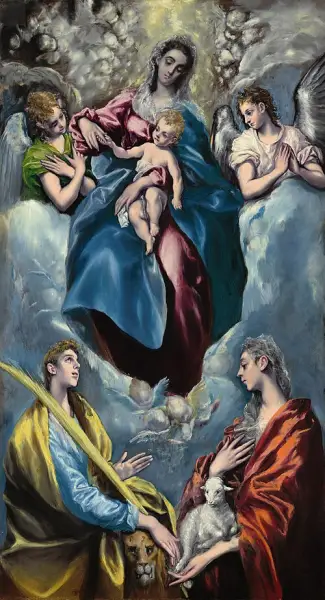
Martina came of a distinguished Roman family. Her father had held the consulship, the highest civil honor the old city could confer, and she was left an orphan at an early age, inheriting both a noble name and personal beauty. The account of her life presents her as a virgin who gave herself wholly to Christ and made no secret of it: her testimony to the Christian faith was so open and so constant that she could not hope to escape the notice of the authorities when the persecution under the emperor Severus Alexander reached the city. In an age when Christians were still a suspect minority in the capital, a young woman of rank who refused the public religion of the state was doubly conspicuous, and her refusal to compromise marked her out for arrest. Nothing further is recorded of her childhood or family; her story begins in earnest on the day she was summoned to choose between the idols of Rome and the God she served. Later devotion would pair her image with that of Agnes, the other noble virgin of Rome who died young for the faith, and painters of the Roman school found in the two of them an enduring subject: the maiden of ancient birth who traded a senatorial lineage for the palm of martyrdom, and who stands in the courts of heaven among the virgin witnesses of the early church.
§ Biography
Trial, Torment, and Beheading
Arrested and commanded to return to the worship of the Roman gods, Martina refused, and the refusal set in motion the sequence of sufferings preserved in her ancient life. She was first scourged. When torment failed to break her, she was sentenced to face the wild beasts of the amphitheater, yet the animals left her untouched by any miracle of harmlessness. She was then thrown upon a burning pyre, and again came through the flames without injury. At last the sentence of beheading was carried out, and she died a virgin and a martyr. Her hagiography records one further wonder: some of the executioners who presided over her torments were converted by what they saw, professed the faith for which she died, and were themselves beheaded. The tradition places the scene of her martyrdom at Ostia, the harbor city at the mouth of the Tiber, though by the time of the early medieval calendars her martyrdom was variously dated, some authorities setting it in 226 and others in 228, under the pontificate of Pope Urban I. Whatever the exact year, the memory of her passion fixed itself early and firmly in the Roman church, and the ordeal of scourging, beasts, and fire by which she was made a martyr became the pattern retold on her feast each year.
§ Biography
The Church by the Mamertine and the Relics of 1634
Ostia was the scene of her martyrdom, but Martina's body was carried up the river to Rome, where she was buried and venerated. Near the Mamertine Prison, at the foot of the Capitoline, a church was dedicated in her honor under her own name and that of the evangelist Luke: Santi Luca e Martina, which still stands as her principal shrine. Her cult continued quietly through the centuries until October 25, 1634, when workmen restoring the crypt uncovered buried remains, as happened often in the churches of Baroque Rome. The painter Pietro da Cortona, president of the Accademia di San Luca, whose artists worshipped in the church, attributed the bones to the martyred saint, and it was no doubt hoped that the discovery would bring an influx of funds for a new church to shelter the relics. Pope Urban VIII, then occupying the Holy See, took the saint under his patronage: he had the church repaired and rebuilt its interior, and he is thought to have composed the hymns sung at her office. The Roman Martyrology preserves her name, and she ranks among the patron saints of Rome.
§ Veneration
Timeline
- 228
Martyred, probably in this year though some authorities prefer 226, during the persecution under Severus Alexander.
§ Biography
- 25 Oct 1634
Remains attributed to Martina were found by Pietro da Cortona during restoration of the crypt; Pope Urban VIII then had the church repaired and apparently composed her office hymns.
§ Veneration
The Record
- Major works
- Church of Santi Luca e Martina in Rome, dedicated in her honor
- Patron of
- Patron saint of Rome·Patron of nursing mothers
- Symbols
- Palm of martyrdom
- Canonization
- Pre-congregation; her cult was confirmed by her ancient veneration, and Urban VIII promoted it after the finding of her relics in 1634.
Prayer
Bibliography
Show 6 sources
- Clugnet, Léon. "St. Martina." The Catholic Encyclopedia Vol. 9. New York: Robert Appleton Company, 1910.
- Connors, Joseph (1998). "Pietro da Cortona 1597-1669". Journal of the Society of Architectural Historians. 57 (3): 318–321.
- Merz, Jörg Martin (2003). ""Saint Martina Refuses to Adore the Idols:" Pietro da Cortona's Painting at Princeton in Context". Record of the Art Museum, Princeton University. 62: 84–104.
- Monks of Ramsgate. Martina, in Book of Saints, 1921. CatholicSaints.Info, 25 November 2014.
- Martyrologium Romanum (Libreria Editrice Vaticana 2001, ISBN 978-88-209-7210-3), p. 117.
- Prosper Gueranger OSB, The Liturgical Year, Marian House, 1983.
Profile text adapted from the Wikipedia article, licensed CC BY-SA 4.0.
Pray with this saint every day
Save St. Martina of Rome to your favorites, read the full profile, and get feast-day reminders in the Saints app.
Get the Saints AppFree on the App Store for iPhone and iPad