
died 29 December 435·Feast January 2
St. Martinianus
Archbishop of Milan and founder of churches
Overview
Martinianus, sometimes called Martinus or, in Italian, Martiniano, governed the church of Milan as archbishop from 423 until 435, in the generation after the great Ambrose had filled the see. A Milanese by birth, he was associated by tradition with the noble Roman family of the Hosii. The poet-bishop Ennodius of Pavia, writing in the early sixth century, records that Martinianus was chosen bishop despite having no desire for the office, held back by humility and fear. As archbishop he founded two churches in Milan, one dedicated to Saint Zechariah and Saint Stephen, probably raised in 417, which after several reconstructions stands today as the Basilica of Santo Stefano Maggiore. He appears in history's light in 431, when John of Antioch, in a letter to Rufus of Thessalonica, thanks him for sending the emperor a treatise of Ambrose's concerning the Lord's incarnation, the work now known as De Incarnationis, and greets him as very godly and holy. Martinianus died on December 29, 435, and was buried in his own Basilica of Saint Stephen; because the octave of Christmas had been introduced, his feast was kept on January 2. In 1988 his remains were translated to the Milan Cathedral and laid beneath the altar of Saint Agatha.
The Complete Life
A Son of Milan and the Family of the Hosii
Martinianus belonged to Milan by birth, born in the city in the later fourth century while it still stood among the chief residences of the western emperors. An old tradition links him with the Roman family of the Hosii, a connection that would make him a kinsman of the great officials of that name who served Constantine and his successors, though the claim rests on tradition rather than documented descent. Of his education and early service in the church of Milan nothing definite survives, but his later conduct presupposes the formation of a cultivated ecclesiastic of the Ambrosian school: he knew the writings of Ambrose well enough to prize a treatise on the incarnation, and he possessed the standing to address the imperial court on the church's behalf. The Milan in which he grew up was a church still shaped by the memory of its famous bishop, who had died within the living memory of his own generation, and Martinianus would pass his life safeguarding that heritage through the disturbed decades in which the western empire trembled before the barbarian invasions. The archbishop's family connection, if real, would also explain the ease with which he dealt with men of rank in later life, and it places him among the Roman aristocrats who increasingly furnished the episcopate of northern Italy in the generations after Ambrose, handing over to the church the talents and connections once spent on the service of the state.
§ Life
A Reluctant Election
The most human detail preserved about Martinianus concerns his election to the see of Milan. According to Ennodius, bishop of Pavia, writing a lifetime later in the early sixth century, Martinianus was elected archbishop notwithstanding that he had no desire whatever for the position, being held back by humility and by fear. The reluctance was not an affectation: the church of Milan stood second in dignity in the western empire, and its archbishop faced the pressures of an imperial court, the turbulence of theological controversy, and the growing insecurity of an Italy soon to feel the weight of barbarian armies. Nevertheless the choice fell on him, and he accepted, succeeding Marolus in 423. His episcopate lasted twelve years, from 423 to 435, and he was followed in the see by Glycerius. The account of his unwillingness, handed down by a poet who himself wore a bishop's ring, became part of his sanctity: the tradition of the church has always distrusted those who hunt high office and honored those who accept it trembling. Whatever his inward shrinking, the church of Milan received from his hands twelve years of steady governance, the fruit of an obedience that cost him more, perhaps, than any martyrdom of ambition would have cost his contemporaries.
§ Life
Builder and Envoy of the Ambrosian Church
Martinianus left his mark on the city in stone. He founded two churches in Milan, of which the better known was dedicated to Saint Zechariah and Saint Stephen and was probably begun in 417; destroyed and rebuilt more than once, it survives today as the Basilica di Santo Stefano Maggiore, one of the ancient devotional centers of the city. His second foundation is recorded but not identified. More revealing still is his appearance in the ecclesiastical politics of the eastern controversy over Nestorius. In 431 John of Antioch, leader of the moderate Eastern bishops, wrote to Rufus of Thessalonica and mentioned a letter received from Martinianus, whom he greets as very godly and holy bishop of Milan: Martinianus had sent to the pious emperor one of Ambrose's treatises touching the incarnation of the Lord; this is the writing now called De Incarnationis, On the Sacrament of the Lord's Incarnation. The gesture made the voice of the Ambrosian church of Milan heard in the council of the empire at the very moment when the divinity and humanity of Christ were being debated, and it shows the archbishop as a diplomat of doctrine, arming the throne with the theology of his great predecessor.
§ Life
Death, Feast, and Translation
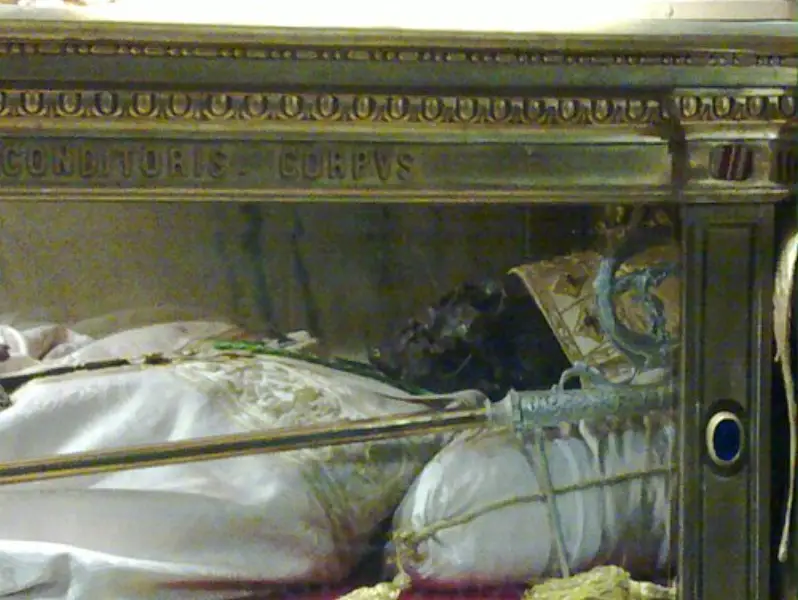
Martinianus died on December 29, 435, at Milan, closing a twelve-year episcopate. He was buried in the Basilica of Saint Stephen, the church of his own foundation, and his tomb there became the center of his cult. The date of his death fell almost immediately within the newly instituted octave of Christmas, and for that reason his feast day was postponed to January 2, the day on which the Catholic and Eastern Orthodox Churches still honor him. For more than fifteen centuries his body rested in the basilica he had raised, a span during which the church was repeatedly destroyed and rebuilt and the city of Milan passed through Roman, barbarian, communal, and ducal rule. In 1988 his remains were moved once more, out of the Basilica of Saint Stephen and into the Cathedral of Milan, where they were laid beneath the altar of Saint Agatha, so that the archbishop of the age of Ambrose's memory now lies in the great cathedral of the see he governed. The postponement of a saint's day to accommodate the feast of the Nativity is itself a small monument to him, marking the rank that the celebration of Christmas had attained in the Roman church within a generation of his death.
§ Life
Remembering the Successor of Ambrose
Martinianus stands in the episcopal roll of Milan between Marolus and Glycerius, one of the long line of saintly archbishops that runs from Barnabas through Ambrose to the modern age, and his cult has endured without interruption in the Ambrosian church. His chief monument in stone, the Basilica of Saint Stephen, remained for centuries one of the principal churches of Milan and keeps his memory in its dedication; his chief monument in letters is accidental but precious, for the letter of John of Antioch that mentions him preserves the only contemporary voice in which he is heard, a pagan-sounding title of respect, very godly and holy, paid by an eastern patriarch to a western bishop. The relocation of his remains to the cathedral in 1988 renewed his presence in the devotional life of the archdiocese. Modern scholars of the Milanese episcopate, from Cazzani to Ruggeri to Rimoldi, keep his place in the catalogues, and the feast on January 2, shifted from his death day by the Christmas octave, remains fixed in the calendar of the church he served. In the cathedral he lies near the altar of Saint Agatha, a martyr of the age of Decius, so that the bishop of 435 and the virgin of the third century keep their watch together over the Milanese church.
§ Life
Timeline
- 417
Probably founded the Milanese church dedicated to Saint Zechariah and Saint Stephen, later the Basilica of Santo Stefano Maggiore.
§ Life
- 423
Elected Archbishop of Milan, succeeding Marolus, despite his reluctance born of humility and fear.
§ Life
- 431
Sent the emperor a copy of Ambrose's treatise on the incarnation, an act reported by John of Antioch in a letter to Rufus of Thessalonica.
§ Life
- 29 Dec 435
Died at Milan and was buried in the Basilica of Saint Stephen, which he had founded.
§ Life
- 1988
His remains were brought to Milan Cathedral and laid below the altar of Saint Agatha.
§ Life
The Record
- Major works
- Church of Saint Zechariah and Saint Stephen in Milan (foundation, now Basilica di Santo Stefano Maggiore)·Second church founded in Milan·Transmission of Ambrose's De Incarnationis to the imperial court
- Patron of
- Patron of the Archdiocese of Milan, whose episcopal list he graces
- Symbols
- Bishop's vestments and crozier·Model of the Basilica of Saint Stephen
- Canonization
- Pre-congregation; honored as a saint in the Catholic and Eastern Orthodox Churches from antiquity.
Prayer
Bibliography
Show 4 sources
- Cazzani, Eugenio (1996). Vescovi e arcivescovi di Milano. Milano: Massimo. pp. 25–26. ISBN 88-7030-891-X.
- Ennodius, Carmina II, 81.
- Rimoldi, Antonio. "San Martiniano di Milano". Santi e Beati. Retrieved 27 Sep 2011.
- Ruggeri, Fausto (1991). I Vescovi di Milano. Milano: NED. pp. 14–15. ISBN 88-7023-154-2.
Profile text adapted from the Wikipedia article, licensed CC BY-SA 4.0.
Pray with this saint every day
Save St. Martinianus to your favorites, read the full profile, and get feast-day reminders in the Saints app.
Get the Saints AppFree on the App Store for iPhone and iPad