
died 10 July 1860·Feast July 10
Martyrs of Damascus
Eight Franciscans and three Maronite laymen slain in 1860
Overview
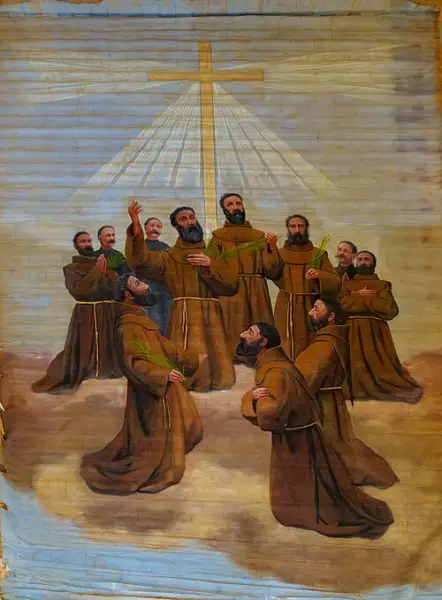
The Martyrs of Damascus are eleven Catholic saints killed in the night between July 9 and 10, 1860, while at prayer inside a Franciscan-run parish in Damascus, during the civil conflict that tore through Mount Lebanon and Damascus in that year. Eight were Franciscans: Manuel Ruiz López, guardian of the friary, and his companions Carmelo Bolta Bañuls, Nicanor Ascanio Soria, Nicolás María Alberca Torres, Pedro Nolasco Soler Méndez, Francisco Pinazo Peñalver, and Juan Jacob Fernández, all Spaniards, together with the Austrian parochial vicar Engelbert Kolland. The other three were the Massabki Brothers, Francis, Abdel Moati, and Raphael, Maronite Catholic laymen of Damascus, sons of Nehme Massabki, who had come to the friary for shelter. The attackers were Druze, and the martyrs died by beheading, clubbing, and stabbing. Manuel Ruiz made for the tabernacle, to consume the Blessed Sacrament before the attackers could seize it, and was struck down; Francis Massabki refused the offer of life in exchange for apostasy; Juan Jacob Fernández was hurled from the church roof and finished with a knife. Pius XI beatified them in 1926, and Pope Francis canonized all eleven on October 20, 2024. Their feast is kept on July 10.
The Complete Life
Eleven Men of Two Churches
The eleven martyrs were born between 1802 and 1830 and came from two worlds that met in the Franciscan parish of Damascus. Seven were Spaniards and one an Austrian from Salzburg, all of them eventually religious of the Observant Franciscans who staffed the Catholic mission in the Syrian capital: Manuel Ruiz López, Carmelo Bolta Bañuls, Nicanor Ascanio Soria, Nicolás María Alberca Torres, Pedro Nolasco Soler Méndez, Francisco Pinazo Peñalver, Juan Jacob Fernández, and Engelbert Kolland. The other three were sons of Damascus itself, the Massabki brothers Francis, Abdel Moati, and Raphael, Maronite Catholics and children of Nehme Massabki, a family of the ancient Eastern church that had been in communion with Rome for centuries. The two groups were bound together by the parish and the friary: the brothers served the Franciscans as benefactors and representatives, and the friars served the Maronite and Catholic population as pastors. When the civil war of 1860 reached Damascus, the eleven found themselves gathered in one house of God, Eastern laymen and Western religious, and they died in one company of martyrs. None of them was young in the easy sense: half were in middle age or beyond when they died, and their years in the Damascus mission had made the parish a meeting point of two communions, the Latin religious of the Franciscan custody and the Maronite faithful of the city, whose fortunes had long been joined.
§ Biographies
The Friars and Their Offices
The eight religious served the Damascus mission in every office a friary can hold. Manuel Ruiz López, fifty-six at his death, was guardian, the head of the friary. Carmelo Bolta Bañuls, fifty-seven, was the pastor of the parish. Engelbert Kolland, the one Austrian, was parochial vicar and was loved by the people. Nicanor Ascanio Soria had first been ordained a diocesan priest and had returned to the Franciscans only two years before his death at forty-six; his biographers note that his whole spirituality was oriented toward martyrdom. Nicolás María Alberca Torres had passed from the Brothers of Jesus Nazarene Hospital to the friars in 1856, receiving ordination two years before his death at thirty. Pedro Nolasco Soler Méndez, ordained three years before his death, was thirty-three. Francisco Pinazo Peñalver, who lived as a lay brother nearly all his days, served the parish as its sacristan, keeper of the sanctuary lamps and vestments, and died at fifty-eight. Juan Jacob Fernández was the cook of the friary; he had entered the order with Francisco in 1831 and was fifty-two when the killers came.
§ Spanish Franciscans
The Massabki Brothers, Laymen of Damascus
Francis, Abdel Moati, and Raphael Massabki were laymen of substance and standing in the Maronite community of Damascus. Francis was a silk merchant, a married man, and a father, and his business abilities made him the representative of the Maronite Patriarch in Syria as well as an agent who acted on behalf of the Franciscans, so that the friars trusted him with their affairs. Abdel Moati too was married, and Raphael, who remained unmarried, was known all over the city for the generosity he showed to the friars of the Franciscan house. All three brothers were marked by devotion to prayer, and it was this, together with their service to the parish, that brought them into the church on the night of the massacre. Francis's standing in the city was so well known that his killers offered him his life if he would convert to Islam; his refusal, made before witnesses, has made him the central figure of the eleven in the memory of the Maronite church. Abdel Moati was killed before two of his own children, a father martyred in the sight of those who most needed the example of his constancy.
§ Massabki Brothers
Prayer, Eucharist, and the Desire for Martyrdom
The spirituality that shines through the account of the eleven is one of ordinary sanctity caught in an extraordinary hour. The Massabki brothers were men of prayer, and the friars were men of the daily round: the pastor at his altar, the sacristan at his sanctuary, the cook at his pots, the vicar beloved by his people. One of their number, Nicanor Ascanio Soria, had deliberately oriented his entire spiritual life toward martyrdom, and in the event he received what he had sought. The guardian of the friary, Manuel Ruiz, showed in his last moments what the Eucharist meant to the community: when the attackers burst in, he ran not to the door but to the tabernacle, to consume the sacrament before it could be profaned, and died with the Lord on his tongue. Juan Jacob Fernández, thrown alive from the tile roof of the church, spent his final breaths in fervent prayer that God would accept his sacrifice. The images that later devotion attached to them, the martyr's palm, the Eucharist, and the rosary, gather up this witness of a spirituality of presence: Christ kept in the sacrament, carried in the rosary, and confessed to the death.
§ Biographies
The Night of July 9-10, 1860
The massacre came in the night between July 9 and 10, 1860, in the midst of the civil conflict that had been burning through Mount Lebanon and now reached Damascus. Druze bands attacked the Christian quarters of the city, and the Franciscan parish became a refuge and a target at once. Eleven men were found inside it, praying: eight Franciscans and the three Massabki brothers. The killers were Druze, and the deaths they inflicted were by beheading, clubbing, and stabbing. Father Ruiz hurried to the tabernacle to consume the Eucharist before the mob reached the altar. Francis Massabki was offered his life on condition of conversion and refused it. Abdel Moati died before the eyes of two of his children. Juan Jacob Fernández was hurled from the tile roof of the church and, still living, prayed aloud that God would accept his sacrifice until a knife finished him. By morning the friary's eight religious and its three Maronite guests were dead, and the date of the massacre, July 10, became the day on which the church would remember them all.
§ Spanish Franciscans
From Beatification to the Altars of Saints
The church moved quickly to honor the eleven. Pope Pius XI proclaimed their beatification and they were beatified on October 10, 1926, in Saint Peter's Basilica in Rome, sixty-six years after their deaths, when the memory of the Damascus massacre was still alive in the Maronite and Franciscan worlds. A new stage opened in modern times: on December 18, 2022, Maronite Patriarch Bechara Boutros al-Rahi announced that the Massabki Brothers were to be enrolled among the saints with no miracle demanded of their cause, since martyrdom for the faith carries its own proof. On July 1, 2024, Pope Francis presided at an Ordinary Consistory of Cardinals in the Apostolic Palace that approved the canonization of fifteen people, among them the Martyrs of Damascus; Cardinal Marcello Semeraro presented the Peroratio, the report on the lives and miracles of the Massabki Brothers and of Ruiz and his seven companions. On October 20, 2024, Pope Francis canonized all eleven in Saint Peter's Square, enrolling the Spanish and Austrian friars and the Damascene merchants together in the catalogue of saints, nearly a hundred years after their beatification and more than a century and a half after the night of their death.
§ Beatification and canonization processes
Timeline
- 1831
Juan Jacob Fernández entered the Franciscan order together with Francisco Pinazo Peñalver.
§ Spanish Franciscans
- 1856
Nicolás María Alberca Torres transferred from the Brothers of Jesus Nazarene Hospital to the Franciscans.
§ Spanish Franciscans
- 10 Jul 1860
All eleven were martyred by Druze attackers in the night between 9 and 10 July inside the Franciscan parish at Damascus.
§ Martyrs of Damascus
- 10 Oct 1926
Beatified by Pope Pius XI in Saint Peter's Basilica in Rome.
§ Beatification and canonization processes
- 18 Dec 2022
Maronite Patriarch Bechara Boutros al-Rahi announced the Massabki Brothers would be raised to the altars with no miracle required, since martyrdom for the faith is proof enough.
§ Beatification and canonization processes
- 1 Jul 2024
Pope Francis presided at an Ordinary Consistory of Cardinals approving the canonization of the eleven martyrs.
§ Beatification and canonization processes
- 20 Oct 2024
Canonized by Pope Francis in Saint Peter's Square, Vatican City.
§ Beatification and canonization processes
The Record
- Major works
- Franciscan parish and friary at Damascus, in whose service the eight religious died
- Patron of
- Patrons of Damascus Christians and of Maronite and Franciscan unity
- Symbols
- Martyr's palm·Eucharist·Rosary
- Canonization
- Beatified by Pope Pius XI on 10 October 1926 at Saint Peter's Basilica; canonized by Pope Francis on 20 October 2024 in Saint Peter's Square.
Prayer
Bibliography
Show 8 sources
- "Blessed Massabki Brothers".
- "Canonization of the Blessed Martyrs of Damascus".
- Courtney Mares (17 October 2024). "These are the 14 people who will be canonized saints this weekend". Catholic News Agency.
- "Beatos Manuel Ruiz y siete compañeros, Mártires", Santoral Franciscano (in Spanish).
- "The Three Massabki Brother Martyrs at Damascus". Genealogy.com (10 October 1926). Retrieved 12 November 2011.
- "The Three Blessed Massabki Brothers to be named saints". LBCI Lebanon. 18 December 2022.
- "Carlo Acutis and 14 Blesseds approved for canonization - Vatican News". www.vaticannews.va. 1 July 2024.
- "Who are the 14 Blesseds the Pope will canonize Sunday?". Aleteia. 16 October 2024.
Profile text adapted from the Wikipedia article, licensed CC BY-SA 4.0.
Pray with this saint every day
Save Martyrs of Damascus to your favorites, read the full profile, and get feast-day reminders in the Saints app.
Get the Saints AppFree on the App Store for iPhone and iPad