
died 9 July 1572·Feast July 9
The Martyrs of Gorkum
Nineteen Dutch clerics hanged at Brielle
Overview
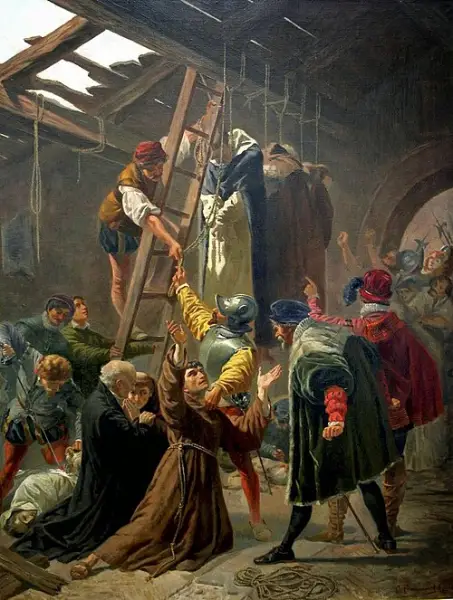
The Martyrs of Gorkum were nineteen Catholic clerics — Franciscans, secular priests, and members of other religious orders — who were hanged at Brielle on 9 July 1572 by militant Calvinists of the Watergeuzen during the Dutch Revolt against Spanish rule. Seized in the town of Gorkum after the raiders stormed its castle and looted its churches, the prisoners endured two weeks of humiliation and torture before a hastily convened tribunal condemned them. They were offered their lives on one condition: that they deny Catholic teaching on the Eucharist, the real presence of Christ in the Blessed Sacrament, and the supremacy of the pope. Four of the captives relented; the remaining nineteen refused, and went together to the gallows at a turfshed beside the St. Elizabeth Monastery at Rugge. Among them were Nicholas Pieck, guardian of the Gorkum friary, the aged Willehad of Denmark, and Andrew Wouters, a priest of disordered life whose defiant last words became famous. Beatified in 1675 and canonized in 1867, the nineteen remain widely revered by Catholics in the Netherlands, and their relics are honored in Brussels and at Brielle.
The Complete Life
A Divided Land
The world into which the future martyrs of Gorkum were born was the Spanish Netherlands of the mid-sixteenth century, a mosaic of small kingdoms and towns under the Catholic king of Spain, Philip II. Since the Reformation era that opened in 1521, much of the regional nobility had drifted from Catholicism into Calvinism, and resentment of Philip's heavy taxation and harsh treatment of Protestants grew steadily among them. In Gorkum itself — the town also called Gorinchem — the Catholic authorities long refused to permit a Calvinist place of worship within the walls, so the local Protestants gathered for sermons outside the city. Confrontation sharpened: activists began attacking Catholic churches, and in 1566 the city yielded a measure of toleration, allowing the Calvinists to use a wooden shed beyond the ramparts known as the Geuzen House. When the Dutch Revolt broke out in 1568, Philip dispatched the Duke of Alba, whose campaigns of massacre and execution embittered both sides. Calvinist rage fell with particular fury on Catholic clergy, who were regarded as collaborators of Spain. The priests and friars of Gorkum, born into this fractured country, would soon stand at the collision point of its hatreds.
§ Background
Shepherds of a Troubled Town
The men whom the storm would overtake came from every corner of Catholic religious life in the Low Countries. At the Franciscan friary in Gorkum served Nicholas Pieck, its guardian, a native son who had often preached in the town against Calvinism; his vicar Andrus van Weert, once a missionary to Palestine and likewise a fearless preacher; Dirk van der Eem, chaplain to a community of Franciscan Tertiary Sisters; Nicasius of Heeze, a priest who was also Baron de Heeze in North Brabant; Willehad, ninety years old, who had already fled Denmark to escape Calvinist persecution; and Govaert van Mervel, a Belgian sacristan and confessor whose pastime was painting. Beyond the friary were Leonardus Vechel, the parish priest of Gorkum, educated at the Catholic University of Louvain; Godefried van Duynsen, another priest of the town; Joannes Lenartz of Oisterwijk, a Canon Regular who guided the Augustinian nuns of Gorkum in the spiritual life; Adriaan van Hilvarenbeek, a Premonstratensian canon; and Andrew Wouters, a pastor of Heinenoord whose private morals were the scandal of his critics. When news of the arrests reached Joannes van Hoornaer, a Dominican parish priest, he travelled to Gorkum in disguise to bring the prisoners the sacraments — and was captured himself.
§ Franciscan prisoners
Captivity on the Water
In June 1572 the Watergeuzen, the Sea Beggars whom William of Orange had licensed as privateers, arrived before Gorkum. The defenders opened their gates on de la Marck's promise that the town would not be pillaged, but the mayor held the castle, and the Catholic clergy took refuge inside its walls. The raiders burned the fortress and forced its surrender; the churches of Gorkum were then looted, and the friars and priests were dragged away as prisoners. On 6 July the first fifteen captives were carried out of the town by barge. At Dordrecht the humiliation became spectacle: the prisoners were stripped to their underwear, their robes were sold, and onlookers were charged to come and gaze at them. The barge reached Brielle on 8 July, and the number of captive clerics there eventually rose to twenty-three. Shut into a dungeon, the men were tortured and degraded while their captors searched for hidden church treasure. Pieck was strung up by the neck from a beam with his Franciscan cord again and again, until at last the cord gave way. Through it all the clergy awaited only one question: whether they would trade the faith they had preached for the lives they still held.
§ Dutch Revolt
The Refusal
On 9 July 1572 de la Marck convened a tribunal that swiftly condemned the twenty-three prisoners to death. Yet the sentence came with an escape clause crafted by de la Marck and the Calvinist ministers: reprieve for any cleric who renounced three central teachings of the Catholic faith — transubstantiation, the real presence of Christ in the Blessed Sacrament, and papal supremacy. The choice put before the prisoners was thus aimed at the very heart of their priesthood. Four of the captives yielded and went free. Nineteen refused. Andrew Wouters, whose irregular life had long been notorious, answered his judges with words that have outlived them all: 'Fornicator I always was; heretic I never was.' Even the intervention of William of Orange could not save them — in one telling he ordered their unconditional release and de la Marck ignored him, in another he offered freedom to all who would only deny papal supremacy, and the prisoners still declined. While they awaited death the nineteen recited Hail Marys and Pater Nosters, and Pieck begged God to forgive his executioners, keeping to the last the pastoral charity that had marked his preaching.
§ Interrogation and trial
The Gallows at Rugge
On the evening of the same day as their trial, the nineteen condemned men were brought to a turfshed standing on the monastery lands of St. Elizabeth at Rugge. Before the hanging began, Pieck spoke to his companions of the reward that awaited them, saying that the hour had come to receive from the Lord's hand the long-desired crown of eternal happiness. The executioners then killed the clerics with deliberate cruelty: the nooses were set so that death would come slowly and in agony, the rope passing into the mouth of each victim, and some of the men were mutilated while still alive. All nineteen died on 9 July 1572. When the bodies were finally cut down, the Watergeuzen cast them into a ditch nearby and covered them without ceremony. There the martyrs lay until the Franciscans, permitted by the authorities of Brielle in 1616, reverently exhumed them and carried their remains to the Franciscan church in Brussels, where a reliquary received the bones of the men whom the Low Countries had watched die for the Eucharist, the sacramental presence of Christ, and the visible unity of the Church under the pope.
§ Execution
From Veneration to the Altars
Devotion to the martyrs of Gorkum grew quickly among the Catholics of the Netherlands. Tradition told that a shrub bearing nineteen white flowers sprang from the ditch in which they were buried, and reports of miracles worked through their intercession — especially cures of hernias — began to reach the Vatican. On 14 November 1675 Pope Clement X beatified the nineteen in Rome, and nearly two centuries of veneration later Pope Pius IX canonized them on 29 June 1867. At the canonization ceremony Pius drew particular attention to the martyrs' fidelity to Catholic dogma, for the doctrine they had died confessing — the Eucharist, the real presence, and the papacy — was the same doctrine the Church of his own age saw contested across Europe. In the liturgical calendar their feast is kept on 9 July, the anniversary of their death, and they are honored especially in the Netherlands and by the Order of Friars Minor, whose friars stood at the head of their number. The raising of the Brielle martyrs to the altars made Gorkum a byword for steadfast confession in the Dutch Catholic memory.
§ Legacy
Relics and Pilgrimage
The bodily remains of the martyrs became the center of an enduring cult. After their exhumation in 1616 they were translated to the Franciscan church in Brussels, and a reliquary in the Church of St. Nicholas in Brussels preserves them to this day, together with relics at the Pilgrimage Church of Rugge. The place of their burial itself was not forgotten: in 1880 a wooden church rose at the former burial site in Brielle, and in 1932 it was replaced by the larger Pilgrimage Church of Rugge, which soon drew numerous pilgrimages and processions. A painting of the martyrs by Bart Welten and later devotional prints, such as Jean-Baptiste Nolin's 1675 apothecosis after Johan Zierneels, spread their image through the Catholic world; their story is told even in churches as distant as the Church of San Francisco in Guatemala City. For Dutch Catholics the nineteen remain an emblem of fidelity in an age when their country turned Calvinist, and the anniversary of their execution, kept each 9 July, recalls a company of friars, canons, and secular priests who chose the gallows over the renunciation of their faith.
§ Legacy
Timeline
- 1521
The Protestant Reformation begins an era in which nobles of the Low Countries gradually abandon Catholicism for Calvinism.
§ Background
- 1566
Gorkum's rulers permit local Calvinists to hold services in a wooden shed outside the walls, the Geuzen House.
§ Background
- 1568
The Dutch Revolt against Spanish rule begins, unleashing reprisals and counter-reprisals in the region.
§ Dutch Revolt
- 1569
William of Orange authorizes the Watergeuzen privateer fleet of twenty-five vessels under William de la Marck.
§ Dutch Revolt
- Mar 1572
Elizabeth I expels the Watergeuzen from their English bases to placate Spain.
§ Dutch Revolt
- Apr 1572
De la Marck's fleet seizes the undefended port of Brielle and makes it its base.
§ Dutch Revolt
- Jun 1572
Watergeuzen forces take Gorkum, burn the castle, and arrest the Catholic clergy sheltering there.
§ Franciscan prisoners
- 6 Jul 1572
The first fifteen prisoners are shipped from Gorkum, paraded stripped at Dordrecht, and conveyed toward Brielle.
§ Interrogation and trial
- 8 Jul 1572
The captives reach Brielle, where the prison population eventually swells to twenty-three clerics.
§ Interrogation and trial
- 9 Jul 1572
Condemned at de la Marck's tribunal, nineteen clerics who refuse to deny their faith are hanged at Rugge near Brielle.
§ Execution
- 1616
Brielle's authorities allow the Franciscans to exhume the martyrs' remains and translate them to Brussels.
§ Legacy
- 1648
The Treaty of Münster ends decades of warfare and consolidates the northern Netherlands into the Dutch Republic.
§ Legacy
- 14 Nov 1675
Pope Clement X beatifies the nineteen martyrs in Rome.
§ Legacy
- 29 Jun 1867
Pope Pius IX canonizes the martyrs, stressing their loyalty to Catholic dogma.
§ Legacy
- 1880
A wooden church is raised over the former burial site at Brielle.
§ Legacy
- 1932
The wooden church is replaced by the Pilgrimage Church of Rugge, a goal of numerous pilgrimages.
§ Legacy
In Their Own Words
Fornicator I always was; heretic I never was.
The hour is now at hand, to receive from the hand of the Lord the long desired reward of the struggle, the crown of eternal happiness.
The Record
- Patron of
- against hernias
- Canonization
- Beatified by Pope Clement X on 14 November 1675; canonized by Pope Pius IX on 29 June 1867 in Rome.
Prayer
Bibliography
Show 17 sources
- "Martyrs of Gorkum", Oxford Reference.
- "De Heilige Godefriedus van Melveren". melveren.be. Retrieved 2026-07-14.
- Attard, Mario (2024-07-09). "The Splendid Witness of the Martyrs of Gorkum - Catholic Insight". Retrieved 2026-07-15.
- "CATHOLIC ENCYCLOPEDIA: The Martyrs of Gorkum". www.newadvent.org. Retrieved 2026-07-14.
- "Timeline: 1568-1592". Rebels or Beggars: Renaissance History. Retrieved 2026-07-15.
- "CATHOLIC ENCYCLOPEDIA: St. Nicholas Pieck". www.newadvent.org. Retrieved 2026-07-14.
- "St. Willehad of Denmark - Saints & Angels". Catholic Online. Retrieved 2026-07-14.
- "Godfried (Coart) van Melver is een rasechte Truiense martelaar". Truiensnieuws.be (in Netherlands Dutch). 2020-07-10.
- Dominican Friars, Province of St. Joseph (8 July 2012). "Dominican Saints 101: St. John of Cologne". Accessed 9 July 2013.
- Uitvlugt, Donald Jacob. "The Eucharist, the Papacy, and the Martyrs of Gorkum".
- "Dutch Franciscan Martyrs: Faithful to Catholic Beliefs". Commission on the Franciscan Intellectual Tradition.
- "The Martyrs of Gorcum: History and Significance". RELICS. 2025-02-01.
- Müller, Daniela et al, Iconoclasm and Iconoclash, Brill, 2007. ISBN 978-9047422495.
- "Historie | Martelaren van Gorcum". www.martelarenvangorcum.nl. Retrieved 2026-07-16.
- "Bedevaartkerk (Pilgrimage Church)". City of Brielle. Retrieved July 14, 2026.
- Butler, Alban. "July 9: SS. Martyrs of Gorcum" in Lives of the Saints, Vol. VII, (1866). Accessed 9 July 2013.
- "Wie waren de 19 martelaren? | Martelaren van Gorcum". www.martelarenvangorcum.nl. Retrieved 2026-07-16.
Profile text adapted from the Wikipedia article, licensed CC BY-SA 4.0.
Pray with this saint every day
Save The Martyrs of Gorkum to your favorites, read the full profile, and get feast-day reminders in the Saints app.
Get the Saints AppFree on the App Store for iPhone and iPad