
died 1645·Feast October 3
The Martyrs of Natal
Colonial Brazilian Catholics killed by Dutch Calvinists
Overview
The Martyrs of Natal were thirty Catholics of Colonial Brazil — two priests and twenty-eight lay people, among them married couples, young women, and children — killed in 1645 in the northern reaches of the Portuguese territory during the Dutch occupation of the region. The first deaths came on 16 July 1645, when Dutch soldiers burst into the chapel of Our Lady of the Candles at Cunhaú just before the Eucharistic rite and murdered the Jesuit André de Soveral as he presided at Mass, together with the layman Domingos Carvalho and others among the sixty-nine faithful gathered there. On 3 October 1645 a second massacre, led at Uruaçu by the radical Calvinist Antonio Paraopaba with some two hundred armed natives and their Dutch allies, cut down twenty-eight more, including the priest Ambrósio Francisco Ferro. As the layman Mateus Moreira died he cried out, 'Praise be the Blessed Sacrament.' The church recognized the hatred of the faith that drove both attacks: John Paul II beatified the group in Saint Peter's Square in 2000, and Pope Francis canonized them on 15 October 2017, waiving the miracle ordinarily required. They are patrons of Rio Grande do Norte.
The Complete Life
Faith Under the Dutch
The region of Natal received the Catholic faith from Portuguese colonists, but the Dutch Calvinists who seized control of the territory soon spread anti-Catholic sentiment through it and made the persecution of the remaining Catholics a deliberate objective. Into this hostile atmosphere, and despite the air of menace that hung over every gathering of the faithful, Catholic priests chose to move into the area so that the people would not be left without the sacraments. The most remarkable of them was André de Soveral, born in Brazil in 1572, who had entered the Society of Jesus in 1593 and completed his novitiate at Bahia. Trained in Latin, in the language of the native peoples, and in theology, he was sent to the Jesuit college at Olinda and in 1606 began mission work among the natives of Rio Grande do Norte, teaching catechism; by 1614 he served as parish priest of Cunhaú. With him laboured the priest Ambrósio Francisco Ferro, an evangelizer of the region. Around these two shepherds gathered the lay Catholics of the district — farmers, married couples, children — ordinary members of the Church whose names mostly survive only in the roll of those who died with them.
§ Background
Two Massacres
The slaughter came in two waves. On Sunday, 16 July 1645, sixty-nine people had assembled in the chapel of Our Lady of the Candles at Cunhaú for the Mass that Soveral was to preside over. Just before the Eucharistic rite began, Dutch soldiers attacked the chapel and murdered the Jesuit priest and his companion Domingos Carvalho, along with others of the congregation — a killing carried out, as the church would later judge, out of hatred for the faith itself. Three months later the violence returned. On 3 October 1645 some two hundred armed natives, acting with their Dutch allies and led by the radical Calvinist Antonio Paraopaba, targeted a group of Catholics and hacked thirty of them to death, sparing neither children nor the priest Ambrósio Francisco Ferro. Among the victims was the layman Mateus Moreira, whose dying cry — 'Praise be the Blessed Sacrament' — enshrined the mystery for which the company died. The two massacres, at Cunhaú and at Uruaçu in Rio Grande do Norte, together claimed the thirty witnesses whom the Church now honours: two priests and twenty-eight lay faithful, most of them anonymous, some of them children.
§ October massacre
From Cause to Canonization
The recognition of the thirty as saints followed the Church's ordinary path, patiently traced across three decades. The beatification process opened at Natal on 6 June 1989, when the Congregation for the Causes of Saints issued its nihil obstat and the victims were titled Servants of God. The diocesan inquiry occupied the years from 1989 to 1994, and the congregation validated it on 25 November 1994, receiving the Positio in 1998. The theologians gave their approval on 23 June 1998, and the congregation followed on 10 November of the same year. Pope John Paul II confirmed that all in the group had been killed in odium fidei — in hatred of the faith — which freed the cause from any further proof for beatification, and he presided over their beatification in Saint Peter's Square on 5 March 2000. Pope Francis, who had long shown his closeness to the cause, approved the omission of the miracle normally required for canonization after the congregation endorsed it on 14 March 2017; he signed the decree on 23 March; on 20 April a consistory of cardinals set the date, and the rite was celebrated in Saint Peter's Square on 15 October 2017. Giovangiuseppe Califano served as postulator at the canonization.
§ Canonization
Patrons of Rio Grande do Norte
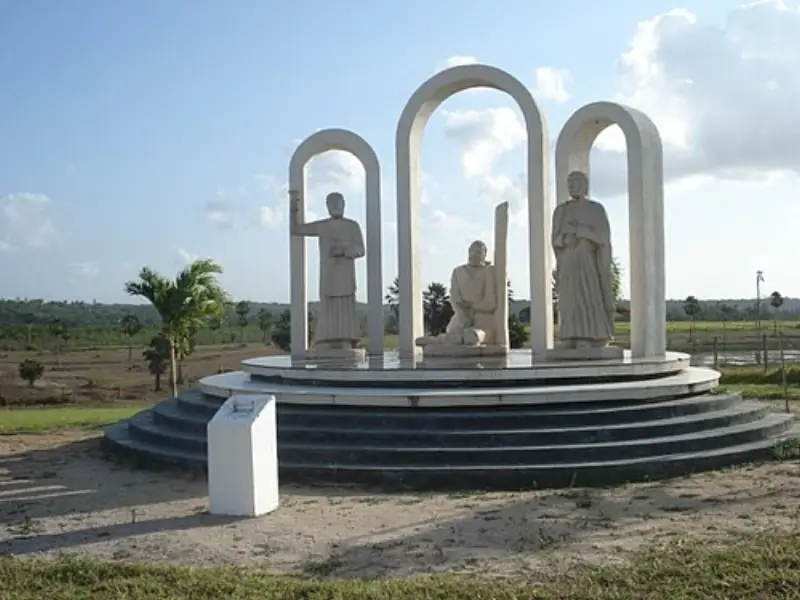
The martyrs of Natal remain bound to the land where they died. The state of Rio Grande do Norte honours them as its patrons, and their memory is kept liturgically on 3 October, the anniversary of the massacre at Uruaçu. Chapels testify to the devotion that grew around them: a chapel dedicated to the martyrs stands at São Gonçalo do Amarante, as does a monument raised in their honour. Their iconography is marked by the palm branch of martyrdom, and the roll of their names — the Jesuit André de Soveral, the priest Ambrósio Francisco Ferro, Mateus Moreira with his dying confession of the Blessed Sacrament, married couples such as Antônio Vilela and Estêvão Machado de Miranda with their daughters, and seven unnamed companions of João Martins — preserves the portrait of an entire Catholic community that refused to abandon its faith. Canonized by Pope Francis amid the universal Church, they stand as the first saints raised from Colonial Brazil's northern Martyrs of Natal, witnesses whose blood was shed before the Eucharist they believed in and whose cry of praise outlasted their killers.
§ Individuals
Timeline
- 1572
André de Soveral, the future Jesuit martyr, is born in Brazil.
§ André de Soveral
- 1593
Soveral enters the Society of Jesus and makes his novitiate in Bahia.
§ André de Soveral
- 1606
Soveral undertakes his first mission work among the natives of Rio Grande do Norte, teaching catechism.
§ André de Soveral
- 1614
Soveral serves as parish priest at Cunhaú.
§ André de Soveral
- 16 Jul 1645
Dutch soldiers attack the chapel of Our Lady of the Candles at Cunhaú before the Eucharist and kill Soveral, Domingos Carvalho, and others.
§ André de Soveral
- 3 Oct 1645
Two hundred armed natives with Dutch allies hack to death twenty-eight Catholics, including children and the priest Ambrósio Francisco Ferro, at Uruaçu.
§ October massacre
- 6 Jun 1989
The beatification cause opens in Natal as the Congregation for the Causes of Saints grants its nihil obstat, titling the group Servants of God.
§ Canonization
- 25 Nov 1994
The Congregation validates the diocesan process, which had run from 1989, having received the Positio in 1998.
§ Canonization
- 23 Jun 1998
Theological consultants approve the cause, followed by the Congregation on 10 November.
§ Canonization
- 5 Mar 2000
Pope John Paul II, confirming the martyrs were killed in hatred of the faith, beatifies the group in Saint Peter's Square.
§ Canonization
- 23 Mar 2017
Pope Francis signs a decree approving canonization for the group, waiving the required miracle.
§ Canonization
- 15 Oct 2017
Pope Francis canonizes the Martyrs of Natal in Saint Peter's Square.
§ Canonization
In Their Own Words
Praise be the Blessed Sacrament
The Record
- Patron of
- Rio Grande do Norte
- Symbols
- Palm branch
- Canonization
- Beatified by Pope John Paul II on 5 March 2000; canonized by Pope Francis on 15 October 2017 with the required miracle waived.
Prayer
Bibliography
Show 6 sources
- "RN ganha mártires como padroeiros". Tribuna do Norte.
- "Martyrs of Brazil". Saints SQPN. 16 July 2016. Retrieved 2 November 2016.
- "Blessed André de Soveral, S.J." Manresa. Retrieved 2 November 2016.
- "Blessed André de Soveral and Domingo Carvalho". Santi e Beati. Retrieved 2 November 2016.
- "Blessed Catholic Martyrs of Brazil". Santi e Beati. Retrieved 2 November 2016.
- "Jesuit André de Soveral Among New Saints Canonized by Pope Francis". Jesuits.org. Retrieved 24 October 2017.
Profile text adapted from the Wikipedia article, licensed CC BY-SA 4.0.
Pray with this saint every day
Save The Martyrs of Natal to your favorites, read the full profile, and get feast-day reminders in the Saints app.
Get the Saints AppFree on the App Store for iPhone and iPad