
died c. 304·Feast December 28 (Eastern Churches); June 23 (Roman Martyrology)
The Martyrs of Nicomedia
Thousands slain in the Great Persecution
Overview
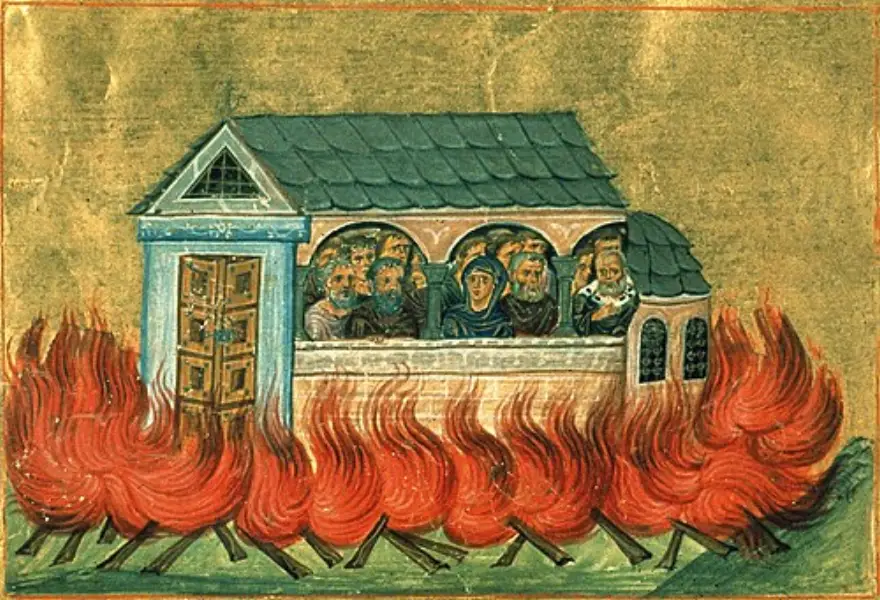
The Martyrs of Nicomedia are the vast company of Christians who died at Nicomedia when the emperor Diocletian's persecution swept the Roman world, the most extensive assault on the Church before its legalization under Constantine. Nicomedia, then one of the chief imperial residences and the administrative heart of the eastern provinces, became one of the first places where the anti-Christian edicts were enforced: in 303 the authorities destroyed the principal church of the city and burned the Scriptures, while the imperial decrees compelled Christians everywhere to sacrifice to the Roman gods on pain of imprisonment, torture, or death. Byzantine tradition records that the climactic massacre fell on Christmas Day of 304, when a vast congregation gathered to celebrate the Nativity refused to join pagan sacrificial rites and was surrounded by soldiers; the faithful were burned, drowned, and beheaded, and some traditions tell of a church set ablaze with its worshippers inside. Later liturgical texts count twenty thousand victims, a figure modern historians regard as symbolic rather than statistical. With the unnamed thousands stand the bishop Anthimus, the court official Gorgonius, the convert Domna, and the child Vasilissa, all commemorated together as the Martyrs of Nicomedia.
The Complete Life
The Church in the Imperial City
In the late third and early fourth centuries Nicomedia ranked among the principal residences of the Roman emperors, serving Diocletian as the administrative centre of the eastern provinces. Its political weight made it, fatefully, one of the first cities where the anti-Christian laws of the coming persecution were carried out. The historian Eusebius of Caesarea records that the assault on the church of Nicomedia began in 303, when the Roman authorities ordered the demolition of the city's principal Christian church and the burning of its Scriptures. The imperial edicts went further: Christians throughout the empire were required to offer sacrifice to the traditional gods and to take part in public ceremonies of the Roman state religion, and those who refused faced imprisonment, torture, or execution. Communities across the eastern provinces were crushed under this repression. The Christians of Nicomedia thus practised their faith in the shadow of the palace itself, knowing that every assembly could be watched and every refusal punished. It was in this city, where the empire's power was most visible and its demands hardest to escape, that the largest company of the era's martyrs would seal its confession with blood.
§ Background
Faith That Would Not Sacrifice
The heart of the conflict at Nicomedia was a single act of worship refused. The imperial religion demanded that Christians burn incense to the Roman gods and join the ceremonies of the state cult; the Christians' faith allowed no such compromise, for they held that homage belonged to Christ alone. When the demand was pressed upon the assembled believers, they answered it with a refusal that cost them everything. According to hagiographical accounts the executions that followed took many forms — burning, drowning, and beheading — as the authorities sought to break a loyalty that no torture could shake. Some traditions preserve the detail that believers assembled within a church were burned there after soldiers, meeting their refusal to offer sacrifice to the gods, set the roof alight above them. The account belongs to the final and fiercest phase of what historians call the Great Persecution, and later martyrologies name Nicomedia among its most severe episodes. In the spiritual memory of the Church, the martyrs of the city stand for every believer who has had to choose between the observable rites of a hostile power and the invisible Lord whom conscience cannot betray.
§ Massacre
Christmas Day at Nicomedia
Byzantine tradition fixes the great massacre of Nicomedia on Christmas Day of 304. On that feast a large gathering of Christians had come together to celebrate the Nativity of Jesus, and the Roman authorities demanded that all present offer sacrifices to the pagan gods. The congregation refused to renounce its faith, and Roman soldiers closed around the assembly. What followed, in the telling of the tradition, was slaughter on a scale rarely matched in the persecutions of the empire: believers were put to the sword, consumed by fire, and drowned, while one account describes the church itself being set alight with the worshippers within it. Among the victims honoured individually by later generations were Anthimus, bishop of the city, who was eventually captured and beheaded; Gorgonius, a Christian official of the imperial household; Domna, a convert executed in the persecution; and Vasilissa, a child who, the hagiographical sources say, was put to death for refusing to deny Christ. These named witnesses stand in the Church's memory for the unnamed thousands who died with them, all gathered into one communion and commemorated together as the twenty thousand martyrs of Nicomedia.
§ Massacre
Veneration Across the Traditions
The martyrs of Nicomedia belong to the age before formal canonization, when the verdict of martyrdom was rendered by the uninterrupted prayer of the Church. They are venerated in the Catholic Church, the Eastern Orthodox Church, the Oriental Orthodox churches, and some Lutheran bodies, whose calendars commemorate the early Christian martyrs. The date of their feast differs by tradition: in the Eastern Orthodox Church and the Byzantine Catholic Churches their collective memory is celebrated on 28 December, the day after the Nativity whose celebration they were keeping when they died, while the Roman Martyrology of the Catholic Church records them on 23 June. Their story lives not only in the liturgical books but in sacred art: Byzantine liturgical texts and iconography preserve their image, most famously in the miniatures of the Menologion of Basil II, where the martyrs of Nicomedia are painted among the company of the Church's witnesses. The designation by which they are best known — the twenty thousand martyrs — comes from the later liturgical tradition, and under that title Orthodox prayer continues to seek their intercession, patron saints of all who suffer for the faith.
§ Cult and commemoration
Memory, Sources, and Debate
The memory of Nicomedia rests on two layers of testimony. The first is contemporary: the works of Eusebius of Caesarea and Lactantius record how the churches were razed, the Scriptures consumed by flame, and believers seized and put to death for defying the imperial religion, and both authors treat the city as a chief theatre of the persecution. The second layer is later: Byzantine synaxaria and liturgical texts expanded the early accounts and spoke of vast numbers put to death in the city. Few scholars doubt that Nicomedia stood in the front rank of the persecuting cities of the early 300s, but they treat the traditional figure of twenty thousand as symbolic or exaggerated rather than as a census. Scholars such as W. H. C. Frend have observed that the tallies found in early martyr texts were often shaped by hagiographic growth rather than careful reckoning, and G. E. M. de Ste. Croix argued that such estimates serve theological and literary purposes more than demographic ones. The debate has not dimmed the cult: whatever the true count, the Church honours the martyrs of Nicomedia as witnesses to the cost of the Great Persecution, among the greatest companies of saints the ancient Church produced.
§ Historicity and scholarly debate
Timeline
- 303
Roman authorities destroy Nicomedia's principal Christian church and burn the Scriptures, opening the persecution in the city.
§ Background
- 25 Dec 304
A large congregation celebrating the Nativity refuses pagan sacrifice; Roman soldiers surround the gathering and kill thousands by fire, water, and the sword.
§ Massacre
The Record
- Patron of
- persecuted Christians
- Symbols
- Crown of martyrdom·Martyr's palm
- Canonization
- Pre-congregation martyrs, venerated in the Catholic, Eastern Orthodox, Oriental Orthodox, and some Lutheran churches.
Prayer
Bibliography
Show 7 sources
- Walsh, Michael J. (2007). A New Dictionary of Saints: East and West. Liturgical Press. p. 401.
- Frend, W. H. C. (1965). Martyrdom and Persecution in the Early Church. Oxford University Press.
- "The 20,000 Martyrs of Nicomedia". Orthodox Church in America. Archived from the original on 19 May 2025. Retrieved 12 March 2026.
- de Ste. Croix, G. E. M. (2006). Christian Persecution, Martyrdom, and Orthodoxy. Oxford University Press.
- Eusebius of Caesarea. "VIII". Ecclesiastical History.
- Alban Butler. Butler's Lives of the Saints.
- Lactantius. On the Deaths of the Persecutors.
Profile text adapted from the Wikipedia article, licensed CC BY-SA 4.0.
Pray with this saint every day
Save The Martyrs of Nicomedia to your favorites, read the full profile, and get feast-day reminders in the Saints app.
Get the Saints AppFree on the App Store for iPhone and iPad