
c. 4th century – c. 420·Feast December 4
St. Maruthas of Martyropolis
Bishop, diplomat, and Father of the Syrian Church
Overview
Maruthas was a Syriac monk who rose to the episcopate of Maypherkat, a city of Mesopotamia also called Meiafarakin, serving as its bishop from before 399 until about 410. So many relics of martyrs were gathered into his episcopal city under his care that it came to be known by the Greek name Martyropolis, the city of the martyrs. His life joined the cloister to the court. A friend of John Chrysostom and a man of political consequence, he moved as envoy and ambassador between the East Roman emperor and the Persian king. Anxious for the church of Persia, which had suffered bitterly under Shapur II, he traveled to Constantinople, though Emperor Arcadius was absorbed in the affairs surrounding Chrysostom's exile. Later Theodosius II sent him to the Persian court, where his courtesy, his holy life, and his reputed skill in medicine won the esteem of King Yazdegerd I despite the hostility of the Magi, and he secured peace between the two empires. A councilman at Constantinople in 381 and at Antioch in 383, an organizer of the Persian church alongside the catholicos Isaac, and a prolific writer and hymnographer, he died before 420, kept on 4 December by both East and West.
The Complete Life
From Cloister to Cathedra
Maruthas began his Christian life as a monk of the Syriac tradition, formed in the ascetic discipline of Mesopotamia before the church called him to govern. By 399 he had been raised to the episcopate of Maypherkat, a town in Mesopotamia known in other sources as Meiafarakin, and he held the see until roughly 410. The work for which his city remembers him was undertaken with a builder's hands: he gathered within his cathedral town the bones of so many witnesses of the faith that the settlement received a new name in Greek, Martyropolis, the city of the martyrs. It was a statement in stone and bone that the persecuted church of Persia had given the faith heroes worth honoring in a Christian town. The same organizing instinct marked his wider service. He is counted among the first to give the church a regular structure, and he pursued that labor in partnership with the catholicos Isaac, holding two synods at Ctesiphon for the benefit of the Persian church. A monk by formation, he ended as one of the great ecclesiastical organizers of the Syriac East.
§ Introduction
Envoy Between Two Empires
The Persian church of Maruthas's day carried fresh wounds: it had endured severe persecution under Shapur II, and its plight drew the bishop westward. In the interests of that suffering church he came to Constantinople, only to find Emperor Arcadius too occupied with the affairs surrounding the exile of John Chrysostom — the great preacher whom Maruthas counted as a friend — to attend to the Persians. The cause was not lost. Later, Emperor Theodosius II dispatched Maruthas to the court of Persia as his representative, and there the bishop accomplished what soldiers could not. Notwithstanding the opposition of the Magi, he won the esteem of King Yazdegerd I by his affability, his saintly conduct, and, as tradition claims, his knowledge of medicine. The court physician-diplomat in a cassock became a trusted figure in a hostile capital, and out of that trust came a negotiated peace between the East Roman Empire and Persia. For a church living on the border of two empires at war, that peace was not an abstraction but a reprieve from suspicion and violence, purchased by a bishop's patience.
§ Introduction
A pen in Service of the Martyrs
Maruthas fed the church he served with books, laws, and song. His pen preserved the memory of persecution: his Acts of the Persian Martyrs records the victims killed under Shapur II and Yazdegerd I, while his hymns on the saints slain in Shapur's persecution gave the suffering church poetry with which to honor its own. He wrote a History of the Council of Nicaea and rendered the canons of that council into Syriac, carrying the discipline of the great council into the Syriac-speaking church. He composed a Syrian liturgy, or anaphora, for the altar, commented on the Gospels for their readers, and set down the acts of the Council of Seleucia-Ctesiphon that he had guided. His orthodoxy was tested and proven in council: he stood among the fathers at the First Council of Constantinople in 381 and at the Council of Antioch in 383, where the Messalians were condemned. Scholarship, canon law, liturgy, and hymnody — he moved through all of them, and the hymns on the Eucharist and the Cross suggest a theologian whose doctrine was first of all adoration.
§ Introduction
The Bishop's Last Years
The sources follow Maruthas to the edge of the fifth century and then let him go quietly. His episcopal tenure at Maypherkat ran through about 410; his death came, so far as the record allows, before 420, when he was an old man who had outlived the emperor Arcadius, his friend John Chrysostom, and many of the contemporaries of the councils of his youth. What he left behind in his own city was permanent: a see renamed for the martyrs whose relics rested there, and a Christian community strengthened by his building. What he left the wider church was equally durable — a Persian church given synods, canons, and structure in its hardest hour, a peace between empires that outlasted the diplomacy that made it, and a shelf of writings that kept the memory of the martyrs alive in Syriac. No dramatic death is recorded for him, no final persecution; his last years appear to have been spent as his whole life had been ordered, in the steady work of a bishop who had made peace his trade and the martyrs his companions.
§ Introduction
Father of the Syrian Church
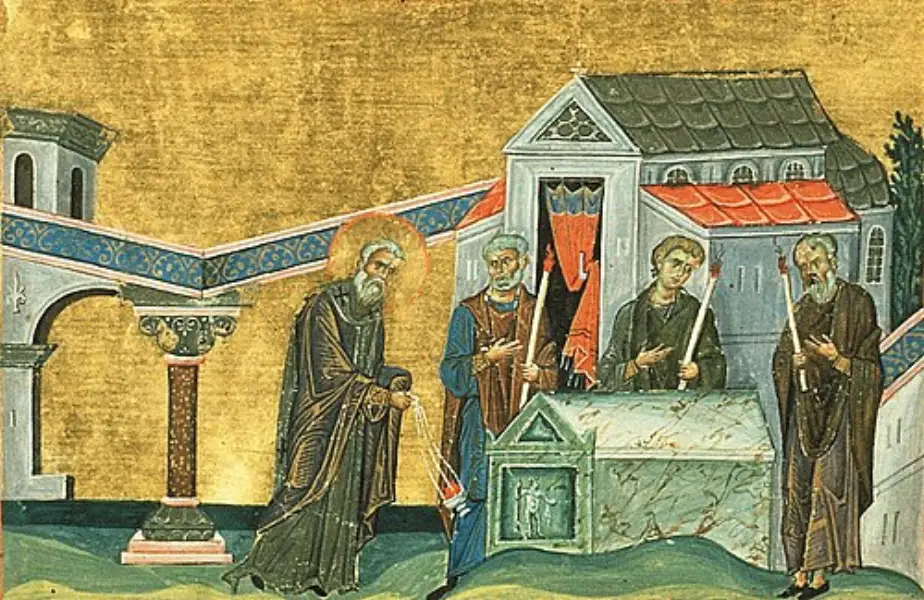
The memory of Maruthas settled early and stayed. Tradition gives him the title Father of the Syrian Church, and his portrait stands in the Menologion of Basil II, the great illuminated menology of the Byzantine court, shown as Bishop of Martyropolis in Mesopotamia. His cult crossed every boundary that divided the Christianity of his region: Roman Catholics, Eastern Catholics, Eastern Orthodox, and Oriental Orthodox Christians alike honor him, with his feast kept on 4 December. Historians of the ancient church return to him as a rare figure who was at once council father, monastic bishop, imperial ambassador, and physician of souls and bodies alike. The city of the martyrs he founded kept his name in its very stones, and the acts he compiled kept the Persian martyrs in the memory of churches that had never seen Persia. Few bishops of his century served so many worlds at once — Roman and Persian, Greek and Syriac, court and cloister — and fewer still are honored by all of them together. His name endures as well in the scholarship of the East: students of the Syriac church still meet him first as the compiler of its martyrs' acts, the writer who set down what the persecutors had done.
§ Introduction
Timeline
- 381
Takes part in the general First Council of Constantinople
§ Introduction
- 383
Attends a Council of Antioch at which the Messalians are condemned
§ Introduction
- 399
Serves as bishop of Maypherkat in Mesopotamia from before this year
§ Introduction
- 410
His tenure as bishop of Maypherkat, begun before 399, continues until about this year
§ Introduction
- 420
Dies before this year, mourned as Father of the Syrian Church
§ Introduction
The Record
- Major works
- Acts of the Persian Martyrs·History of the Council of Nicaea·Syriac translation of the canons of the Council of Nicaea·A Syrian liturgy (anaphora)·Commentaries on the Gospels·Acts of the Council of Seleucia-Ctesiphon·Hymns on the Holy Eucharist, on the Cross, and on the saints killed in Shapur's persecution
- Canonization
- Pre-congregation; venerated in the Roman Catholic, Eastern Catholic, Eastern Orthodox, and Oriental Orthodox Churches
Prayer
Bibliography
Show 8 sources
- "St. Maruthas". catholic.org. Retrieved August 21, 2012.
- "The Armenian Life of Marutha of Maipherkat", Ralph Marcus, The Harvard Theological Review, Vol. 25, No. 1 (Jan., 1932), 47.
- Curtin, D. P. (May 2021). Council of Seleucia-Ctesiphon: Under Mar Isaac. ISBN 9781088234327.
- Maruthas from the Catholic Encyclopedia (1915).
- De Lacy O'Leary, The Syriac Church and Fathers (2002).
- Smith, William & Wace, Henry (editors); A dictionary of christian biography, literature, sects and doctrine, "Maruthas (1)", (1877).
- Moffett, Samuel Hugh. A History of Christianity in Asia, (Maryknoll: Orbis Books, 1998) p. 154-155.
- Herbermann, Charles, ed. (1913). "St. Maruthas". Catholic Encyclopedia. New York: Robert Appleton Company.
Profile text adapted from the Wikipedia article, licensed CC BY-SA 4.0.
Pray with this saint every day
Save St. Maruthas of Martyropolis to your favorites, read the full profile, and get feast-day reminders in the Saints app.
Get the Saints AppFree on the App Store for iPhone and iPad