
1796 – 1868·Feast April 24
St. Mary Euphrasia Pelletier
Foundress of the Sisters of the Good Shepherd
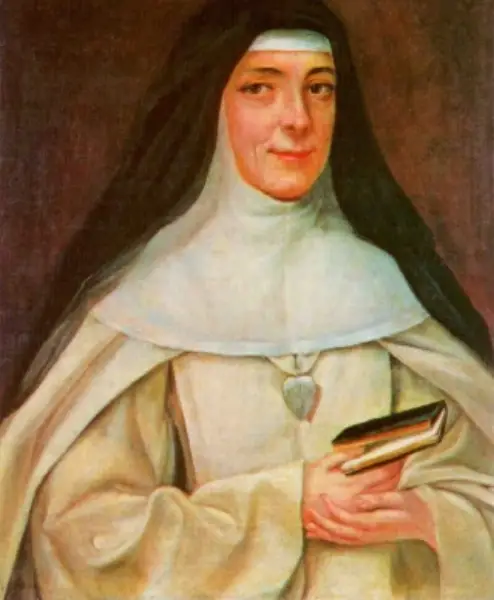
Overview
Mary Euphrasia Pelletier, baptized Rose Virginie Pelletier, was born on 31 July 1796 on the island of Noirmoutier off the northwest coast of France, where her parents had fled to escape the violence of the Revolution. Orphaned of her father at ten and placed in a boarding school at Tours in 1810, the boarding school she attended stood beside a convent of the Order of Our Lady of Charity, known as the Refuge, the congregation John Eudes had founded to shelter women and girls at risk of exploitation. Against her guardian's wishes she entered that community in 1814, received the habit a year later as Mary of Saint Euphrasia, and made her vows in 1817. Elected superior of Tours at twenty-nine, she was sent in 1829 to found a refuge at Angers, established in a former cotton factory and placed under the patronage of the Good Shepherd. Convinced that the work needed unity rather than scattered autonomous houses, she secured papal approval in 1835 for a congregation under a generalate and sent sisters across Europe and beyond. By her death on 24 April 1868 she led 3,000 sisters in 110 convents across thirty-five countries. Leo XIII declared her venerable in 1897, Pius XI beatified her in 1933, and Pius XII canonized her in 1940.
The Complete Life
A Child of the Revolution's Exile
Rose Virginie Pelletier entered the world in flight. Her parents had taken refuge on Noirmoutier, a small island off the French Atlantic coast, believing its remoteness would shield the family from the violence of the Revolution; there, on 31 July 1796, the eighth child of Julian and Anne Pelletier was born. The protection was partial at best. Her father died when she was ten, and in 1810 her mother placed her in a boarding school at Tours, where her mother's own death followed in 1813, leaving the girl orphaned before she had finished her schooling. Yet the neighborhood of that school proved decisive. Nearby stood a convent of the Order of Our Lady of Charity, known as the Refuge, founded a century and a half earlier by John Eudes to care for women and girls who were homeless, orphaned, abandoned by their families, or driven to prostitution to survive. The sisters there offered shelter, food, vocational training, and the chance of a new beginning. The community itself bore the scars of the revolutionary decades: it had been dispersed, most of its members imprisoned, and what remained when Pelletier encountered it was a body of elderly, weary sisters keeping the work alive.
§ Biography
Entry into the Refuge
Pelletier's guardian opposed the idea, but at twenty she entered the Tours convent of Our Lady of Charity on 20 October 1814, and a year later, on 6 September 1815, was clothed with the habit under the name Mary of Saint Euphrasia. Because she had not yet reached twenty-one, the age the constitutions required for profession, she waited two years before making her vows in 1817, and then took up the ordinary labor of the house as a teacher. Recognition came quickly. In 1825, still only twenty-nine, she was elected superior of the convent, an office she could exercise only with a dispensation from the age the constitutions demanded. It was during her time governing at Tours that she showed the breadth that would mark her whole life: besides the active work of the refuge, she founded a community of Magdalens, women who wished to live a fully contemplative life in enclosure and to sustain the congregation's apostolic works by their prayer. That contemplative branch survives today as the Contemplatives of the Good Shepherd, twin to the active congregation she would later gather under one authority.
§ Biography
The Good Shepherd at Angers
In 1828 the Bishop of Angers came into a legacy of 30,000 francs designated for a refuge for women in need, and he entrusted its foundation to Pelletier. She reached Angers in 1829 and on 31 July of that year established the convent in a former cotton factory, placing it under the patronage of the Bon Pasteur, the Good Shepherd. Leadership proved difficult to delegate: the first superior appointed in her place, Sister Paul Bodin, was not equal to the task, and Pelletier was recalled from Tours and installed as Mother superior of Angers in 1831. Her deeper conviction concerned structure. John Eudes had founded his houses as separate and autonomous, and neither Tours nor Nantes wished to extend itself to Angers; Pelletier judged that the work could grow only if each new house came under a central generalate. She planted convents at Le Mans, Poitiers, Grenoble, and Metz, and in April 1835 Pope Gregory XVI approved the motherhouse at Angers as the Congregation of Our Lady of Charity of the Good Shepherd, directly subject to the Holy See, with Cardinal Odescalchi as its first cardinal-protector. From Angers the congregation spread to Italy, Belgium, Germany, and England.
§ Foundation of the Sisters of the Good Shepherd
Opposition and Loneliness
The expansion of the congregation did not come without a price. For years Pelletier had to contend with the opposition of Bishop Angebault of Angers, who wished to exercise the authority of superior general over the congregation even though its constitutions made no provision for such a claim. Her enemies charged her with ambition, with innovation, and with disobedience, and she found herself receiving conflicting instructions from Rome and from her own bishop. Rome stood by her, but the local clergy, wary of anyone who had drawn the bishop's displeasure, tended to keep their distance. The historian of the congregation Norma O'Shea records that the prelate's opposition together with the loss of several sisters and long-standing friends left her a lonely woman in her last years. Through it all she held fast to the charge committed to her. The congregation by 1868 comprised 3,000 women religious in 110 houses across thirty-five lands. Cancer ended her life at Angers on 24 April 1868, and she was buried on the property of the congregation's motherhouse there, at the Abbey of Saint Nicholas, the shrine to which her spiritual family still goes.
§ Foundation of the Sisters of the Good Shepherd
From Venerable to Saint
The church's judgment on the woman the bishop of Angers had obstructed unfolded steadily after her death. On 11 December 1897 Pope Leo XIII proclaimed Mary Euphrasia Pelletier venerable, the church's formal recognition of the heroic virtue that her sisters had long attested. A generation later, on 30 April 1933, Pope Pius XI beatified her in St. Peter's Basilica in the presence of the congregation she had founded. The final act came during the Second World War's opening spring: on 2 May 1940, Pope Pius XII canonized her in St. Peter's Basilica, enrolling the foundress of the Good Shepherd sisters among the saints of the Catholic Church. Her feast is kept on 24 April, the anniversary of her death at Angers. In the calendar of the church she is honored as a virgin and foundress; in the story of her congregation she is remembered as the first superior general, the woman whose insistence on unity turned a scattering of autonomous refuges into a single institute able to carry the work of the Good Shepherd around the world. With that final act, the foundress whom a local bishop had once tried to bring under his own authority was raised to the honor of the altars of the universal church.
§ Beatification process
The Work Continues
The measure of Pelletier's foundation is its persistence. At her death in 1868 the congregation counted 3,000 sisters in 110 convents across thirty-five countries; today approximately 5,500 Sisters of the Good Shepherd, active and contemplative together, serve in seventy-two countries. The twofold form she gave the institute has endured as she shaped it: the active sisters continuing the refuge and rehabilitation of women and girls in the spirit of John Eudes, and the Magdalens, now the Contemplatives of the Good Shepherd, sustaining that ministry in enclosure by their prayer. Her influence reached beyond her own congregation — among those who looked to her example was Mary of the Divine Heart — and her memory is preserved in the motherhouse at Angers, in the Abbey of Saint Nicholas where she is buried, and in the statue of the founder that stands in St. Peter's Basilica among the founders of institutes. Canonized in 1940, she remains for the church the great witness that no woman is beyond rescue, and for her sisters the mother whose government, tested by opposition, proved stronger than the isolation meant to break it.
§ Legacy
Timeline
- 31 Jul 1796
Born Rose Virginie Pelletier on the island of Noirmoutier, where her family had fled from the French Revolution
§ Biography
- 1810
Her mother places her in a boarding school in Tours
§ Biography
- 1813
Her mother dies, leaving her orphaned
§ Biography
- 20 Oct 1814
Enters the convent of Our Lady of Charity of the Refuge at Tours despite her guardian's reservations
§ Biography
- 6 Sep 1815
Receives the habit and the religious name Mary of Saint Euphrasia
§ Biography
- 1817
Makes her religious vows upon turning twenty-one and begins work as a teacher
§ Biography
- 1825
Elected superior of the Tours convent at twenty-nine, requiring a dispensation from the age required by the constitutions
§ Biography
- 31 Jul 1829
Founds the refuge at Angers in a former cotton factory, placing it under the patronage of the Good Shepherd
§ Foundation of the Sisters of the Good Shepherd
- 1831
Recalled from Tours, is appointed Mother superior of the Angers convent after Sister Paul Bodin proves unequal to the task
§ Foundation of the Sisters of the Good Shepherd
- Apr 1835
Pope Gregory XVI approves the motherhouse at Angers as the Congregation of Our Lady of Charity of the Good Shepherd, directly subject to the Holy See
§ Foundation of the Sisters of the Good Shepherd
- 24 Apr 1868
Dies of cancer at Angers, leaving a congregation of 3,000 women religious spread over 110 houses in thirty-five nations
§ Foundation of the Sisters of the Good Shepherd
- 11 Dec 1897
Pope Leo XIII declares her venerable
§ Beatification process
- 30 Apr 1933
Beatified by Pope Pius XI at St. Peter's Basilica
§ Beatification process
- 2 May 1940
Canonized by Pope Pius XII at St. Peter's Basilica
§ Beatification process
The Record
- Major works
- Sisters of the Good Shepherd (Our Lady of Charity of the Good Shepherd of Angers)·The Magdalens, today the Contemplatives of the Good Shepherd
- Canonization
- Canonized 2 May 1940 by Pope Pius XII at St. Peter's Basilica
Prayer
Bibliography
Show 9 sources
- "Saint Euphrasia Biography", Saint Euphrasia Catholic Church, Granada Hills, CA.
- "St Mary Euphrasia Pelletier – Foundress", Good Shepherd Sisters, Australia and New Zealand.
- Clarke, A.M., Life of Reverend Mother Mary of St. Euphrasia Pelletier, London, Burns and Oates Limited, 1895.
- Norma O'Shea, A Brief Sketch of the Life of Mary Euphrasia, Good Shepherd Sisters, Waterford, Ireland.
- Butler's lives of the saints, Volume 4 by Alban Butler, Paul Burns 1999 ISBN 0-86012-253-0 page 175.
- "Saint Mary Euphrasia Pelletier", Catholic Pamphlets, 1958 (PDF).
- "Sister Mary Euphrasia", Good Shepherd of North America.
- "St. Mary Euphrasia Pelletier", Good Shepherd Sisters, Philippine Province.
- Herbermann, Charles, ed. (1913). "Our Lady of Charity of the Good Shepherd". Catholic Encyclopedia. New York: Robert Appleton Company.
Profile text adapted from the Wikipedia article, licensed CC BY-SA 4.0.
Pray with this saint every day
Save St. Mary Euphrasia Pelletier to your favorites, read the full profile, and get feast-day reminders in the Saints app.
Get the Saints AppFree on the App Store for iPhone and iPad