
1715 – 1791·Feast October 6
St. Mary Frances of the Five Wounds
Franciscan tertiary and mystic of Naples
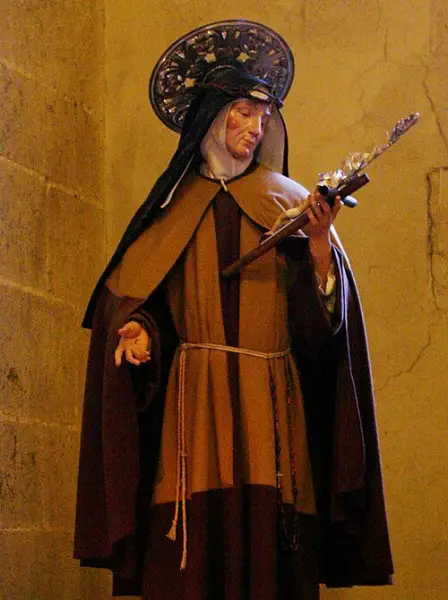
Overview
Mary Frances of the Five Wounds was born Anna Maria Gallo on 25 March 1715 in the Spanish Quarter of Naples, a district of poverty and crime where her father, a weaver of gold lace, ruled his household with brutality. At sixteen she refused the wealthy marriage her father tried to impose and asked instead to join the Franciscan Third Order, receiving the habit on 8 September 1731 and taking a name that joined her love of the Virgin, of Francis of Assisi, and of Christ's sufferings. Because no convent received her, she lived out her religious life in the family home, guided by the friar John Joseph of the Cross and the Barnabite Francis Xavier Bianchi, and became known among her neighbors for her care of the sector's poor. In 1753 she and a fellow tertiary, Maria Felice, moved into a small house owned by the priest Giovanni Pessiri, sleeping on the floor of the second story. There she is said to have received the marks of the stigmata, which she concealed beneath her work gloves, and to have been healed of several afflictions through visions of the Archangel Raphael. She died on 7 October 1791, was canonized in 1867, and remains the patroness of expectant mothers.
The Complete Life
A Childhood in the Spanish Quarter
Anna Maria Gallo was born on 25 March 1715 into the Quartieri Spagnoli, the Spanish Quarter of Naples, then as now one of the densest and roughest quarters of the city, known for prostitution and crime. Her family stood somewhere in the middle class: her father, Francesco Gallo, worked as a weaver of gold lace, and her mother was Barbara Basinsin. Whatever respectability the trade brought, the household lived under a cloud, for the father was a violently abusive man who beat his family regularly and often severely. Into this hard world tradition places one soft prophecy: the Jesuit Francis de Geronimo, himself a saint of Naples, is said to have foretold the infant's future sanctity. The child grew up amid the sights and sounds of a poor harbor city, and the poverty she saw around her would later shape the charity for which her neighbors knew her. What the quarter gave her first, though, was endurance — the habit of surviving hardship in a home where tenderness was scarce, and the instinct, already visible at sixteen, to choose her own path against considerable pressure.
§ Life
Refusing the Marriage
When Anna Maria was sixteen, her father resolved to marry her to a young man of means who sought her hand, a match that would have secured the family's fortunes. She refused. Instead she asked to join the Franciscan Third Order, which would let her live a religious life without leaving the family home. The Franciscans of Naples belonged to the reform movement of Peter of Alcantara, and the friars and tertiaries under their rule were famous for the severity of their lives — an austere school for a young woman who had already learned hardness at first hand. Her father would not at first consent, and only through the intervention of a friar, Father Theophilus, was permission finally granted. On 8 September 1731 Anna Maria was received into the order and clothed in the Franciscan habit, taking the religious name by which she is now known, a name drawn from her love of the Blessed Mother, of Francis of Assisi, and of the Passion of Christ. She never entered a convent; the family home remained her monastery for the whole of her long life.
§ Life
Charity in the Sector
The tertiary of the Spanish Quarter became a fixture of its street life of mercy. For guidance of her soul Anna Maria placed herself under the Franciscan John Joseph of the Cross, numbered among the great saints of Naples, and took as her confessor the Barnabite priest Francis Xavier Bianchi. Under this guidance she gave herself to the poor of her own sector, helping those who lived around her with a directness that made her known throughout the neighborhood. Her charity was rooted in prayer: she was a person of deep interior life, given to long hours of meditation, and her neighbors recognized that the woman who brought them help drew her strength from hours they did not see. In 1753 her life took a new form when she joined another Franciscan tertiary, known to history only as Maria Felice. The two women rented rooms in a dwelling owned by the priest Giovanni Pessiri, who took charge of their souls; the religious slept on bare boards in the storey beneath him. From that narrow lodging her reputation for sanctity continued to grow.
§ Life
The Wounds Hidden in Gloves
In the house of Giovanni Pessiri Mary Frances's interior life passed into the mystery for which she is named. There, it is said, she received the wounds of the stigmata, sharing bodily in the Passion to which her religious name was already consecrated. She did not display them: while she went about her tasks a pair of gloves kept the lesions from ordinary sight, and the favors she could not refuse stayed hidden beneath a laborer's small disguise. Alongside the wounds came affliction of every kind — she suffered patiently through many physical illnesses and dark spiritual trials, a long purgation that lasted decades. Tradition also records visions of the Archangel Raphael, the healer of the Book of Tobit, who is said to have cured her of several of her ailments. The pattern of her spirituality is clear even at this distance: union with the crucified Christ sought not in spectacle but in endurance, a suffering borne in silence, and charity that went out from the sickroom to the poor of the quarter. The stigmata made her singular; the patience with which she carried them is what her neighbors remembered first.
§ Life
Death and Burial
Mary Frances spent the last half of her life in the priest's house in the Spanish Quarter, and there her long story closed. She died in Naples on 7 October 1791, seventy-six years old, having lived as a tertiary for six decades. The city that had watched her hidden life of prayer and charity now claimed her publicly: her body was laid to rest in the Franciscan Church of Santa Lucia al Monte, the church she had attended during her lifetime on the hill above the harbor. There she rests near her old spiritual director, for the same church holds the tomb of Saint John Joseph of the Cross. Within twelve years of her death her cause had moved decisively: Pope Pius VII declared her venerable on 18 May 1803, affirming that her virtues had been practiced to a heroic degree. The arc from there to the altars ran through the nineteenth century, but the last years of her life had already written the verdict — a woman the quarter called holy, buried among its saints, awaiting the church's formal confirmation of what her neighbors had long believed.
§ Veneration
Raised to the Altars
The church's recognition of Anna Maria Gallo proceeded steadily across more than a century. Declared venerable by Pius VII in 1803, she was beatified by Pope Gregory XVI in Rome on 12 November 1843, and on 29 June 1867 Pope Pius IX canonized her in Rome as Saint Mary Frances of the Five Wounds. She was the first woman from Naples ever to be declared a saint by the Catholic Church, an honor with particular weight in a city so rich in sanctity. The pope who canonized her also fixed her patronage: Pius IX appointed her special guardian of women awaiting childbirth and of wives who struggled to conceive, binding her intercession to the most concrete hopes of families. Her feast is kept on 6 October, the day after the anniversary of her death. In her the Third Order of St. Francis found one of its purest representatives — a woman who never wore the habit of a convent, never left her city, and never sought distinction, yet was canonized for the heroic endurance and charity of an entirely ordinary set of rooms.
§ Veneration
The Saint of the Quarter
Devotion to Mary Frances has never left the neighborhood that produced her. She is the patroness saint of the Spanish Quarter, and its residents credit her intercession with the sector's remarkable preservation during the Second World War, when more than a hundred bombs fell on the district yet the damage stayed strangely light. Her family home has been preserved, becoming first a chapel and museum, and in 2001 her relics were borne in procession on 6 October from Santa Lucia to the dwelling that now bears the title of the Church of St. Mary Frances of the Five Wounds. There the practice she might have imagined continues: expectant mothers go to be blessed with her relic, and the sanctuary displays many votive offerings from mothers who attribute safe deliveries to her help. Beyond Naples she is honored as patroness of the Gallo World Family Foundation, formed by members of the Gallo family scattered across the world to promote Judeo-Christian values in the service of the world's betterment. The weaver's daughter from the roughest quarter of Naples thus stands godmother both to her city's mothers and to a worldwide family that bears her name.
§ Veneration
Timeline
- 25 Mar 1715
Born Anna Maria Gallo in the Spanish Quarter of Naples, daughter of Francesco Gallo and Barbara Basinsin
§ Life
- 8 Sep 1731
Received into the Franciscan Third Order and begins wearing the habit, taking the religious name Mary Frances
§ Life
- 1753
Moves with the tertiary Maria Felice into the house of the priest Giovanni Pessiri, who becomes their spiritual director
§ Life
- 7 Oct 1791
Dies in Naples after decades of prayer, charity, and physical affliction
§ Life
- 18 May 1803
Declared venerable by Pope Pius VII
§ Veneration
- 12 Nov 1843
Beatified by Pope Gregory XVI in Rome
§ Veneration
- 29 Jun 1867
Canonized by Pope Pius IX in Rome, the first woman from Naples raised to the altars
§ Veneration
- 6 Oct 2001
Her remains are carried in translation from Santa Lucia church to the house that had sheltered her through the second half of her life
§ Veneration
The Record
- Patron of
- Expectant mothers·Women having difficulty conceiving·The Spanish Quarter of Naples, of which she is patroness saint·Gallo World Family Foundation
- Canonization
- Canonized 29 June 1867 by Pope Pius IX in Rome; the first woman of Naples to be so honored
Prayer
Bibliography
Show 8 sources
- "Saint Mary Frances". www.roman-catholic-saints.com. Retrieved 9 December 2024.
- Heckmann, Ferdinand. "St. Mary Frances of the Five Wounds of Jesus." The Catholic Encyclopedia. Vol. 9. New York: Robert Appleton Company, 1910. 6 Aug. 2013.
- "Santa Maria Francesca delle Cinque Piaghe". Santi e Beati (in Italian). Retrieved 2 March 2013.
- The Franciscan Book of Saints, ed. by Marion Habig, ofm., Franciscan Herald Press, 1959.
- "The Gloves she wore to cover the Stigmata". St. Mary Frances' Home. Retrieved 2 March 2013.
- "Archangel Raphael", Queen of Angels Foundation.
- "Nel santuario di Santa Maria Francesca delle Cinque Piaghe". TV2000 Italia. 8 August 2012.
- "Mission Statement". Gallo World Family Foundation.
Profile text adapted from the Wikipedia article, licensed CC BY-SA 4.0.
Pray with this saint every day
Save St. Mary Frances of the Five Wounds to your favorites, read the full profile, and get feast-day reminders in the Saints app.
Get the Saints AppFree on the App Store for iPhone and iPad