
1842 – 1909·Feast August 8
St. Mary of the Cross MacKillop
Foundress of the Sisters of St Joseph and first Australian saint
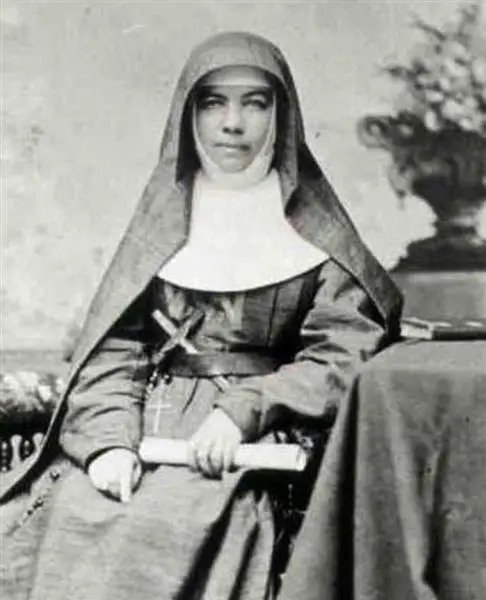
Overview
Mary Helen MacKillop, known in religion as Mary of the Cross, first saw the light on 15 January 1842 in the Melbourne district now called Fitzroy, the oldest of the eight children of Scottish immigrants. Taught at private schools and at home under her father's eye, she took up employment in her sixteenth year and in 1860 became a governess at Penola, South Australia, where she taught not only her cousins but the poor farm children of the district, coming to know the priest Julian Tenison-Woods. In 1866 the two of them founded the Sisters of St Joseph of the Sacred Heart, a congregation whose rule of life stressed poverty, trust in divine providence, and a willingness to go wherever needed; its sisters lived among the people rather than in convents and carried education to the rural poor of Australia and New Zealand. Her reward was conflict: excommunicated in 1871 in a dispute that followed her reporting of clergy child abuse, absolved five months later and fully exonerated, she traveled to Rome in 1873 and won papal approval for her institute. Elected superior general in 1875 and again in 1899, she guided the Josephites through decades of expansion and opposition, suffered a paralyzing stroke in 1902, and died in North Sydney on 8 August 1909. She was canonized on 17 October 2010 as the first Australian Catholic saint.
The Complete Life
A Scottish Family in the Colonies
The family's first child, Mary Helen MacKillop, arrived on 15 January 1842 in the Melbourne district then known as Newtown, now Fitzroy, born to Highland Scots. Her father, Alexander MacKillop, had prepared for the priesthood from boyhood, studying at the Scots College in Rome and at Blairs College in Kincardineshire, before leaving at twenty-nine on the eve of his ordination and migrating to Australia, where he arrived in Sydney in 1838. Her mother, Flora MacDonald of Fort William, reached Melbourne in 1840; the couple married there that July. Their eldest child was baptized six weeks after birth with the names Maria Ellen, though she was always known as Mary. Seven siblings followed, among them Donald, who entered the Jesuits and labored among the Aboriginal communities of the Northern Territory, and Lexie, who joined the Good Shepherd Sisters in Melbourne. The family's fortunes were unstable. Alexander was a loving father but an unsuccessful farmer and prospector, and in February 1851, having mortgaged the farm, he left his family for seventeen months in Scotland. Taught in private schools and at home by her father, she made her First Communion in August 1850 and at sixteen went to work as a clerk in a Melbourne stationery store to help support them.
§ Early life and career
Penola and the Stable School
In 1860 Mary took a position as governess on the estate of her aunt and uncle, Margaret and Alexander Cameron, at Penola in the southeast of South Australia. She was already set on helping the poor wherever she could, and so she taught not only the Cameron children but the farm children of the district as well — and through that work she met Fr Julian Tenison-Woods, the parish priest of the southeast since his ordination in 1857. After two years with the Camerons she taught in Portland, Victoria, and in 1864 opened her own boarding school there, Bay View House Seminary for Young Ladies. In 1866 Woods invited Mary and her sisters Annie and Lexie to Penola to open a Catholic school; the school met in a stable, and after renovations by their brother the MacKillops were teaching more than fifty children. On 21 November 1866, the feast of the Presentation of Mary, other women joined them. Mary received the religious appellation Sister Mary of the Cross, and she with Lexie donned unadorned habits. The group called itself the Sisters of St Joseph of the Sacred Heart, moved to a new house on Grote Street in Adelaide, and opened a school at the request of Bishop Laurence Sheil.
§ Founding of school and religious congregation
The Rule of Life
The rule of life that Woods and MacKillop drew up for the new congregation was radical in its simplicity. Its demands were stark: poverty above all, utter reliance on providence, the surrender of private property, confidence that God would supply every need, and readiness to be sent anywhere. Bishop Sheil approved it, and its spirit shaped everything the Josephites became. Unlike most religious women of the era, the sisters made their homes among the people instead of withdrawing into convents, wore a plain brown habit that earned them the affectionate name of Brown Joeys, and were ready to trail the farmer, the railway hand, and the miner into remote settlements, sharing their mode of life. The congregation was also unusual in its governance: its constitutions demanded that the congregation's head be drawn from its own members rather than imposed by the diocesan bishop — a structure that preserved the institute's independence and, more than once, brought MacKillop into conflict with the episcopate. The Josephites refused government funding, declined to teach instrumental music when the church considered it essential, and would not educate the daughters of the wealthy, preferring the neglected children, the girls in danger, the aged poor, and the prisoner in jail. Poverty was not an ornament of their rule but its engine.
§ Founding of school and religious congregation
Expansion, Exile, and Excommunication
The congregation grew quickly. By the end of 1869 more than seventy Josephites were teaching at twenty-one schools in Adelaide and the country districts, and the sisters ran an orphanage, a reformatory near Kapunda, a house for elderly people and the chronically sick, and works for neglected children and girls in danger. In December 1869 MacKillop took sisters to Brisbane; by 1871, 130 sisters were serving in upwards of forty schools and welfare houses throughout South Australia and Queensland. That growth stirred resistance. She clashed with Bishop James Quinn of Brisbane over who would control her schools, and in 1879 Quinn ordered the sisters out of his diocese. Far graver was the crisis of 1871. After Mary and her sisters uncovered the sexual abuse of children by a priest of Kapunda and reported it through Fr Woods, enemies among the clergy began a campaign of rumor and discredit. On 22 September 1871 Bishop Sheil excommunicated her for insubordination; most of the Josephite schools closed. Forbidden contact with any Catholic, she was sheltered by the Jewish merchant Emanuel Solomon and by Jesuit priests. On his deathbed Sheil ordered the sentence lifted, and on 21 February 1872 Mary was absolved in the Morphett Vale church. An episcopal commission later exonerated her completely.
§ Excommunication
The Long Evening
Mary's Roman journey of 1873 secured the congregation's future but cost her the partnership of its co-founder: Woods blamed her for the changes Rome required in the rule's treatment of property, and though the two were personally reconciled before his death in 1889, he never returned to the work. Back in Australia in January 1875, she was elected superior general in March of that year, and the institute kept spreading — into New South Wales, into New Zealand from 1883, into Victoria from 1889, with foundations across the diocese of Armidale in the 1880s and 1890s. Official approval came from Pope Leo XIII in 1885 and final approval in 1888. Not all bishops welcomed an institute with central government, and after Archbishop Vaughan died in 1883 his successor Patrick Francis Moran removed Mary from the office of superior general, replacing her with Bernard Walsh. She served the congregation all the same, writing constant letters of support and counsel, founding a convent at Petersburg in January 1897, and traveling again to New Zealand in 1896. Elected unopposed as superior general in 1899, she led the Josephites until her death, even after a stroke in Auckland in 1902 left her right side paralysed; confined to a wheelchair, she taught herself to write left-handed, and in 1905 the community returned her to office. She died at the convent in North Sydney on 8 August 1909.
§ Return from Rome
From Gore Hill to St Peter's
The earth around Mary MacKillop's grave at Gore Hill Cemetery was carried away piece by piece by the faithful until her remains had to be moved; on 27 January 1914 her body was moved to a tomb before the altar of Our Lady in the newly raised memorial chapel on Mount Street, North Sydney, a gift of her lifelong Presbyterian friend Joanna Barr Smith. In 1925 the Josephite superior Mother Laurence began the cause, under a tribunal established by Archbishop Michael Kelly of Sydney. The process endured interruptions and a twenty-three-year delay before the initial investigations closed in 1973. Her heroic virtue was declared in 1992, the same year the church accepted the cure of Veronica Hopson, apparently dying of leukaemia in 1961, as worked through MacKillop's intercession, and on 19 January 1995 Pope John Paul II beatified her in Sydney. On 19 December 2009 a papal decree acknowledged a second miracle: Kathleen Evans, given no hope against cancer of the lung and brain, had been permanently and entirely healed. Her canonization was announced in February 2010 and celebrated on 17 October 2010 in St Peter's Square, where some eight thousand Australians witnessed Pope Benedict XVI declare their first saint.
§ Canonisation and commemoration
A Nation's Saint
Australia received its first canonized saint with an outpouring of national recognition. In the week before the ceremony the federal government moved to protect her name from commercial use — an honor shared, the Prime Minister's office noted, only with the cricketer Donald Bradman — and Australia Post issued a commemorative stamp. The Vatican Museum marked the occasion with an exhibition of Aboriginal art, and the congregation she founded carried its schools and welfare institutions across Australia and New Zealand, from the outback towns of South Australia to the mining districts of Otago. Her memory is written across the map and culture of Australia: an electoral district in South Australia, numerous MacKillop colleges, a rose bred in her honor in 1985, the first coin of the Royal Australian Mint's Inspirational Australians series in 2008, a Sydney ferry, bridges in Adelaide and Port Adelaide, and her place on the Victorian Honour Roll of Women since 2001. Composers have written hymns and cantatas for her feasts, filmmakers and playwrights have told her story, and a university in Pennsylvania renamed a residence hall for her in 2018. In the village of Roybridge in Scotland, where her parents lived before emigrating, the parish church keeps a shrine to the daughter of its exiles.
§ Recognition
Timeline
- 15 Jan 1842
Born Mary Helen MacKillop at Newtown, now Fitzroy, Melbourne, eldest child of Alexander MacKillop and Flora MacDonald
§ Early life and career
- 15 Aug 1850
Receives her First Holy Communion at the age of nine
§ Early life and career
- Feb 1851
Her father leaves the family for a seventeen-month trip to Scotland after mortgaging the farm, beginning years of hardship
§ Early life and career
- 1860
Takes a post as governess on the Cameron estate at Penola, South Australia, teaching the farm children as well as her cousins
§ Early life and career
- 1862
Begins teaching the young of Portland, Victoria, and afterwards joins the staff of the town's school
§ Early life and career
- 1864
Opens her own boarding school, Bay View House Seminary for Young Ladies, in Portland
§ Early life and career
- 21 Nov 1866
Adopts the religious name Sister Mary of the Cross as other women join the new Sisters of St Joseph of the Sacred Heart at Penola
§ Founding of school and religious congregation
- Oct 1867
A Josephite school opens at Yankalilla, South Australia, extending the congregation's mission to rural districts
§ Expansion of the Sisters of St Joseph
- Dec 1869
Travels to Brisbane with several sisters to establish the order in Queensland
§ Expansion of the Sisters of St Joseph
- 22 Sep 1871
Bishop Laurence Sheil excommunicates her for insubordination after she refuses a constitutional change that could have left her sisters homeless
§ Excommunication
- 21 Feb 1872
Absolved at the Morphett Vale church by Fr Charles Horan, acting on Bishop Sheil's deathbed instruction
§ Excommunication
- 1873
Travels to Rome to seek papal approval for the congregation and is encouraged by Pope Pius IX
§ Rome
- Jan 1875
Returns to Australia after nearly two years abroad, bringing fifteen new Josephites from Ireland
§ Return from Rome
- Mar 1875
Elected unanimously as superior general of the Sisters of St Joseph
§ Return from Rome
- 1883
Relocates to Sydney on the instruction of Bishop Reynolds of Adelaide, as the Josephites expand into New South Wales and New Zealand
§ Rome
- 1885
Pope Leo XIII grants official approval to the Josephites, with headquarters in Sydney
§ Return from Rome
- 31 May 1886
Her mother, Flora MacKillop, dies with seventy others in the wreck of the SS Ly-ee-Moon at Green Cape
§ Return from Rome
- 1888
Pope Leo XIII grants his definitive approval to the Josephite congregation
§ Return from Rome
- 16 Jan 1897
Founds a convent and base for the Josephites at Petersburg, South Australia, taking charge of the town's Catholic school
§ Return from Rome
- 1899
Elected unopposed as superior general after the death of Mother Bernard, holding the office until her death
§ Return from Rome
- 1902
Suffers a stroke in Auckland, New Zealand, leaving her paralysed on her right side and reliant on a wheelchair for seven years
§ Return from Rome
- 8 Aug 1909
Dies at the Josephite convent in North Sydney; Cardinal Moran says he has assisted at the deathbed of a saint
§ Death
- 27 Jan 1914
Her body is moved to a tomb before the altar of Our Lady in the new memorial chapel on Mount Street, North Sydney
§ Death
- 1992
Her heroic virtue is declared, and the church endorses the cure of Veronica Hopson as attributable to her intercession
§ Canonisation and commemoration
- 19 Jan 1995
Beatified by Pope John Paul II in Sydney
§ Canonisation and commemoration
- 19 Dec 2009
A papal decree formally recognises the cure of Kathleen Evans from inoperable cancer as her second miracle
§ Canonisation and commemoration
- 17 Oct 2010
Canonized by Pope Benedict XVI in St Peter's Square, becoming the first Australian Catholic saint
§ Canonisation and commemoration
In Their Own Words
I consider this day to have assisted at the deathbed of a saint.
The Record
- Major works
- Sisters of St Joseph of the Sacred Heart (the Josephites)·Bay View House Seminary for Young Ladies, Portland·Schools and welfare institutions across Australia and New Zealand, with an emphasis on education for the rural poor
- Patron of
- Australia·Archdiocese of Brisbane·Knights of the Southern Cross
- Canonization
- Canonized 17 October 2010 by Pope Benedict XVI in St Peter's Square, Vatican City
Prayer
Bibliography
Show 13 sources
- "MacKillop has become Australia's first saint", ABC News, 20 December 2009.
- "Canonization for Mary MacKillop underway". The Sydney Morning Herald. 17 October 2010.
- "St. Mary MacKillop". britannica.com. 3 May 2024.
- Mary's Story: Beginnings (Sisters of Saint Joseph), archived from the original on 8 October 2010.
- Pickles, Katie (December 2005). "Colonial Sainthood in Australasia". National Identities. 7 (4): 401. doi:10.1080/14608940500334457.
- McLaughlin, Martin (18 October 2010). "Saintly daughter of Scotland honoured". The Scotsman. Edinburgh.
- Borchardt, D. H. (1976). "Julian Edmund Tenison-Woods (1832–1889)". Australian Dictionary of Biography. Vol. 6. National Centre of Biography, Australian National University.
- Thorpe, Osmund (1974). "Mary Helen MacKillop (1842–1909)". Australian Dictionary of Biography. National Centre of Biography, Australian National University.
- "MacKillop banished after uncovering sex abuse". Australian Broadcasting Corporation. 25 September 2010.
- "The Bishop and the Sisters of Saint Joseph". The Irish Harp and Farmers' Herald. South Australia. 7 October 1871. p. 6 – via Trove.
- B. Bennett, Mary MacKillop: A rocky road to canonisation, Journal of the Australian Catholic Historical Society 31/2 (2010/11), 60–67.
- Maley, Jacqueline (11 January 2010). "Cancer survivor Kathleen speaks of her Mary miracle". The Sydney Morning Herald. Sydney, Australia.
- Paton, Margaret (2010). Mary MacKillop: The ground of her loving. London: Darton Longman Todd. ISBN 978-0-232-52799-5.
Profile text adapted from the Wikipedia article, licensed CC BY-SA 4.0.
Pray with this saint every day
Save St. Mary of the Cross MacKillop to your favorites, read the full profile, and get feast-day reminders in the Saints app.
Get the Saints AppFree on the App Store for iPhone and iPad