
1st century·Feast July 22
St. Mary Magdalene
Apostle to the Apostles, first witness of the Resurrection
Overview
Mary Magdalene stands among the most prominent women of the Gospels: a follower who traveled with Jesus, was delivered from seven demons by him, helped support his ministry out of her own resources, and remained faithful when nearly all the men had fled. Every one of the four canonical gospels places her at the foot of the cross, and the Synoptics name her among the women who watched the burial of Jesus. In the Gospel of John her role reaches its summit: alone at the tomb in the early morning, she meets the risen Christ, mistakes him at first for the gardener, and recognizes him when he speaks her name. He sends her back to the apostles with the news of his resurrection, and for this the church of every age has called her the apostle to the apostles — the first witness of the Resurrection and the first to carry its message to the Twelve. In the East she has always been honored as a virtuous Myrrhbearer, Equal to the Apostles; in the West, a sermon of Pope Gregory the Great in 591 conflated her with the unnamed sinner of Luke's gospel, creating the mistaken image of a reformed prostitute that endured for fourteen centuries until the church formally corrected it. Her feast is kept on 22 July, now ranked as a feast like those of the apostles themselves.
The Complete Life
The Woman from Magdala
Her name tells what little can be known of her origins. no Jewish girls' name was commoner in the first century than Mary, so the gospels set this Mary apart by her hometown or title: the Magdalene. Most scholars take the epithet to mean that she came from Magdala, an antiquity's fishing port on the west bank of the Sea of Galilee, a settlement that by the late first century had acquired an unfortunate reputation for vice — a reputation that may itself have fed the later assumption that she had been a sinner. Other scholars, among them Elizabeth Schrader Polczer and Joan Taylor, argue that Magdalene, which in Hebrew and Aramaic means tower, may have been an honorific nickname, perhaps marking the stature of her faith; interpreters since Jerome have heard in the name a suggestion that she was fortified like a tower. Scholars of every persuasion agree that she was a real historical figure, yet almost nothing else of her early life is recorded. She left no writings of her own and is never mentioned in the epistles of Paul or the other letters of the New Testament; the three Synoptic Gospels, all written within the first century, remain the earliest and most reliable witnesses to her life.
§ During Jesus' ministry
Delivered and Devoted
The Gospel of Luke preserves the single sentence that explains her devotion: Jesus had cast seven demons out of her. Whatever torments lay behind that number — some scholars suggest seven successive exorcisms over a long period, others hear in the seven a symbol of complete possession — she must have suffered severely, and her deliverance must have been correspondingly profound. From that healing flowed the rest of her life. Luke lists her among the women who traveled with Jesus through the cities and villages as he proclaimed the kingdom of God, and among those who provided for him and the Twelve out of their own resources; from this, historians conclude that she was a woman of some wealth. Her standing among the disciples is legible in the order of the lists themselves: whenever the women who followed Jesus are named in the Synoptics, Mary Magdalene comes first, occupying among the female disciples a position comparable to Simon Peter's among the male apostles. The gospels treat her and her companions as vital to the ministry rather than incidental to it — healed women funding and accompanying the mission, present from Galilee to Jerusalem, a fact the evangelists saw no need to explain because their readers took it for granted.
§ During Jesus' ministry
Last at the Cross, First at the Tomb
All four gospels agree that women watched the crucifixion, and three of them name Mary Magdalene among the witnesses. Historians regard her presence there as among the most secure facts of the Passion narrative: Christians of the first century would have been unlikely to invent female witnesses in a world that did not recognize women's testimony, and the women appear in the Synoptic tradition and in John independently of one another. When the male disciples had fled, they remained — braver, or simply less likely to be arrested. She followed the body to its burial as well, named by Mark, Matthew, and Luke among those who saw where Joseph of Arimathea laid him. And on the first day of the week she came back. In John's account, the most intimate of them all, she stands weeping outside the tomb, questions the two angels seated where the body had lain, and turns to confront the figure she takes for the gardener — until he says her name. Her answer, Rabbouni, teacher, is the first spoken word to the risen Christ in the whole of scripture. He sends her to the brothers with the news, and the Gospel of John thereby presents her as the first apostle, the one sent to the apostles — the first witness of the Resurrection and the first missionary of its message.
§ Resurrection of Jesus
Myrrhbearer and Equal to the Apostles
The Christian East never confused Mary Magdalene with any other woman of the gospels. The Orthodox East insists that her whole life, from its beginning to its end, was virtuous, and it has never kept her feast as a penitent's. Instead she receives the titles the tradition reserves for the greatest saints: Myrrhbearer, one of the women who carried sweet spices to the tomb of Christ, and Equal to the Apostles — isapostolos, a rank shared by very few. In Eastern iconography she carries her container of ointment, or holds a red egg, the emblem of new life bursting from the tomb. A beloved folk tradition explains the egg: after the Resurrection, so the story goes, she used her standing to gain a place at a banquet of the emperor Tiberius in Rome, and there, holding a plain egg, she proclaimed that Christ is risen. The emperor laughed that the claim was as likely as the egg turning red in her hand — whereupon it turned bright red before he finished speaking, and she went on preaching to the whole imperial house. Eastern Christians have shared dyed eggs at Easter for centuries with the cry Christ is risen!, a custom that keeps her witness alive at every celebration of the feast.
§ Eastern Orthodox
The Legend of Provence
Scripture is silent about the end of her life, and imagination rushed in to fill the silence. An eastern tradition, supported in the West by Gregory of Tours, holds that she retired with the Virgin Mary to Ephesus and died there; another tradition, recorded by the Patriarch Modestus of Jerusalem, says she went to live with the apostle John after Mary's death. But the West told a grander tale. The Golden Legend, compiled around 1260 by the Dominican Jacobus de Voragine, makes her fabulously rich and beautiful, and sends her after the crucifixion onto a rudderless boat in the Mediterranean with Martha, Lazarus, and companions — cast out by pagans to die, yet miraculously washing ashore at Marseille. There she converts the governor of the city, whose dead wife rises at her intercession, and then withdraws for the last thirty years of her life to a cave in the desert of Provence, a penitent ascetic lifted by angels at every canonical hour to hear their songs. On her final day the bishop Maximin brings her the Eucharist; she receives it in tears of joy, lies down, and dies. Legend, not history — but for centuries this was the life the Christian West knew, painted on chapel walls and carved over cathedral doorways.
§ The Golden Legend
A Veneration Corrected
Venerated from the apostolic age without any process of canonization, Mary Magdalene acquired over the centuries an identity the gospels never gave her. In 591 Pope Gregory the Great, in an Easter sermon, joined the Magdalene of Luke 8 to Mary of Bethany and to the unnamed sinner who anointed Jesus's feet, reading her seven demons as the seven vices and her past as one of sexual sin. The composite figure suited the medieval cult of penance perfectly, and for nearly fourteen hundred years the West pictured her as a reformed prostitute — though no gospel says any such thing. Ambrose in the fourth century had already rejected the conflation; in 1517 the humanist Jacques Lefèvre d'Étaples argued against it, and the Sorbonne condemned him for it in 1521. Only in 1969 did Pope Paul VI remove the identification from the General Roman Calendar, directing that the liturgy of 22 July speak of neither Mary of Bethany nor the sinner of Luke, but solely of the Magdalene, whom the risen Christ chose to show himself to first. Her ancient dignity followed: because of her apostolic office the church recites the Gloria on her feast — an honor given to no other female saint but the Mother of God — and on 10 June 2016 her commemoration was raised to the rank of feast, with a preface naming her explicitly the Apostle to the Apostles.
§ Catholicism
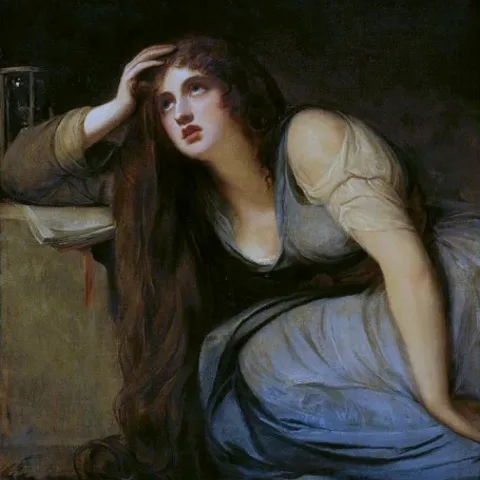
The Most Painted of Sinners and Saints
No woman of scripture, the Virgin Mary excepted, has been depicted more often than the Magdalene. A fresco in the house-church at Dura-Europos, painted around 240, shows her with her bowl of myrrh approaching the tomb — the oldest surviving image of her, and one of the oldest of any Christian subject. Medieval art gave her two bodies of work: the extravagantly dressed woman at the cross, and the Penitent Magdalene covered only by her own long hair, weeping in a desert that echoed the legend of Provence. Donatello carved her gaunt and aged; Titian and the Baroque painters showed her in tears — tears so characteristic that the English language distilled them into the word maudlin. Giotto frescoed her life in the Scrovegni Chapel; Rubens, El Greco, Georges de La Tour, and Artemisia Gentileschi returned to her again and again. The Gnostic texts of Nag Hammadi gave her a second afterlife as the disciple who understood: the Gospel of Mary, the Gospel of Philip with its account of Jesus loving her above the Twelve, the Pistis Sophia where she asks more questions than all the apostles together. Modern culture has quarried both traditions, from rock opera to fiction — and in 2016 the church's own liturgy settled what the gospels had said all along.
§ In Western art
Timeline
- 170
The pagan philosopher Celsus, writing his attack on Christianity between this year and 180, mocks the resurrection testimony as the hallucination of a distraught woman
§ Patristic era
- 240
The fresco of the Dura-Europos church, the oldest surviving depiction of Mary Magdalene, shows her with the other myrrh-bearing women approaching the sealed tomb
§ Patristic era
- 591
Pope Gregory I identifies Mary Magdalene with Mary of Bethany and the sinful woman of Luke, giving rise in the West to her portrayal as a repentant prostitute
§ Portrayal as a prostitute
- 771
According to the account preserved in the Golden Legend, her relics are transferred from Aix-en-Provence to the newly founded abbey of Vézelay by Gerard, Duke of Burgundy
§ The Golden Legend
- 1050
Starting around this year, the monks of Vézelay Abbey begin claiming possession of Mary Magdalene's actual skeleton
§ Belief of burial in France
- 1260
Jacobus de Voragine compiles the Golden Legend, the most famous account of the saint's legendary life, rich in the tale of her voyage to Marseille and her penitence in Provence
§ The Golden Legend
- 1265
The monks of Vézelay publicly announce the discovery of her skeleton
§ Belief of burial in France
- 1267
The Vézelay bones are brought before the king of France, who venerates them
§ Belief of burial in France
- 9 Dec 1279
An excavation ordered by Charles II, King of Naples, at Saint-Maximin-la-Sainte-Baume in Provence uncovers another burial said to be hers
§ Belief of burial in France
- 1517
Jacques Lefèvre d'Étaples publishes his disputation contesting the union of the Magdalene, Mary of Bethany, and Luke's anonymous sinner into one person
§ Reformation and Counter-Reformation
- 1521
The theology faculty of the Sorbonne brands as heretical the claim that these were three distinct women
§ Reformation and Counter-Reformation
- 1969
Pope Paul VI strips from the General Roman Calendar the old merger of the Magdalene with Mary of Bethany and Luke's penitent woman
§ Modern era
- 15 Aug 1988
Pope John Paul II's apostolic letter Mulieris Dignitatem honors her as the first eyewitness of the risen Christ and the apostle of the Apostles
§ Catholicism
- 10 Jun 2016
The Congregation for Divine Worship elevates her liturgical commemoration from a memorial to a feast day, with a preface naming her Apostle to the Apostles
§ Catholicism
In Their Own Words
the first witness to the resurrection, that she might set straight again by her faith in the resurrection, what was turned over in her transgression
She whom Luke calls the sinful woman, whom John calls Mary, we believe to be the Mary from whom seven devils were ejected according to Mark.
She is the first to meet the Risen Christ. [...] Hence she came to be called "the apostle of the Apostles".
The Record
- Patron of
- Apothecaries and pharmacists·Perfumeries·Hairdressers, glovers, and tanners·Converts and penitent sinners·Contemplative life·Women and those tempted sexually·People ridiculed for their piety·Order of Preachers (Dominicans)·Provence; Atrani, Italy; Arahal, Spain; Maribor, Slovenia; Diocese of Salt Lake City, and many other places
- Symbols
- Alabaster box of ointment (Western)·Container of ointment as a Myrrhbearer (Eastern)·Red egg, symbol of the Resurrection·Embracing the feet of Christ after the Resurrection
- Canonization
- Pre-Congregation; venerated since the earliest centuries across Catholic, Orthodox, Anglican, Lutheran, and other Protestant traditions
Prayer
Bibliography
Show 12 sources
- "Mary Magdalene, the clichés". BBC, Religions. July 20, 2011.
- Schrader, Elizabeth; Taylor, Joan E. (December 1, 2021). "The Meaning of "Magdalene": A Review of Literary Evidence". Journal of Biblical Literature. 140 (4): 751–773. doi:10.15699/jbl.1404.2021.6. ISSN 0021-9231.
- Dunn, James D. G. (2003). Jesus remembered. Grand Rapids, Michigan. p. 339. ISBN 0-8028-3931-2.
- Schenk, Christine (2017). Crispina and her sisters: women and authority in early Christianity. Minneapolis (Minn.): Fortress press. p. 11. ISBN 978-1-5064-1188-0.
- Missale Romanum. New York: Benzinger Brothers. 1962.
- Gregory of Tours, De miraculis, I, xxx.
- "Gospel of Philip". Early Christian Writings. Peter Kirby. Retrieved July 23, 2021.
- "Gospel of Mary". Early Christian Writings. Peter Kirby. Retrieved May 7, 2013.
- Carroll, James (June 2006). "Who Was Mary Magdalene?". Smithsonian Magazine. Retrieved July 23, 2021.
- Brown, Andrew (September 21, 2012). "Gospel of Jesus's Wife is fake, claims expert". The Guardian. Retrieved August 6, 2014.
- Goodstein, Laurie (May 5, 2014). "Fresh Doubts Raised About Papyrus Scrap Known as 'Gospel of Jesus' Wife'". The New York Times. Retrieved February 27, 2017.
- Doyle, Ken (September 11, 2011). "Apostle to the apostles: The story of Mary Magdalene". Catholic Times.
Profile text adapted from the Wikipedia article, licensed CC BY-SA 4.0.
Pray with this saint every day
Save St. Mary Magdalene to your favorites, read the full profile, and get feast-day reminders in the Saints app.
Get the Saints AppFree on the App Store for iPhone and iPad