
1566 – 1607·Feast May 25
St. Mary Magdalene de' Pazzi
Florentine Carmelite nun and ecstatic mystic
Overview
Mary Magdalene de' Pazzi was an Italian Carmelite nun and mystic of the Counter-Reformation era. Born into one of the richest and most prominent noble households of Renaissance Florence, she was christened Caterina Lucrezia but called Lucrezia within the family. Drawn to religious life from childhood, she embraced severe penitential practices early, received her First Communion at ten, and in the same year bound herself by a vow of virginity. After her father first tried to arrange her marriage, he consented to her entering the Florentine Carmelite monastery of Santa Maria degli Angeli, where she was clothed as a novice in January 1583 and took the name Sister Mary Magdalene. Gravely ill as a young religious, she professed her vows as she lay on a cot within the chapel, and immediately fell into the first of a long series of ecstasies. Her confessor, guarding against deception, had her dictates recorded, producing five large volumes of visions, together with letters on reform and a collection of sayings known as the Admonitions. Renowned during her life for reported prophecy, apparitions at a distance, and cures, she died in Florence on 25 May 1607, forty-one years old. Beatified in 1626 and canonized in 1669, she remains especially venerated in her native city, where her incorrupt body rests at Careggi.
The Complete Life
A Noble Daughter of Florence
Caterina Lucrezia de' Pazzi entered the world in Florence on 2 April 1566, a child of exceptional privilege. Her father, Camillo di Geri de' Pazzi, was numbered among the richest and most distinguished noble lineages of Renaissance Florence, and her mother was Maria Buondelmonti. The girl was named Caterina Lucrezia at baptism, but at home she answered to her second name, a courtesy shown to her paternal grandmother, Lucrezia Mannucci. Her religious sensitivity appeared remarkably early. At about the age of nine the family chaplain taught her how to meditate, using a contemporary manual on meditation on the Passion of Christ; decades later she carried that same book with her into the monastery. Around the same age she began severe penitential disciplines, including self-flagellation, a barbed metal cilice, and a home-made crown of thorns. At ten, an early age for the period, she received her First Communion and in the same year bound herself by a vow of virginity. At twelve, in her mother's presence, she experienced her first ecstasy, and mystical graces continued to mark her life from that point forward. In 1580 her father sent the fourteen-year-old for her schooling to a convent of the Order of Malta, though the stay was brief, for he soon summoned her home with marriage to a young nobleman in view.
§ Life
The Cloister Chosen
Called home from her schooling to be matched with a young nobleman, Caterina told her father plainly of her vow of chastity. He resisted, then at last relented and allowed her to pursue monastic life instead of marriage. Her choice of community was deliberate: she entered the Carmelite house of Santa Maria degli Angeli at Florence, since its rule permitted the sisters to receive Holy Communion daily, a privilege she treasured. On 30 January 1583 the community welcomed her as a novice and bestowed the religious name Sister Mary Magdalene. Her formation was tested almost at once. Still a novice, she became critically ill, and she bore the agony without a murmur. When one of the sisters, as she received the habit, asked how she could endure so much, she pointed to the crucifix and answered that whoever keeps the sufferings of Christ before his eyes and lays his own sufferings upon God through the passion of the Lord comes to taste pain itself as sweetness. As death seemed near, her superiors permitted a private profession of vows, made while she lay on a cot in the chapel. Immediately afterward she fell into an ecstasy lasting about two hours, the first of a remarkable series: the experience returned on the following forty mornings, each time after Communion.
§ Life
Ecstasies Recorded for the Church
To forestall deception and keep the revelations safe she received, her confessor directed that her experiences be dictated to fellow nuns, and within six years five substantial volumes had been filled with a written account of her ecstasies. The opening three volumes gather the ecstasies that ran from May 1584 through the Pentecost week of the following year; that week proved to be the prelude to a severe trial of the spirit that lasted five years, an ordeal set down in the fourth book. The fifth volume collects her letters concerning reform and renewal in the Church. To these was added another work, the Admonitions, a compilation of her sayings drawn from her experience in the formation of women entering religious orders. Her reputation for extraordinary graces spread during her lifetime. It was believed that she could read the thoughts of others and foretell things to come; during one ecstatic state she was understood to have predicted the future elevation of Cardinal Alessandro de' Medici to the papacy as Pope Leo XI. She was also said to have appeared in person to several people in distant places and to have cured a number of the sick. Whatever judgment later ages may pass on such accounts, in her own lifetime they made the Florentine nun a figure of wide renown.
§ Mystic
The Way of Mortification
The spirituality of Mary Magdalene de' Pazzi joined ecstatic union with God to a rigorous discipline of the body. She was known to practice mortification, scourging herself and using a crown of thorns, and her early years already displayed the pattern: the barbed cilice, the home-made crown of thorns, and acts of self-denial undertaken before she was ten years old. Writers who examined her life have described harsher extremes, recording that she sometimes wore only a single garment and tore it off to roll herself on thorns, and that she fasted, walked barefoot across the snow, poured molten wax upon her flesh, and even cleaned with her tongue the sores of the sick, among them lepers. One account from 1585, among the earliest of its kind on record, describes her begging other nuns to bind her and hurl hot wax at her. Modern students of asceticism and pathology have offered clinical readings of these behaviors, describing her as a sufferer of anorexia mirabilis and noting symptoms resembling bulimia. Whatever the analysis, her contemporaries saw in her a living reproduction of the Passion: an enormous statue in her church in Florence depicts her holding a flagellant whip, and pilgrims from around the world still come there to pay her tribute.
§ Mortification
The Long Agony
The last chapter of her life was a prolonged conformity to the cross. At about the age of thirty-seven, wasted and tormented by coughing and pain, she withdrew to her bed and remained there for the four years that remained to her. Her sufferings were severe and intimate: her gums became so gravely infected that her teeth dropped out one after another, and her flesh was riddled with festering bed sores. When the sisters offered to move her and ease her condition, she warned them away, fearing that contact with her body might stir desires in them. She died on 25 May 1607, forty-one years old, and was laid to rest in the monastery chapel's choir. Her death did not end the fascination with her body. In 1668, as preparation for her canonization advanced, her remains were declared miraculously incorrupt, nearly sixty years after her burial. Her incorrupt body rests today in the Monastery of Santa Maria Maddalena de' Pazzi at Careggi, near Florence, where it remains an object of devotion. Two years after her death her confessor, the Jesuit Vincenzo Puccini, published an account of her life as an edifying example, a book whose later editions were expanded with material from the canonization process.
§ Mortification
Raised to the Altars
Numerous miracles were reported after her death, and the machinery of canonization moved with unusual speed at first. The process for her beatification was opened in 1610 under Pope Paul V and was completed under Pope Urban VIII in 1626, when she was beatified in Rome. The final step took longer: sixty-two years passed after her death before she was raised to the altars on 28 April 1669, when Pope Clement IX canonized her. The honor fell in the same ceremony's era as the canonization of her fellow mystic Pedro de Alcántara, and a commemorative medal marked the joint elevation of the two contemplatives. The Liturgy of the Hours of the Roman Church soon enshrined her memory in the calendar itself: in 1670, the year after her canonization, her feast was inscribed in the General Roman Calendar on 25 May, the anniversary of her passing; in 1728 the date was transferred to Pope Gregory VII, and her observance moved to 29 May, where it stayed until 1969, when the calendar reform restored it to its original place, the true anniversary of her death. Puccini's biography of the saint was translated into French in honor of the canonization.
§ Veneration
Memory in Florence and Beyond
Mary Magdalene de' Pazzi remains little known outside Italy, yet her cult is very strong, and nowhere stronger than in Florence, her native city. There her incorrupt body lies at the monastery that bears her name at Careggi, and her church holds the great statue of her with the flagellant whip that still draws visitors from around the world. One of the first churches consecrated in her honor was that of the Pažaislis monastery, commissioned in Lithuania in 1662, a sign of how quickly her reputation crossed borders in the century of her canonization. Her written legacy has also traveled. The Paulist Press brought out a choice of her writings, rendered into English, in its Classics of Western Spirituality series, making the dictated ecstasies of the Florentine Carmelite available to readers far beyond her homeland. Recent scholarship has turned to her importance for the Church's mission to the East, particularly in connection with India, where the Carmelite presence she inspired has been reexamined. Historians of the Counter-Reformation continue to study her as a case study in the making of a modern saint, and her life, both in its mystical heights and its severe ascetical extremes, remains a subject of fascination for devotees and scholars alike.
§ Veneration
Timeline
- 2 Apr 1566
Born at Florence to Camillo di Geri de' Pazzi and Maria Buondelmonti, and christened Caterina Lucrezia.
§ Life
- 1580
Sent by her father for schooling at a convent of nuns of the Order of Malta, but soon recalled home to be married.
§ Life
- 30 Jan 1583
Accepted as a novice at the Carmelite monastery of Santa Maria degli Angeli in Florence, taking the name Sister Mary Magdalene.
§ Life
- May 1584
A sequence of ecstasies began that her confessor had recorded; the first three volumes of her visions cover this period.
§ Mystic
- 25 May 1607
Died at forty-one and was laid to rest in the choir of the monastery's chapel.
§ Mystic
- 1610
The process for her beatification was begun under Pope Paul V.
§ Veneration
- 1626
Beatified in Rome by Pope Urban VIII, completing the cause begun in 1610.
§ Veneration
- 1668
In preparation for canonization, her body was declared miraculously incorrupt.
§ Mystic
- 28 Apr 1669
Canonized in Rome by Pope Clement IX, sixty-two years after her death.
§ Veneration
- 1670
Her feast was inserted into the General Roman Calendar for 25 May, the anniversary of her death.
§ Feast day
- 1728
The date of 25 May was assigned to Pope Gregory VII and her feast was transferred to 29 May.
§ Feast day
- 1969
Her observance was returned to 25 May, restoring the true anniversary of her death.
§ Feast day
In Their Own Words
Those who call to mind the sufferings of Christ, and who offer up their own to God through His passion, find their pains sweet and pleasant.
The Record
- Major works
- Five volumes of dictated visions and ecstasies·Admonitions, a collection of her sayings on forming women in religious orders·Letters concerning reform and renewal
- Symbols
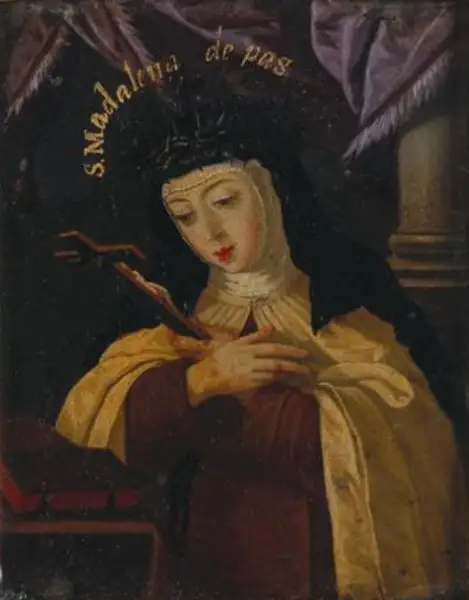
- Crown of thorns·Crucifix·Flagellant whip·Carmelite habit
- Canonization
- Canonized 28 April 1669 in Rome by Pope Clement IX.
Prayer
Bibliography
Show 6 sources
- Smet, Joachim, O. Carm. The Carmelites: The Post Tridentine Period 1550–1600 (vol III), La rinnovazione della Chiesa, Lettere dettate in estasi. Città Nuova – Edizioni O.C.D., 1986. ISBN 88-311-4804-4.
- Pirlo, Paolo O., SHMI (1997). "St. Mary Magdalene de Pazzi". My First Book of Saints. Sons of Holy Mary Immaculate – Quality Catholic Publications. pp. 106–107. ISBN 971-91595-4-5.
- Fabrini, Placido; Isoleri, Antonio; De' Pazzi, Maria Maddalena (1900). The life of St. Mary Magdalen De-Pazzi: Florentine noble, sacred Carmelite virgin. Philadelphia.
- Dingwall, Eric John (1962). Very Peculiar People. University Books. p. 120.
- Puccini, Vincenzio (1639). Vita della Beata Maria Maddalena de' Pazzi, Vergine Nobile Fiorentina (5 ed.). Florence: Giovanni Batista Landini.
- Copeland, Clare. Maria Maddalena de' Pazzi: The Making of a Counter-Reformation Saint. Oxford; New York, NY: Oxford University Press, 2016.
Profile text adapted from the Wikipedia article, licensed CC BY-SA 4.0.
Pray with this saint every day
Save St. Mary Magdalene de' Pazzi to your favorites, read the full profile, and get feast-day reminders in the Saints app.
Get the Saints AppFree on the App Store for iPhone and iPad