
1st century AD·Feast July 29
St. Mary of Bethany
Sister of Martha and Lazarus, anointer of Jesus
Overview
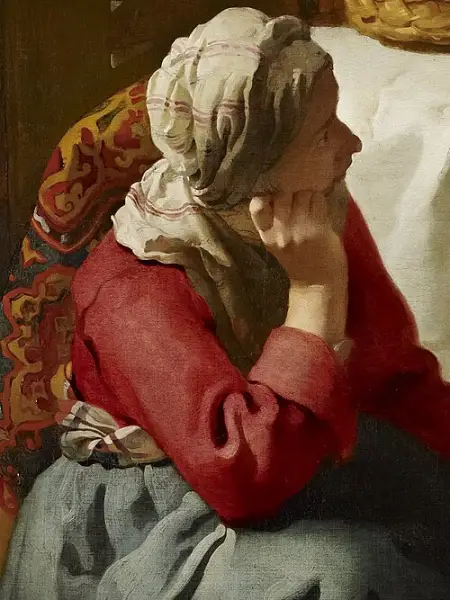
Mary of Bethany is a biblical figure named in John's Gospel and most likely in Luke's as well, honored as a saint across the Catholic, Eastern Orthodox, Oriental Orthodox, Lutheran, and Anglican traditions. She lived in the village of Bethany in Judaea, below the Mount of Olives and close to Jerusalem, together with her brother Lazarus and her sister Martha. The Gospels portray her in three unforgettable scenes. When her brother Lazarus died, she fell at the feet of Jesus in grief, and her tears moved him deeply before he raised Lazarus from the dead. In Luke's Gospel she chose the place of a disciple, sitting at the Lord's feet and listening to his teaching while Martha served, and Jesus declared that she had chosen the better part, which would not be taken from her. Six days before the Passover of his death, she anointed Jesus with a whole jar of costly nard perfume, wiping his feet with her hair, an act he defended against criticism and linked to his coming burial. Eastern tradition counts her among the Myrrh-bearing Women and relates that she later fled Judea with Lazarus and Martha during the persecution after Stephen's martyrdom, helping to proclaim the Gospel. Western tradition long confused her with Mary Magdalene until the liturgical reforms of the modern era restored her separate commemoration.
The Complete Life
The Household at Bethany
Mary of Bethany belonged to a family of three siblings: she, her brother Lazarus, and her sister Martha. Their home was Bethany, a small village in Judaea lying south of the Mount of Olives, not far from Jerusalem. Her name renders the Judeo-Aramaic Maryam, the form of the Hebrew Miryam or Miriam, a name variously explained as meaning wished-for child, bitter, or rebellious. The Gospel accounts give glimpses of a household of some substance. Observers have noted that Lazarus possessed a family vault of his own and that a large number of Jews came from Jerusalem to console the sisters at their brother's death, details suggesting that the household of Lazarus were people of considerable means. That relative affluence helps explain how Mary could possess a quantity of expensive perfume, the pure nard valued at a year's wages that she would one day pour out over the feet of Jesus. In the village that tradition remembers as a place Jesus loved to visit, the three siblings formed the circle of friends among whom he found rest, and it was there, in their house, that the decisive scenes of Mary's life would unfold.
§ Biblical references
Seated at the Master's Feet
The Gospel of Luke preserves the scene that discloses Mary's inner calling. When Jesus visited the home of two sisters in an unnamed village, Martha opened her home to him and threw herself into the preparations, while her sister Mary seated herself at the Lord's feet to hear his words. Frustrated by the burden of hospitality, Martha asked Jesus to tell Mary to help her, and received instead one of his most tender reproofs: only one thing is needed, he said, and Mary had chosen the better part, which would not be taken from her. For Mary to take that seat, and for a teacher to allow her to occupy it, was itself a controversial act. As one commentator observes, she assumed the role of a disciple by taking her seat at the teacher's feet, a posture rarely granted to a woman in the Judaism of the first century. In that posture of attentive silence she became a model of listening for every later generation. The same temper shows itself in John's account of their brother's death, where Martha, the more aggressive sister, went out at once toward the arriving Jesus, while her quieter, more contemplative sister waited at home until she was called, then fell at his feet in wordless grief.
§ Luke 10
The Anointing at Bethany
The act for which Mary of Bethany is best remembered is her anointing of Jesus, reported in the Gospel of John, where alone among the evangelists the woman is identified by name. Six days ahead of the Passover, Jesus came to Bethany, where a dinner was given in his honor; Martha served, and Lazarus reclined at the table. Mary then brought out the purest nard ointment, a perfume of extraordinary cost, and poured it over the feet of Jesus, and wiped his feet with her hair, until the whole house was filled with the fragrance. Judas Iscariot objected that the perfume might have fetched a whole year's wages — three hundred denarii in Mark's telling — and the proceeds handed to the poor; the narrator notes that he spoke not from care for the poor but because, as keeper of the money bag, he was a thief. Jesus defended her without reserve: the poor would always remain among them, but his presence among them was brief, and her anointing was meant to prepare him for burial. Matthew and Mark add his solemn promise that wherever the gospel is proclaimed to the world's end, her deed too shall be recounted in her memory. One commentator judges that she seems to have been the only one sensitive to the impending death of Jesus, willing to give material expression to her devotion.
§ Anointing of Jesus
Love That Gives Without Counting
The spirituality revealed in Mary of Bethany is one of receptive, extravagant love. Her posture in the Gospels is always at the feet of Jesus: seated there to learn while he taught in her home, prostrate there in grief at her brother's tomb, kneeling there to anoint him before his passion. The evangelist John records that when Jesus saw her weeping, together with the Jews who had come to console her, his spirit was stirred to its depths and he was troubled, and the word used for his love toward the two sisters is agapao, the self-sacrificial love that gives everything. In her anointing, that same generosity flows back toward him. She surrendered a treasure worth a year's wages in a single gesture, unloosed her hair in public, and made of the dinner table a preparation for his burial. Commentators note the contrast with her sister's active service: Mary said less than Martha, one writer observes, yet wept more; whatever she lacked in words she supplied in weeping. Her devotion was defended by the Lord himself against every calculation of utility, and it has become the emblem of contemplative love that receives the word of Christ, honors his body, and perceives his approaching death before the disciples do.
§ Biblical references
Traditions of a Later Journey
The Gospels fall silent after the events of Holy Week, but several traditions surround the later life of Mary of Bethany. Orthodox tradition relates that her brother Lazarus was driven from Jerusalem amid the persecution that struck the Jerusalem Church after the martyrdom of St Stephen, and that his sisters Mary and Martha escaped Judea at his side, aiding him as he proclaimed the Gospel in various lands. According to Cyprian tradition, the three eventually settled on Cyprus, where Lazarus took up office as first bishop of Kition, the modern Larnaca. One tradition holds that Mary herself journeyed to Ephesus in the company of the Apostle John and remained there until she died. Another suggests that she passed into Gaul alongside Lazarus and Martha, perhaps making her home at Tarascon, where devotion to her continues to this day. The Orthodox tradition numbers Mary and Martha among the Myrrhbearers, faithful followers of Jesus who stood at Golgotha during the Crucifixion and reached his sepulcher in the early dawn after the Sabbath with myrrh to anoint the body of their Lord, becoming the first witnesses of the Resurrection when they found the tomb empty and heard the joyful news from an angel.
§ Eastern Orthodox tradition
Feasts of the Sister of Lazarus
Mary of Bethany was never formally canonized, for her sanctity was recognized from the apostolic age itself, placing her among the pre-congregation saints venerated by the whole Church. Within the Roman Rite she is honored with her brother Lazarus on 29 July, joined to the memorial of their sister Martha; in 2021 the Roman congregation charged with worship inscribed their names upon that memorial, raising it to a liturgical feast of the three siblings. The Lutheran Church keeps the same date of 29 July for the commemoration of Mary with Martha and Lazarus, as do the calendar of the Episcopal Church and, together with Martha, the Church of England, which remembers them with a Lesser Festival. In the East her feast falls differently: the Orthodox East and the Byzantine-rite Catholic churches commemorate her with her sister Martha on 4 June, and again on the Sunday of the Myrrhbearers, third within the Paschal season; she stands likewise at the heart of the observance of Lazarus Saturday, the day before Palm Sunday, when the raising of her brother is celebrated, and her major shrine is the Holy Monastery of Martha and Mary at Al-Eizariya, the modern village that preserves the name of Bethany.
§ Commemoration as a saint
Unmixing the Maries
Few biblical figures have suffered a longer case of mistaken identity than Mary of Bethany. Medieval Western Christianity identified her with Mary Magdalene and with the sinful woman of Luke 7, a conflation owed in large part to a homily of Pope Gregory the Great, who in 591 spoke of several New Testament women as though they were one person, and in another sermon specifically named Mary Magdalene as the sister of Martha in Luke 10. The theologian Jane Schaberg suggests Gregory merely set the last stone upon a legend already standing. The identification shaped Western devotion for centuries and even entered the Roman Rite liturgy of Mary Magdalene's feast, with its Gospel of the sinful woman; it also attached to Mary Magdalene the enduring reputation of a penitent prostitute. Eastern Christianity never adopted the conflation, and the Greek Fathers, as Hugh Pope observed in 1910, consistently distinguished the sinner of Luke 7, the sister of Martha and Lazarus, and Mary Magdalene as three persons. Rome's calendar revision of 1969 reflected the return to that distinction, and the celebration of 2021 gave Mary of Bethany her own place beside her siblings. In the Philippines, processional images bearing her perfume bottle and long hair testify to a living popular devotion, where she is honored as patroness of spiritual studies, lectors, and commentators.
§ Medieval Western identification with Mary Magdalene
Timeline
- 21 Sep 591
In a sermon, Pope Gregory the Great combined the actions of three New Testament women, beginning the Western merging of Mary of Bethany with Mary Magdalene.
§ Medieval Western identification with Mary Magdalene
- 1910
Hugh Pope's Catholic Encyclopedia article examined the Gospel texts and the Greek Fathers' distinction between the sinful woman, Mary of Bethany, and Mary Magdalene.
§ Medieval Western identification with Mary Magdalene
- 1969
The General Roman Calendar was altered, ending the calendar arrangement that had joined Mary of Bethany's memory to that of Mary Magdalene.
§ Medieval Western identification with Mary Magdalene
- 2021
The Congregation for Divine Worship added Mary's name and Lazarus's to the 29 July memorial of Martha, making the Roman Rite celebration a feast of all three siblings.
§ Commemoration as a saint
In Their Own Words
Leave her alone. It was intended that she should save this perfume for the day of my burial. You will always have the poor among you, but you will not always have me.
Martha, Martha, you are worried and upset about many things, but only one thing is needed. Mary has chosen what is better, and it will not be taken away from her.
The Record
- Patron of
- Patroness of Spiritual Studies, Lectors and Commentators in the Philippines
- Symbols
- Alabaster jar of myrrh perfume·Long flowing hair
- Canonization
- Pre-congregation canonization; venerated from the earliest centuries of Christianity.
Prayer
Bibliography
Show 7 sources
- Uraguchi, B. (1916). "The Bethany Family". The Biblical World. 48 (2): 101–114. doi:10.1086/475593. JSTOR 3142286.
- Pope, H. (1910). St. Mary Magdalen, in The Catholic Encyclopedia. New York: Robert Appleton Company.
- Henry, Matthew (1706). Complete Commentary on the Whole Bible.
- Tenney, Merrill C. (1994). "John". In Kenneth L. Barker & John Kohlenberger III (ed.). Zondervan NIV Bible Commentary. Grand Rapids, MI: Zondervan Publishing House.
- Reid, Barbara E., "Mary of Bethany, a Model of Listening", L'Osservatore Romano, August 11, 2017, p. 6.
- Martyrologium Romanum. Libreria Editrice Vaticana, 2001. ISBN 978-88-209-7210-3, pp. 383, 398.
- "Mary", Easton's Bible Dictionary, 1897.
Profile text adapted from the Wikipedia article, licensed CC BY-SA 4.0.
Pray with this saint every day
Save St. Mary of Bethany to your favorites, read the full profile, and get feast-day reminders in the Saints app.
Get the Saints AppFree on the App Store for iPhone and iPad