
1st century AD·Feast April 24
St. Mary of Clopas
Witness at the crucifixion and myrrh-bearing woman
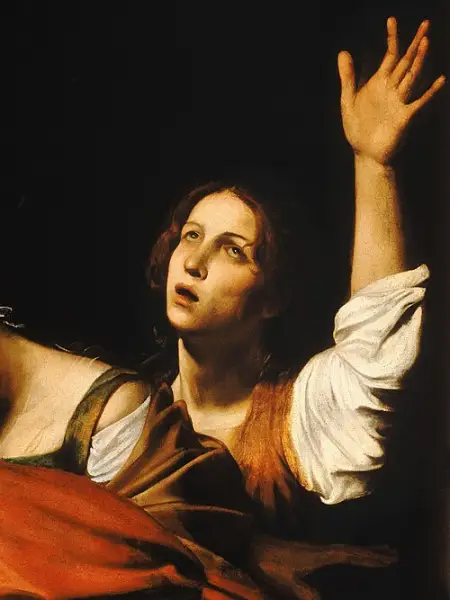
Overview
Mary of Clopas stands among the faithful women of the New Testament who remained with Jesus at the hour of his death. According to the Gospel of John, she stood among the women who watched the crucifixion of Jesus and later brought supplies for his burial. The Greek phrase that names her is ambiguous as to whether she was the daughter or the wife of Clopas, but exegetes have commonly favored the reading wife of Clopas, and Hegesippus named Clopas as a brother of Joseph, which would make her a relative by marriage of the family of Jesus. In the current official text of the Roman Martyrology she is commemorated with Salome on 24 April. Together with Mary Magdalene and Mary Salome she is honored among the Three Marys who kept watch at the tomb of Jesus, and the Eastern churches number her among the Myrrhbearers. Scholars have generally identified her with the Mary whom Matthew and Mark call the mother of James and Joseph, and with the other Mary who came to the tomb on resurrection morning. Her relics are said to repose in France at the sanctuary of the Saintes Maries de la Mer, where devotion of the Three Marys has flourished since the Middle Ages.
The Complete Life
The Woman Named at the Cross
Mary of Clopas is explicitly mentioned in only one verse of the New Testament, yet that verse places her in the most sacred company in the Gospel story. John names her among the women who stood by the cross of Jesus, alongside his mother and Mary Magdalene. The Gospels of Mark and Matthew preserve similar passages nearly identical to one another, listing among the watchers Mary Magdalene, the mother of Zebedee's children, and the mother of James and of Joseph, or of James the less and of Joses. This near-coincidence of names has moved scholars to equate Mary of Clopas with that mother of James and Joseph, whose sons Matthew and Mark count among the four brothers of Jesus. Some interpreters see her too among the women who at daybreak on Easter morning came to the sepulcher with spices to anoint the Lord's body; Matthew names her the other Mary so as not to confuse her with Mary Magdalene, while Mark calls her Mary, mother of James. Whatever the resolution of the ancient name questions, the Gospels present her as a woman of steadfast courage: present when nearly all the male disciples had fled, and serving her Lord's body in love even after his death.
§ Appearances in the gospels
Myrrhbearer and One of the Three Marys
The church's memory has kept Mary of Clopas close to the Passion and the tomb. In the Eastern tradition she is honored as a Myrrhbearer, one of the women who brought myrrh and spices to the sepulcher and so became a first witness of the Resurrection. In the West she is remembered with the Three Marys who kept vigil at the sepulcher, alongside Mary Magdalene and Mary Salome, a trio whose devotion gave rise to one of the most beloved traditions of medieval Christianity. Her witness is not one of words recorded in the Gospels but of presence: she stood where the truth of the crucifixion could be seen, followed the burial with funeral supplies, and returned in the grey light of the third day to anoint the body of the Lord. The oldest extrabiblical testimony reinforces her place in the Lord's circle: the apocryphal Gospel of Philip of the third century echoes John's list and tells of the three who continually accompanied the Lord — his mother Mary, her sister, and Magdalene — each of them bearing the name Mary. In the official Roman Martyrology of the Catholic Church she shares a commemoration with Salome, the two women joined in one memorial of fidelity.
§ Appearances in the gospels
Relics on the Camargue Shore
The Gospels recount nothing of Mary of Clopas after the resurrection morning, but the devotion of the centuries has given her later life a home. Her relics are said to rest in the south of France, at the sanctuary of the Saintes Maries de la Mer, the Holy Marys of the Sea, a sanctuary on the Camargue coast that became one of the great pilgrimage sites of medieval Europe. There she is venerated together with the other holy women who, according to Provençal legend, brought the faith to Gaul, and her cult flourishes under the name by which the local church honors her. Apocryphal writing also stretched her story backward into the holy family's history: the seventh-century Gospel of Pseudo-Matthew presents her as the daughter of Cleophas and Anna, given the same name as her kinswoman the mother of Jesus for the consolation of her parents, and medieval tradition made her the half-sister of the Virgin Mary through Anne's marriage to Clopas. These legends, whatever their historical weight, testify to the church's instinct to keep her near the center of the holy kinship, a kinswoman of the Lord whose fidelity outlasted the darkness of Calvary and whose memory settled, in the end, by the shores of the western sea.
§ Apocryphal writings
Feast Days East and West
Mary of Clopas belongs to the saints of the earliest age, honored before any formal process of canonization existed. She is venerated in the Eastern Orthodox Church, the Catholic Church, and the Oriental Orthodox Church, and her liturgical commemoration falls on different days in East and West. The Orthodox churches keep her feast on 23 May, while in the Catholic Church she is commemorated on 24 April, joined in the present official text of the Roman Martyrology with Salome, the mother of the apostles James and John. The calendar of the Catholic Church's disciples places her among the saints who followed Jesus in his earthly ministry, and the iconographic tradition of the East counts her among the Myrrhbearers, whose Sunday falls within the celebration of Easter. In the Philippines her memory lives in popular piety under the name Santa Maria Jacobe, borne through the streets in Good Friday processions each year, a sign of how the faithful woman of the cross continues to accompany the Passion of Christ in the devotion of the whole church, from the ancient patriarchates of the East to the island parishes of the far Pacific.
§ Appearances in the gospels
The Riddle of Her Name
The scholarly afterlife of Mary of Clopas has been occupied by the riddle of her name and family. The Greek expression Mary of Clopas is ambiguous as to whether she was the daughter or the wife of Clopas, though exegesis has commonly preferred the reading wife. Clopas surfaces in early Christian literature both as a brother of Joseph and as father of Simeon, who ruled the church of Jerusalem as its second bishop; Eusebius of Caesarea, drawing on Hegesippus, records that after the fall of Jerusalem in 70 the Christians unanimously chose Symeon, son of Clopas and a cousin of the Saviour, for the episcopal throne, an identification that would make Mary of Clopas a sister-in-law of Joseph. Jerome, writing against Helvidius in defense of the perpetual virginity of the Lord's mother, maintained that the brothers of Jesus were children of Mary of Clopas and therefore first cousins of Jesus, and supposed her married to Alphaeus, whom he joined to Clopas. A medieval manuscript fragment attributed to Papias makes her the mother of James, Simon, Thaddeus, and Joseph, though Lightfoot and Westcott judged the fragment the work of a medieval namesake, not the second-century bishop. In modern times James Tabor has even deduced that the mother of James and Joses was Mary the mother of Jesus herself, wed to Clopas after Joseph's death in a Levirate marriage.
§ Mary of Clopas and the brothers of Jesus
Timeline
- 70
After the destruction of Jerusalem, the Christians there chose Symeon, son of Clopas, as bishop; Hegesippus records that Clopas, her husband, was a brother of Joseph.
§ Identity of Clopas
- Sep 1961
Robert M. Grant published his study of the ancient and gnostic settings surrounding the Gospel of Philip, which lists three Marys who walked with the Lord.
§ Apocryphal writings
- 1982
Stephen S. Smalley, formerly dean of Chester Cathedral, judged probable the identification of Clopas with Cleopas and with Alphaeus, the father of James.
§ Identity of Clopas
- 2006
James Tabor published The Jesus Dynasty, arguing that the mother of James and Joses was none other than the mother of Jesus herself, wed to Clopas in a Levirate marriage.
§ Mary of Clopas and the brothers of Jesus
In Their Own Words
Now there stood by the cross of Jesus His mother and His mother's sister, Mary of Clopas, and Mary Magdalene.
There were three who always walked with the Lord: Mary, his mother, and her sister, and Magdalene, the one who was called his companion. His sister and his mother and his companion were each a Mary.
The Record
- Canonization
- Pre-congregation canonization; venerated since the earliest centuries in the Catholic, Eastern Orthodox, and Oriental Orthodox churches.
Prayer
Bibliography
Show 7 sources
- Eusebius of Caesarea, Church History, Book III, ch. 11.
- Martyrologium Romanum, ex decreto sacrosancti oecumenici Concilii Vaticani II instauratum auctoritate Ioannis Pauli Pp. II promulgatum, editio typica altera, Typis Vaticanis, A.D. MMIV (2004), p. 251. ISBN 88-209-7210-7.
- S. S. Smalley. "Mary," New Bible Dictionary, 1982, p. 793.
- Grant, Robert M. "The Mystery of Marriage in the Gospel of Philip" Vigiliae Christianae 15.3 (September 1961): 129–140.
- Papias of Hierapolis. Exposition of the Sayings of the Lord. Fragment X.
- Lightfoot, J.B. (1865). "The Brethren of the Lord".
- Tabor, James D. (2006). The Jesus Dynasty: A New Historical Investigation of Jesus, His Royal Family, and the Birth of Christianity. Simon & Schuster. ISBN 0-7432-8723-1.
Profile text adapted from the Wikipedia article, licensed CC BY-SA 4.0.
Pray with this saint every day
Save St. Mary of Clopas to your favorites, read the full profile, and get feast-day reminders in the Saints app.
Get the Saints AppFree on the App Store for iPhone and iPad