
died c. 7–2 BC·Feast December 28
Holy Innocents of Bethlehem
First martyrs slain by Herod at Bethlehem
Overview
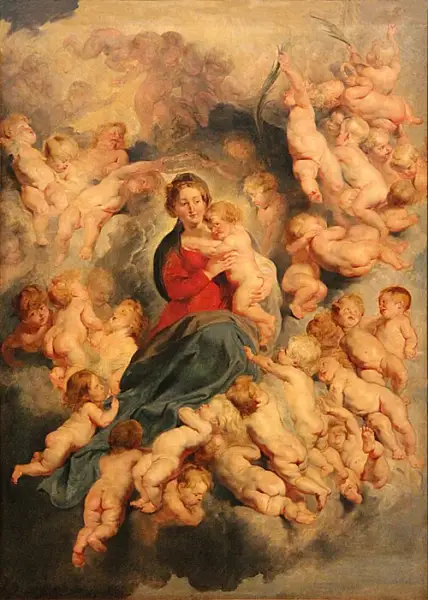
The Holy Innocents are the male children of Bethlehem and its surroundings whom the Gospel of Matthew records King Herod the Great ordered put to death, all boys two years old and under, in his attempt to destroy the newborn king of the Jews whose birth the Magi had announced to him. Outwitted by the wise men, who were warned in a dream and returned home by another road, the furious king unleashed his soldiers on the children of the town. Matthew sees the tragedy through the prophet Jeremiah's image of Rachel weeping for her children at Ramah, refusing consolation because they are no more. Tradition has always honoured these children as the first martyrs of the Christian era, martyrs, as the Fathers observed, who did not know for whom they died: they suffered not for their own confession of Christ but in his place, as the first to shed blood because he had come into the world. Their cult is among the oldest in the Church, appearing in the Western liturgy by about 485, and their feast, Holy Innocents' Day or Childermas, is kept on 28 December in the West as the fourth day of Christmastide. They are patrons of foundlings, babies, and children's choirs.
The Complete Life
The Children of Bethlehem
The story of the Innocents is told only in the Gospel of Matthew, within the Nativity narrative. The Magi came to Jerusalem asking where the king of the Jews had been born, and Herod directed them to Bethlehem, asking them to report back so that he too might pay homage. Warned in a dream that Herod intended to destroy the child, they returned home by another way. When Herod realized he had been deceived, he raged and decreed the death of every male child of Bethlehem and the country round about, aged two or younger, matching the time the Magi had reported to him. Matthew then recalls the oracle of Jeremiah: at Ramah a voice is heard, Rachel crying out for her children and refusing all consolation, since they are gone. Modern readers have noted that Jeremiah's oracle goes on to speak of hope and restoration, so that the lament is framed, even in the Gospel, by the promise of return. The episode mirrors the tale of Pharaoh's attempt on the Hebrew children in the Book of Exodus, in an expanded first-century version in which the child's parents are warned by dreams, as Joseph was warned to flee with Jesus and his mother into Egypt.
§ Biblical narrative
Martyrs Who Did Not Know
From the earliest reflection on the Gospel story, the children of Bethlehem have been reckoned the first Christian martyrs, though, as the tradition carefully adds, martyrs who did not know it. They were not put to the choice that faces the adult confessor; they could not confess Christ, because they did not yet know him, and they died in his place rather than for their own witness. Writers of the early Church such as Irenaeus and Cyprian already counted them among the martyrs, and the Byzantine liturgy sings of fourteen thousand of them, while an early Syrian list of saints gives sixty-four thousand and Coptic sources one hundred and forty-four thousand, echoing the sealed number of the Apocalypse. Those who take the episode as historical bring the figure far lower: Bethlehem was a village, with perhaps a thousand inhabitants, so the victims may have numbered between six and twenty children. But the Church's memory has never been troubled by arithmetic. In her liturgy the littlest victims rank first, and their help is invoked for foundlings, for babies, and for children's choirs, the smallest voices of the singing Church.
§ Numbers
The Feast of the Innocents
The spirituality of this feast holds together grief and glory. Its scriptural centre is the lament of Rachel, and Matthew's citation of Jeremiah gives the day its communion motet, Vox in Rama, given polyphonic settings by masters of the Renaissance and Baroque — Clemens non Papa among them, also Giaches de Wert and, in German, Heinrich Schütz. In the medieval West the day became a festival of inversion, especially north of the Alps: children took the places of teachers and priests, boy bishops presided over some services, and scholars have seen in the custom a Christianized version of the Roman Saturnalia, when slaves played master for a day. In England and France the day was reckoned unlucky, a time when no new project should be begun, and a curious custom asked the faithful, so far as they were able, to abstain from work on the weekday matching Innocents Day throughout the year that followed, until the next feast came round. Philippe de Commynes records the dread with which he had to bring King Louis XI news of an emergency on that day. Beneath the folklore stands a sober Christian paradox: the day belongs to those who could do nothing, and so received everything.
§ Catholic medieval traditions
An Ancient Cult
Few cults are older than that of the Holy Innocents. The earliest Western witness to their feast is the Leonine Sacramentary, a Roman book of about 485, and the first commemorations were tied to the Epiphany: Prudentius names the Innocents in his hymn on that feast, Pope Leo speaks of them in his Epiphany homilies, and and Fulgentius of Ruspe in the sixth century preached on Epiphany, taking in both the slain children and the offerings the Magi brought. From Charlemagne's era onward, Sicarius of Bethlehem was honoured at Brantôme in the Dordogne as one of the supposed victims of the massacre. In the Roman Rite before 1955 the feast bore a penitential character unusual for a martyr's day, with violet vestments, no Gloria, and a Tract instead of the Alleluia, unless the feast coincided with a Sunday, when it was kept with red vestments and full festal joy. Pius XII suppressed the octave in 1955, and the 1960 Code of Rubrics fixed the celebration in the form once reserved for its octave day. Today the West keeps the feast on 28 December, East Syrians on 10 January, West Syrians on 27 December, and the Orthodox on 29 December.
§ Beginnings
Carols, Canvases, and Customs
The massacre has haunted the Christian imagination for two millennia. Medieval liturgical drama staged it in the Ordo Rachelis plays and the N-Town cycle, and in the Pageant of the Shearmen and Tailors at Coventry the episode gave birth to the Coventry Carol, a sixteenth-century lullaby of grief whose text Robert Croo wrote down in 1534 and whose melody survives from 1591, still sung a cappella each Christmastide. Painters returned to the subject again and again for its terrible energy: Pieter Bruegel the Elder and his son painted several versions, the younger van Haarlem showed the mothers fighting back amid the Dutch Revolt, Guido Reni composed a vertical canvas for Bologna in 1611, Poussin made his between 1625 and 1632, and Rubens painted the theme more than once, one Munich version being engraved and reproduced as far away as colonial Peru. Marc-Antoine Charpentier composed the oratorio Caedes sanctorum innocentium around 1683. In the living popular religion of Spain, Hispanic America, and the Philippines, 28 December is a day of pranks and inocentadas, crowned at Ibi in Alicante by the flour-throwing festival of the Els Enfarinats, while in Trinidad and Tobago Catholic children have their toys blessed at Mass on the feast.
§ In Christian art
Timeline
- -7
Herod the Great ordered the killing of all boys two years old and under in and around Bethlehem.
§ Biblical narrative
- 485
The Leonine Sacramentary contains the first Western record of the feast kept for the Holy Innocents.
§ Beginnings
- 1534
Robert Croo wrote down the oldest known text of the Coventry Carol, a mother's lament for the children of Bethlehem.
§ In Christian art
- 1565
Pieter Bruegel the Elder painted his version of the Massacre of the Innocents.
§ In Christian art
- 1590
Cornelis van Haarlem painted his Massacre of the Innocents, reflecting the violence of the Dutch Revolt.
§ In Christian art
- 1591
The melody of the Coventry Carol was first recorded.
§ In Christian art
- 1611
Guido Reni painted his Massacre of the Innocents for the Basilica of San Domenico in Bologna.
§ In Christian art
- 1625
Nicolas Poussin painted his Massacre of the Innocents, completed by 1632.
§ In Christian art
- 1955
Pope Pius XII suppressed the octave of the feast, and the Roman Rite adopted the features once reserved for its octave day.
§ Roman Rite before and after 1955
- 1974
For their album Hamburger Concerto, the rock group Focus set down the first two verses of the old Dutch song about the massacre.
§ In Christian art
In Their Own Words
When Herod realized that he had been outwitted by the Magi, he was furious, and he gave orders to kill all the boys in Bethlehem and its vicinity who were two years old and under, in accordance with the time he had learned from the Magi.
It's better to be Herod's pig than his son
The Record
- Patron of
- foundlings·babies·children's choirs
- Symbols
- martyr's palm·crown of martyrdom
- Canonization
- Pre-congregation; honoured as martyrs from the earliest centuries of the Church.
Prayer
Bibliography
Show 5 sources
- Holweck, Frederick George (1910). "Holy Innocents". In Herbermann, Charles (ed.). Catholic Encyclopedia. Vol. 7. New York: Robert Appleton Company.
- France, Richard T. (1979). "Herod and the Children of Bethlehem". Novum Testamentum. 21 (2): 114–119. doi:10.2307/1560717. JSTOR 1560717.
- Brown, Raymond Edward (1978). An Adult Christ at Christmas: Essays on the Three Biblical Christmas Stories. Liturgical Press. ISBN 978-0-8146-0997-2.
- Blackburn, Bonnie J.; Holford-Strevens, Leofranc (1999). The Oxford Companion to the Year. Oxford University Press. ISBN 978-0-19-214231-3.
- Wasyliw, Patricia Healy (2008). Martyrdom, Murder, and Magic: Child Saints and Their Cults in Medieval Europe. Peter Lang. ISBN 978-0-8204-2764-5.
Profile text adapted from the Wikipedia article, licensed CC BY-SA 4.0.
Pray with this saint every day
Save Holy Innocents of Bethlehem to your favorites, read the full profile, and get feast-day reminders in the Saints app.
Get the Saints AppFree on the App Store for iPhone and iPad