
c. 440 - early 6th century·Feast April 9
St. Materiana
Welsh Princess and Patron of Cornish Churches
Overview
Materiana, whose name appears in many spellings including Madrun, Madryn, Merteriana and Merthiana, is a Welsh saint remembered as patroness of a pair of Cornish churches and of one in Wales. The tradition presents her as a fifth-century princess, firstborn among the three daughters of King Vortimer the Blessed, and after her father's death she governed Gwent jointly with her husband, Prince Ynyr. Legend has it that she fled with her eldest son Ceidio when her grandfather's stronghold of timber was ringed by enemies and burnt, and that the two of them took refuge on the hill of Carn Fadryn. Her cult took firm root across the Bristol Channel. The parish church of Minster in Cornwall, dedicated under the name Merteriana, was her chief patronal church, and her tomb was preserved there until the Reformation. A church at Tintagel, probably founded in the sixth century as a daughter house of Minster, recorded her as its patroness by 1258, while the parish church of Trawsfynydd in Wales is dedicated to St Madryn, Princess of Gwent, who is usually identified with her. In 1478 William Worcester bore witness to a tomb honoured at Minster and to the keeping of her feast on 9 April. A crown and a widow's robe are her traditional attributes.
The Complete Life
A Princess of Gwent
Materiana belongs to the British royalty of the fifth century. Tradition counts her the eldest of the three daughters of King Vortimer the Blessed, and after Vortimer's death she exercised rule over the kingdom of Gwent in southern Wales together with her husband, Prince Ynyr. Her name has travelled through many forms: medieval writers corrupted it to Marcelliana, while Mertheriana and Merthiana resemble the Welsh word merthyr, meaning martyr. Scholars note that Matrona was a widespread Roman name, and that there is no evidence for the supposed link sometimes drawn between her and a pre-Christian goddess named Modron. The turbulence of her early married life is preserved in a family legend. Her grandfather's stronghold, a wooden castle, was surrounded by enemies and set on fire, and Materiana was compelled to escape with her eldest son Ceidio. The two made their way to the hill of Carn Fadryn, where they found shelter until the danger passed. Ceidio in later life founded a church below that hill at the place called Ceidio, and the Lord of Madryn long held the right of presentation to it, a living memory of the royal line from which mother and son had come.
§ Life
Churches across the Sea
Materiana's patronage settled most durably in northern Cornwall. Her chief patronal church is Minster, whose parish is dedicated to her under the name-form Merteriana; the church is older than the settlement at Boscastle, which arose only in Norman times when a castle was raised there. Until the Reformation the saint's tomb stood preserved within the church, drawing pilgrims to her memory. From Minster her cult spread along the coast: the first church at Tintagel was probably founded in the sixth century as a daughter church of Minster, and by 1258 Materiana was formally recorded as Tintagel's patroness. The Norman church and its dedication there have been attributed by Charles Thomas, historian of Cornwall, not to the Earl of Cornwall but to William de Bottreaux, the lord of Boscastle. The present building, restored by James Piers St Aubyn in 1870, keeps a north doorway of about 1080, a chancel statue of the saint and a stained-glass window lighting the nave. Across the water in Wales, the parish church of Trawsfynydd is dedicated to a St Madryn, Princess of Gwent, customarily identified with Materiana; Browne Willis recorded that her feast was kept there on 9 June, and a marble statue of St Madryn once stood at Madryn near Pwllheli.
§ Minster church
Tomb, Feast and Memory
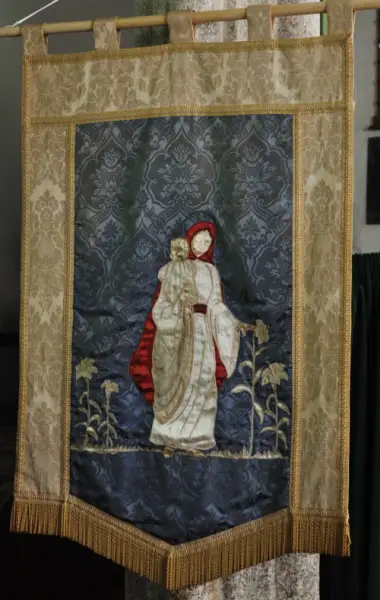
The medieval cult of Materiana centred on her tomb at Minster, where pilgrims venerated it until the Reformation swept such shrines away. In 1478 the antiquary William Worcester set down that the tomb was venerated there and that the saint's feast was observed on 9 April, the date still attached to her memory. At Tintagel the parish feast traditionally fell on 19 October, kept for St Denys, to whom the Trevena chapel was dedicated, a reminder of how local calendars gathered several patrons around one community. Her image endures in Cornish and Welsh church art: beside the chancel statue and the nave window at Tintagel stands the rood screen bearing her banner, designed by Sir Ninian Comper. The landscape itself preserves her, for Carn Fadrun, the hill of her refuge, still carries a form of her name, and the Welsh connections of Madryn near Nefyn reached even to the South Atlantic, where the Argentine town of Puerto Madryn takes its name from the Welsh estate associated with her cult. Anglican, Catholic and Orthodox Christians alike continue to honour this fifth-century princess whose churches still overlook the Cornish sea.
§ Trawsfynydd church
Timeline
- 440
Tradition gives this as the year of her birth at Gwent in Wales, daughter of King Vortimer the Blessed
§ Life
- 1080
The north doorway of the present church of St Materiana at Tintagel dates from about this time
§ Tintagel church
- 1258
First record naming Materiana as the patroness of Tintagel
§ Tintagel church
- 1478
The antiquary William Worcester attests the shrine of her tomb at Minster and the observance of her feast on 9 April
§ Minster church
- 1870
Architect James Piers St Aubyn carries out the restoration of St Materiana's Church at Tintagel
§ Tintagel church
The Record
- Patron of
- Minster, Cornwall·Tintagel, Cornwall·Trawsfynydd, Wales
- Symbols
- crown·widow's robe
- Canonization
- Pre-congregation; venerated in the Anglican Communion, Catholic Church and Eastern Orthodox Church
Prayer
Bibliography
Show 6 sources
- Hutchinson-Hall, John. Orthodox Saints of the British Isles. Vol II (St. Eadfrith Press, 2014) p. 38
- Van der Kiste, John. The Little Book of Cornwall, The History Press, 2013 ISBN 9780752492698
- Baring-Gould, S. Lives of the British Saints; vol. 3, pp. 398-399
- Canner, A. C. (1982) The Parish of Tintagel. Camelford: A. C. Canner; pp. 32-33
- Thomas, Charles (1993) Tintagel, Arthur and Archaeology ISBN 0-7134-6690-1; pp. 19-20
- "EBK: St. Madrun". Earlybritishkingdoms.com. Retrieved 6 April 2020.
Profile text adapted from the Wikipedia article, licensed CC BY-SA 4.0.
Pray with this saint every day
Save St. Materiana to your favorites, read the full profile, and get feast-day reminders in the Saints app.
Get the Saints AppFree on the App Store for iPhone and iPad