
died 18 July 328·Feast July 18
St. Maternus of Milan
Archbishop and builder of Milan's first cathedral
Overview
Maternus, in Italian Materno, was Archbishop of Milan from about 316 until his death on 18 July 328, in the generation when the Church of Milan emerged from the age of persecution into imperial favour. Almost nothing is recorded of his origins, which reach back into the third century, but the account of his election preserves its character: in 316 both clergy and people acclaimed him their Pastor, insisting that he take charge of the see. His episcopate was a season of building and of finding. He is credited with discovering at Lodi Vecchio the remains of the martyrs Nabor and Felix, put to death under Diocletian in 303, and with bringing their relics to Milan, where a church, the Basilica Naboriana, rose in their honour. He completed the Basilica vetus, begun in 313, the first cathedral of Milan, on the ground where the present cathedral stands, and he raised the chapel of San Vittore in Ciel d'Oro outside the walls to enshrine the relics of Saint Victor. Beloved even by the pagans of the city, he had strengthened his flock through the persecution under Diocletian, and ancient accounts attach conversions to his preaching. His remains rest today in the Basilica of Sant'Ambrogio, beside those of the martyrs he translated.
The Complete Life
Chosen by Clergy and People
The record of Maternus's life begins in silence about his origins, and speaks only of the moment he was found. Born, it is thought, in the third century, he belonged to the generation of Milanese Christians who had passed their youth under the threat of the last great persecution. When the see of Milan fell vacant after the episcopate of Mirocles, around the year 316, the choice of a successor was not imposed from above: clergy and people together acclaimed Maternus, both insisting that they must have him for their Pastor. Such elections, in which the whole Christian body of a city cried out its consent, were the ancient manner of choosing bishops, and they testify to a man already known for holiness and steadiness. He took charge of a community freshly delivered from danger, its churches newly possible under the peace of the empire, and he reigned over the see until about 328, governing the Church of Milan in the twelve decisive years that followed the Edict of toleration and preceded the great age of Ambrose by half a century.
§ Life
Finder of Martyrs, Builder of Churches
The work of Maternus as bishop can be read in the stones and relics of Milan. Belief holds that he discovered at Lodi Vecchio, the ancient Laus Pompeia south of the city, the remains of Nabor and Felix, saints put to death in the Diocletian persecution of 303, when the assault on the Church was at its height. He brought their relics to Milan and built for them a church that came to be known as the Basilica Naboriana, giving the recently persecuted community the consolation of possessing the bodies of its heroes. To these foundations he added the completion of the Basilica vetus, whose construction had been begun in 313: it was the first cathedral of Milan, occupying the ground beneath today's Duomo, whose predecessors trace back to Maternus's church. Outside the walls he raised a further sanctuary, dedicated to Saint Victor and enshrining that martyr's relics: the chapel of San Vittore in Ciel d'Oro. In time Ambrose's Basilica Martyrum, which now carries Ambrose's own name, took the chapel within its structure, so that Maternus's building still stands at the heart of Milanese Christianity.
§ Life
A Pastor Beloved Even by Pagans
The sources sketch the inner character of Maternus in two strokes. First, during the persecution under Diocletian he had encouraged and comforted his flock, standing with the Christians of Milan when the cost of the faith was highest; whatever his exact office at the time, his ministry was formed in those years. Second, he was beloved even by the pagans, an unusual tribute to a bishop, suggesting a holiness legible to those who did not share his belief. His reputation as a converter of pagans passed into the hagiography of the region: of the three versions of the Martyrdom of Alexander, the longest recounts conversions performed by Maternus, among them that of Fidelis of Como, the martyr of Summus Lacus. The same account tells that Maternus and Fidelis visited Alexander in prison, a detail that binds the bishop to the works of mercy as well as to preaching. The portrait that emerges is of a shepherd equally at home comforting the trembling faithful under threat, winning the respect of unbelievers, visiting the incarcerated, and gathering souls into the Church — the virtues, in other words, of the Church of the martyrs carried over intact into the Church at peace.
§ Life
Death and a Nine-Century Rest
Maternus died in Milan around the year 328, on the eighteenth of July, the day the Catholic Church later fixed as his feast. He was buried in the Basilica Naboriana, the church he had raised for the martyrs Nabor and Felix, so that in death he lay among the confessors he had translated — a fitting rest for the man who had given them their Milanese home. There his body remained for over nine centuries. In 1258 the Naboriana church was enlarged and rededicated to Saint Francis of Assisi, and Maternus's tomb passed into the keeping of the Friars. His rest was disturbed only when the church itself came to an end: on 14 April 1798, shortly before its demolition in the revolutionary suppression of religious houses, his body was transferred a few hundred metres south to the Basilica of Sant'Ambrogio. There they rest to this day, in a sarcophagus of great age in the right-hand nave, alongside the relics of Saints Nabor and Felix and of Saint Valeria. The bishop thus continues to rest among the martyrs whose cult he established, inside the church of the saint whose basilica absorbed his chapel of Saint Victor.
§ Life
Cult and Memory
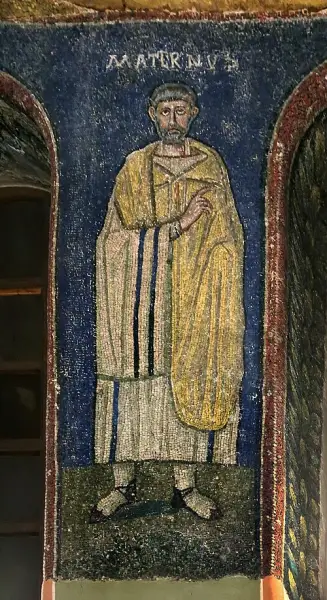
Maternus belongs to the ranks of the pre-congregation saints, honoured by the Catholic Church from antiquity without any formal process, his cult resting on the continuous memory of the Church of Milan. The date of his death, 18 July, was set as his feast day, and it has been kept in his honour in the Ambrosian tradition ever since. He is venerated as a saint in the Catholic Church and stands in the ancient episcopal list of Milan between Mirocles, who held the see from about 313, and Protasius, his successor from about 328 — the lineage that runs down through Eustorgius and Dionysius to Ambrose himself. A fifth-century mosaic portrait of Maternus, preserved in the Sacello of San Vittore in Ciel d'Oro inside the Basilica of Sant'Ambrogio, is among the oldest images of any bishop of Milan and shows that his memory was already being honoured with public art within a century of his death. Scholars of the Ambrosian church, from the Monks of Ramsgate's Book of Saints to the Dizionario della Chiesa Ambrosiana, continue to record his name among the founders of Milanese Christianity.
§ Life
Timeline
- 303
Nabor and Felix, whose remains Maternus would later discover and translate, were martyred at Lodi Vecchio under Emperor Diocletian.
§ Life
- 313
Construction began on the Basilica vetus, the first cathedral of Milan, which Maternus would later complete.
§ Life
- 316
Elected bishop of Milan by acclamation, with clergy and people insisting on having him as their Pastor.
§ Life
- 18 Jul 328
Died in Milan after a reign of about twelve years; the date later became his feast day.
§ Life
- 1258
The Basilica Naboriana, where his body lay buried, was enlarged and dedicated to Saint Francis of Assisi.
§ Life
- 14 Apr 1798
Just before the old Naboriana church was torn down, his remains were carried to Sant'Ambrogio.
§ Life
The Record
- Major works
- Basilica Naboriana in Milan·Completion of the Basilica vetus, Milan's first cathedral·Chapel of San Vittore in Ciel d'Oro
- Symbols
- 5th-century mosaic portrait in the Sacello of San Vittore in Ciel d'Oro
- Canonization
- Pre-congregation; honoured as a saint of the Catholic Church from antiquity.
Prayer
Bibliography
Show 5 sources
- Ruggeri, Fausto (1991). I Vescovi di Milano. Milano: NED. p. 9. ISBN 88-7023-154-2. (in Italian)
- Cazzani, Eugenio (1996). Vescovi e arcivescovi di Milano. Milano: Massimo. p. 15. ISBN 88-7030-891-X. (in Italian)
- Pasini, Cesare (1990). "Materno di Milano, santo (sec. IV)". Dizionario della Chiesa Ambrosiana. Vol. 4. Milano: NED. pp. 2112–2114. ISBN 88-7023-102-X. (in Italian)
- Monks of Ramsgate. "Maternus". Book of Saints, 1921. CatholicSaints.Info. 7 December 2014.
- "Fidelis, martyr of Summus Lacus near Como". The Cult of Saints in Late Antiquity, University of Oxford.
Profile text adapted from the Wikipedia article, licensed CC BY-SA 4.0.
Pray with this saint every day
Save St. Maternus of Milan to your favorites, read the full profile, and get feast-day reminders in the Saints app.
Get the Saints AppFree on the App Store for iPhone and iPad