
c. 285 – 315·Feast September 14
St. Maternus of Cologne
First bishop of Cologne and Apostle of Alsace
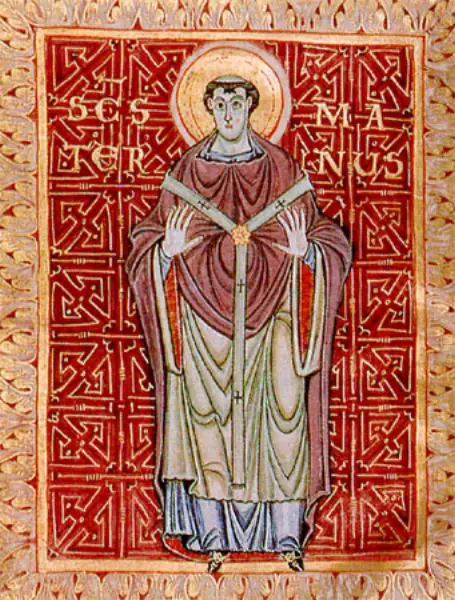
Overview
Maternus, also known as Maternus II, lived from about 285 until 14 September 315 and stands as the first known bishop of Cologne, reportedly the third bishop of Trier, and the founder of the diocese of Tongeren. He belongs to the first generation of northern Christianity for which firm documentation exists. Eusebius records that he was active during the Donatist controversy: in May 313 Emperor Constantine summoned him and other bishops to Rome to consult on the status of Caecilianus of Carthage, and in 314 he sat in the Synod of Arles. Before the Frankfurt silver inscription, a find dated to 230–270, came to light, nothing documented the Christian faith north of the Alps earlier than his appearance at the Roman synod. Scholars of the Bollandist school assign his episcopate to the fourth century, and tradition salutes him as Alsace's first apostle, the man who advanced the faith through that province and deep into western Germany. A rich ninth-century legend makes him the companion of Eucharius and Valerius, missionaries sent from Saint Peter himself, and credits him with building a church where a Roman temple had stood, on ground that Cologne Cathedral would one day occupy. He is venerated in both the Catholic and Eastern Orthodox churches, with his feast on 14 September.
The Complete Life
Sent from Peter's Own Hand
The legend that grew around Maternus, written down in the ninth century, gives him an origin in the apostolic age itself. Saint Eucharius, it says, was dispatched to Gaul as bishop by Saint Peter himself, with the deacon Valerius and Maternus the subdeacon at his side to proclaim the Gospel. Coming to the Rhine and to Ellelum in Alsace, Maternus died there. His two companions hurried back to Peter and pleaded for the dead man's restoration to life. The apostle handed his pastoral staff to Eucharius; touched with it, Maternus, who had lain in his grave forty days, returned to life. The Gentiles were then converted in great numbers, and after founding many churches the three companions reached Trier, where the work of evangelization advanced so rapidly that Eucharius made the city his episcopal residence. Whatever one makes of the tale, it encodes a conviction: that the Christianity of the Rhineland was apostolic in origin, handed on through a living chain from Peter. For fifteen years Maternus served at Valerius's side, and on Valerius's death he took up the see of Trier, which he governed, by the legend's reckoning, for the next forty years.
§ Legend
Apostle of Alsace and First Bishop of Cologne
History gives Maternus a humbler but more certain title: he was the first known bishop of Cologne, and tradition adds that he founded the diocese of Tongeren in what is now Belgium. The Bollandists and other scholars date his episcopate to the fourth century, and he is honoured as Alsace's first apostle, the missionary whose preaching carried Christianity through that province and into the west of Germany. While still assisting Valerius at Trier, the legend says, he had already established the dioceses of Cologne and Tongeren, and he built a church over a former Roman temple, on ground where Cologne Cathedral now rises, so that the great Gothic church of the Rhine rests upon Maternus's first Christian building. Across the border in Walcourt, Belgium, the Basilica of Saint Maternus is said by legend to have been founded by him. By legend or by history, his missionary footprint stretched from the Moselle to the Meuse, and the popular cult that developed in Cologne shows how deeply the memory of the founding bishop took root among his people, even as a separate legend flourished in Trier.
§ Life
Defender of Communion
The historical Maternus appears in the record at a moment when the young Church of the empire was fighting for its own unity. According to Eusebius, he was active during the Donatist controversy, the bitter dispute over whether bishops who had lapsed in the persecution could validly govern and ordain. In May 313, Emperor Constantine summoned Maternus and other bishops to Rome to consult on the status of Caecilianus of Carthage, whose consecration the Donatists contested — an assembly remembered as the Synod of Rome, and the first act of state sponsorship in the settling of a Church dispute. The following year Maternus travelled again, taking part in the Synod of Arles in 314, which gathered bishops from across the West to condemn the Donatist schism. His presence at both gatherings marks him as a trusted voice of the northern episcopate, willing to make the long journey south for the sake of communion. The spirituality such a life implies is one of churchly loyalty: a shepherd who had perhaps known persecution in his youth, and who in the new age of peace put his authority at the service of unity rather than of local grievance.
§ Life
Death and Veneration
Maternus died on 14 September 315, according to the dates preserved in his tradition, and that day was afterwards fixed as his feast. He is venerated as a saint in both the Catholic Church and the Eastern Orthodox Church, one of the small company of fourth-century northern bishops whose memory survived the fall of the Roman frontier world. While a legend grew up in Trier around his name, tying him to the apostolic mission of Eucharius and the staff of Saint Peter, a popular cult developed independently in Cologne, where he was honoured as the first bishop of the see. This double devotion — a hagiographic legend in one city, a living cult in another — testifies to a saint claimed by the whole Rhineland. His name was carried into the standard collections of the saints, from the Book of Saints of the Monks of Ramsgate to the studies of the Bollandists, who took care to distinguish the historical bishop of the fourth century from the legendary companion of the apostles. Feast books of both East and West keep his memory on 14 September.
§ Life
The Oldest Witness of the Northern Church
For all the uncertainty that surrounds him, Maternus occupies a place of first importance in the history of northern European Christianity. His appearance at the Roman synod of 313 stood, until recently, as the oldest certain attestation of the Christian faith in the lands beyond the Alps, and only the Frankfurt silver inscription, a find of 230–270, carried that horizon slightly further back. The institutions he is remembered for founding endured: the see of Cologne grew into one of the great churches of Germany, Tongeren claims him as the founder of its diocese, and the church he established on a Roman temple site became, in time, Cologne Cathedral. In Walcourt his basilica remains a destination of pilgrimage. His story also shaped medieval church politics: the ninth-century legend was plainly meant to demonstrate Trier's apostolic antiquity, and with it the precedence the see claimed among the German dioceses. Even the relic of his revival, the pastoral staff of Saint Peter, had its own history, preserved in Cologne until the end of the tenth century, its upper half presented to Trier and finally taken to Prague by Emperor Charles IV.
§ Legend
Timeline
- 285
Born around this year, according to the traditional dating of his life.
§ Life
- 300
Traditional episcopal lists mark the beginning of his tenure as Bishop of Trier about this year, serving until 327.
§ Life
- May 313
Summoned to Rome by Emperor Constantine with other bishops to consult on the status of Bishop Caecilianus of Carthage.
§ Life
- 314
Took part in the Synod of Arles.
§ Life
- 14 Sep 315
Died on 14 September, the date later fixed as his feast day.
§ Life
The Record
- Major works
- Founding of the diocese of Tongeren·Establishment of the see of Cologne·Church on the site later occupied by Cologne Cathedral·Basilica of Saint Maternus at Walcourt, Belgium
- Symbols
- pastoral staff of Saint Peter
- Canonization
- Pre-congregation; venerated as a saint in the Catholic and Eastern Orthodox churches.
Prayer
Bibliography
Show 6 sources
- Lins, Joseph. "Cologne." The Catholic Encyclopedia Vol. 4. New York: Robert Appleton Company, 1908
- "St. Maternus, Bishop of Cologne", Kolner Dom
- Agasso, Domenico. "Saint Maternus of Cologne", Santi e Beati, September 3, 2001
- Monks of Ramsgate. "Maternus". Book of Saints, 1921. CatholicSaints.Info. 7 December 2014
- Meier, Gabriel. "St. Eucharius." The Catholic Encyclopedia Vol. 5. New York: Robert Appleton Company, 1909. 10 February 2019
- "Geschichte des Christentums neu schreiben?" [Rewrite the History of Christianity?]. evangelisch.de (in German). 11 December 2024. Retrieved 13 December 2024
Profile text adapted from the Wikipedia article, licensed CC BY-SA 4.0.
Pray with this saint every day
Save St. Maternus of Cologne to your favorites, read the full profile, and get feast-day reminders in the Saints app.
Get the Saints AppFree on the App Store for iPhone and iPad