
c. 892 – 968·Feast March 14
St. Matilda of Ringelheim
Queen of Germany and foundress of Quedlinburg
Overview
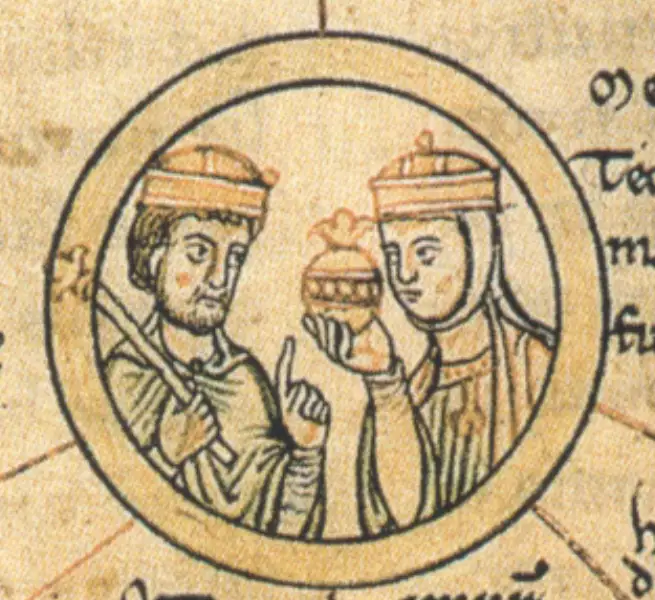
Matilda of Ringelheim, born around 892, was a Saxon noblewoman who became the first queen of Germany as the wife of Henry the Fowler, the first king of the Ottonian dynasty, and the mother of Otto the Great, who restored the Holy Roman Empire in 962. Raised by her grandmother at Herford Abbey, she married Henry in 909 while he was duke of Saxony and bore him five children, among them Otto, Henry duke of Bavaria, and Bruno, archbishop of Cologne. In 929 Henry endowed her with a dower of lands across Saxony in his Hausordnung, wealth she would later turn to the service of the Church. As queen she was noted for piety, a strong sense of justice, and open-handed charity, and she took a particular interest in women's monasteries. After Henry's death in 936 she founded the convent of Quedlinburg at his burial place, then Enger in 947 and Nordhausen in 961. Her handling of her dower brought her into a bitter dispute with her son Otto, from which Queen Eadgyth at last brought reconciliation. Matilda passed away at Quedlinburg on 14 March 968, worn out by long sickness, and was raised to the altars soon afterward; her two hagiographical biographies remain the authoritative account of her life.
The Complete Life
A Daughter of the Saxon Nobility
Matilda was born around 892 at Enger in Saxony, into the highest reaches of the Saxon aristocracy. Her father was Dietrich, a count of the Duchy of Saxony, and her mother was Reinhild; through Dietrich the family traced its line back to Widukind, the Saxon duke who had fought against Charlemagne in the wars that ended in Saxony's conversion two generations before her birth. Her childhood was passed not in her parents' house but at Herford Abbey in the Duchy of Saxony, where her grandmother, herself named Matilda, raised her — an upbringing within the walls of a religious community that left its mark on a life afterwards devoted to monastic foundations. She grew up among four siblings: three sisters, Amalrada, Bia and Fridarun, and a brother, Beuve, who in time became Beuve II, Bishop of Châlons-sur-Marne. Her sister Fridarun married Charles the Simple, king of West Francia, and a niece named Fridarun married Count Wichmann the Elder, drawing the House of Billung into alliance with the Ottonian family and extending its possessions westward. Matilda was thus born into a web of kinship reaching across the divided kingdoms of the Franks, and her marriage would bind Saxony's ancient nobility to its new royal house.
§ Early life and dynastic connections
Marriage to Henry the Fowler
In 909, when she was seventeen, Matilda was married to Henry, at that time duke of Saxony, the son of Duke Otto of Saxony and a man destined for the throne. For Henry the marriage came between two unions: his first marriage, to Hatheburg of Merseburg, a former nun, had been annulled because the Church judged that her vows had never been validly broken, though she had borne him a son, Thankmar, whose legitimacy the annulment cast into doubt. With Matilda the union proved both happy and fruitful in a quite extraordinary measure. She bore the king five children. Otto, born in 912, was crowned Holy Roman emperor in 962 and earned the name Otto the Great; Henry, born in 919 or 922, became duke of Bavaria in 948; Bruno, born in 925, received the archbishopric of Cologne in 953 and the duchy of Lorraine in 954; and two daughters, Hedwig and Gerberga, married into the ruling houses of the West Franks, Hedwig taking Hugh the Great and Gerberga, after Duke Gilbert of Lorraine, King Louis IV of France. Through them Matilda became the ancestress of the Ottonian line and grandmother of kings and emperors across Europe. When Henry was raised to the kingship of Germany, she stood beside him as the first queen of the new dynasty.
§ Children
Foundress of Convents
Matilda's enduring work was the founding of spiritual institutions, above all houses of religious women. In 929 Henry gave her a formal dower in the great Hausordnung, the family ordinance he issued: estates at Quedlinburg, Pöhlde, Nordhausen, Grona close to Göttingen, and Duderstadt. Such wealth, rare in the hands of a queen, became the material of her charity. When Henry died at Memleben in 936 and was buried in Quedlinburg, Matilda founded a convent there in the same year, at the site of his grave. She went to live in it herself during the years that followed, tending the family's legacy, and Quedlinburg Abbey rose to be the chief house of prayer in the realm and the memorial place of its renowned dead. Like other convents of the realm, it became a school for the daughters of noble families, some of whom remained as abbesses and secured their kin's influence; among them was Matilda's own granddaughter, daughter of Otto I and Adelheid of Burgundy, who in 966, after thirty years of the queen's leadership, received the convent's cares from her hands and became its first abbess. With her remaining resources Matilda founded the convent of Enger in 947, and in 961 her last foundation, the convent of Nordhausen.
§ Life as a widow
Piety, Justice, and Charity
The sources agree in the portrait they draw of Matilda's character: she was considered extremely pious, righteous, and charitable, and what she brought to her husband's rule, it is said, was her keen sense of what was just. Two hagiographical biographies of the queen were written after her death, and together with Widukind's Deeds of the Saxons they serve as the authoritative accounts of her life and work; in them her dedication to charity and to her ecclesiastical foundations is attested again and again. Hers was not the sanctity of the cloister but of the throne: prayer and generosity exercised from the place where power could do the most good. She endowed convents rather than her children's ambitions, sheltered the commemoration of the kingdom's dead, and saw to the education of noble daughters within religious houses. When the dispute with her son Otto was finally settled, the terms recorded are strikingly evangelical: Matilda was to surrender her wealth, and Otto in turn was to receive pardon for what he had done — pardon, not restitution, as the price of peace. In her last years, facing death, she spent her strength not on her own comfort but on obtaining papal privileges to protect every monastery of eastern Saxony.
§ Life as a widow
The Feud with Otto and a Peaceful Death
The last decades of Matilda's life were clouded by a struggle within her own family. From 936 until 946 her son Otto, the king, contested the way she administered her dower, laying claim to what belonged to her. The quarrel grew so bitter that Matilda fled into exile, and it was healed only through the intervention of Otto's wife, Queen Eadgyth, who is said to have brought about the reconciliation on remarkable terms: Matilda was to part with her wealth, and in return Otto was to be forgiven. The feud remains controversial among historians to this day. What is certain is how the old queen spent her final years: still guarding her foundations, and in the period leading up to her death in early 968 securing papal privileges for all the monasteries of eastern Saxony, a shield of protection she built for them even while her own legacy stood in danger. After her death the protection proved weaker than she had hoped, for her dower passed to Theophanu, the wife of her grandson Otto II, overriding the arrangements she had made. Her death came at Quedlinburg on 14 March 968, when the long sickness finally ran its course; her body was laid in the abbey church beside her husband, the king whose grave her convent kept.
§ Death
Saint and Queen
Matilda was canonized after 968, raised to the altars within living memory of her death, and her cult was fixed at Quedlinburg Abbey in Saxony-Anhalt, which remains her major shrine. She is venerated in both the Roman Catholic Church and the Eastern Orthodox Church, and her feast is kept on 14 March, the day of her death. The speed and durability of her veneration owed much to the two hagiographical biographies composed after her passing, works that presented the queen's piety, justice, and tireless foundation of convents as a model of royal sanctity, and that remain the authoritative sources for her life. Among the saints of the Ottonian house she holds a special place, for unlike the empresses Adelaide and Cunigunde who came after her, her sanctity was formed not primarily in marriage to a ruling saint but in the long widowhood during which she built, endowed, and forgave. Her memory has been honoured in stone as well as in liturgy: a commemorative plaque bears her name in the Walhalla memorial near Regensburg, the national hall of fame of Germany, where she stands among the great figures of the nation's history.
§ Death
A Queen's Long Shadow
Matilda's legacy rests first of all on her descendants: from her marriage to Henry the Fowler came the Ottonian dynasty, whose greatest figure, her son Otto the Great, restored the Holy Roman Empire in 962 and set the shape of German history for centuries. But her more personal monument is Quedlinburg Abbey, which she founded at her husband's grave and lived in for the last third of her life. Under her granddaughter, its first abbess, it grew into one of the most consequential institutions of imperial Germany, a community of canonesses that educated the daughters of the nobility and stood at the centre of the kingdom's memory and prayer for generations. The convents of Enger and Nordhausen carried her founding hand into other corners of Saxony. The Church she served has kept her name alive: churches bear her name as patroness — St. Mathilde's at Laatzen and its twin at Quedlinburg, together with the Melkite church at Aleppo in Syria — as does the Mathilden-Hospital at Herford, not far from the abbey where she was raised. Historians continue to study her through her two medieval biographies and the Deeds of the Saxons, and the controversy over her feud with Otto keeps her, even now, a figure very much alive in the record of the tenth century.
§ Legacy
Timeline
- 892
Born at Enger in Saxony, daughter of Dietrich and Reinhild and descendant of the Saxon duke Widukind.
§ Early life and dynastic connections
- 909
Married Henry, duke of Saxony, at the age of seventeen.
§ Marriage to Henry I
- 912
Gave birth to her eldest son Otto, the future emperor.
§ Children
- 929
Received her dower from Henry in the Hausordnung: lands at Quedlinburg, Pöhlde, Nordhausen, Grona and Duderstadt.
§ Marriage to Henry I
- 936
Henry died at Memleben and was buried at Quedlinburg, where Matilda founded a convent that same year.
§ Life as a widow
- 946
The dispute with her son Otto over her dower, which had driven her into exile, was ended through the reconciliation brought about by Queen Eadgyth.
§ Life as a widow
- 947
Founded the convent of Enger with her resources.
§ Life as a widow
- 961
Founded her last convent, at Nordhausen.
§ Life as a widow
- 966
Passed leadership of the convent of Quedlinburg to her granddaughter Matilda after thirty years' guidance, making her its first abbess.
§ Life as a widow
- 968
Acquired papal privileges for all the monasteries of eastern Saxony to protect her legacy shortly before her death.
§ Life as a widow
- 14 Mar 968
Died at the convent of Quedlinburg after a long illness and was buried in Quedlinburg Abbey beside Henry.
§ Death
The Record
- Major works
- Convent of Quedlinburg (936)·Convent of Enger (947)·Convent of Nordhausen (961)
- Patron of
- St. Mathilde church, Laatzen·St. Mathilde church, Quedlinburg·Melkite church, Aleppo·Mathilden-Hospital, Herford
- Canonization
- Canonized after 968; venerated in the Roman Catholic and Eastern Orthodox churches.
Prayer
Bibliography
Show 5 sources
- Althoff, Gerd (2018). Königin Mathilde († 968): Ihr Leben als Braut, Ehefrau, Witwe und ihre eigenartigen Lebensbeschreibungen. Beiträge zur Stadtgeschichte. Vol. 11. Bielefeld: Verlag für Regionalgeschichte. ISBN 9783739510811. (in German)
- Althoff, Gerd (1990). "Mathilde". Neue Deutsche Biographie. Vol. 16. Berlin: Duncker & Humblot. p. 371. (in German)
- Schütte, Bernd (1994). Untersuchungen zu den Lebensbeschreibungen der Königin Mathilde. Monumenta Germaniae Historica. Vol. 9. Hannover: Hahnsche Buchhandlung. ISBN 9783775254090. (in German)
- Ehlers, Joachim (1998). "Heinrich I. in Quedlinburg". In Althoff, Gerd; Schubert, Ernst (eds.). Herrschaftsrepräsentation im ottonischen Sachsen. Thorbecke Verlag der Schwabenverlag AG. ISBN 9783799566469.
- Gilsdorf, Sean (2004). Queenship and Sanctity: The Lives of Mathilda and The Epitaph of Adelheid. Washington, D.C.
Profile text adapted from the Wikipedia article, licensed CC BY-SA 4.0.
Pray with this saint every day
Save St. Matilda of Ringelheim to your favorites, read the full profile, and get feast-day reminders in the Saints app.
Get the Saints AppFree on the App Store for iPhone and iPad