
1881 – 1952·Feast May 2
St. Matrona Nikonova
Blind Elder and Wonderworker of Moscow
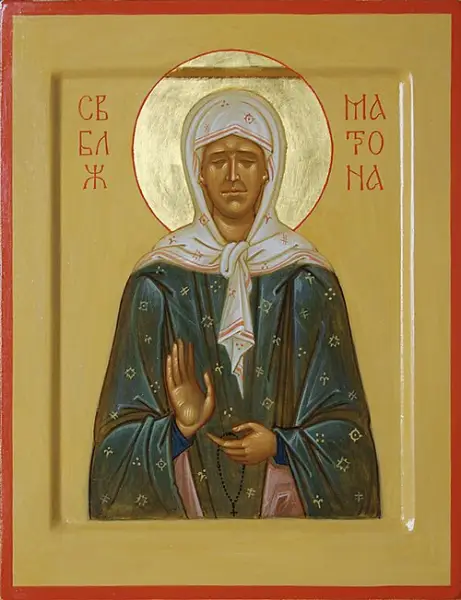
Overview
Matrona Dimitrievna Nikonova, honored as the Blessed Elder of Moscow, was born in 1881 in the village of Sebino in Tula Province to Dimitry Ioannovich and Natalia Nikitichna Nikonov, the fourth of their children. She came into the world blind, with eyelids closed over empty sockets, and bearing a cross-shaped birthmark on her chest, signs her mother accepted as a heavenly calling after a dream of a white bird of divine beauty. From childhood she displayed gifts of prophecy, spiritual vision and healing, and villagers brought her their troubles while she was still a girl. The Revolution of 1917 left her a homeless peasant wanderer; by 1925 she had settled in Moscow, moving between the homes, apartments and basements of friends and sympathizers. Though she openly preached the Orthodox faith while her two brothers served the Communist party, and though others were being exiled to the Gulag, no one ever betrayed where she lived. Pilgrims sought her counsel to the end of her life. She foretold her own death three days beforehand, died on May 2, 1952, at Khimki near Moscow, and was canonized by the Russian Orthodox Church in 1999.
The Complete Life
Born Blind in Sebino
Matrona was born in the village of Sebino in Tula Province, the fourth child of Dimitry Ioannovich and Natalia Nikitichna Nikonov, peasants whose circumstances were so straitened that they at first planned to place the infant in an orphanage. Her mother was turned from that intention by a dream in which a white bird of divine beauty, its eye sockets empty, settled on her breast. The child born to them was wholly blind, her eyelids closed over empty sockets, and on her chest lay a cross-shaped raised birthmark that her mother read as a seal from heaven. Forty days after her birth she was carried to the village church for baptism, and the account preserves a sign said to have accompanied the sacrament: a pillar of fragrant, thin smoke rose above the font, witnessed by all present. Even as an infant she showed unusual marks of piety, sleeping through Wednesdays and Fridays so as to fast from milk on those days, and as a toddler crawling to the icon corner to handle the images and speak to them. The village, and soon the surrounding district, learned that the blind child could see what others could not.
§ Early life
The Gift of Prophecy and Healing
By the age of eight, according to the tradition preserved about her, Matrona had openly revealed prophetic and healing powers. What this meant in practice was a childhood spent receiving visitors: neighbors and strangers alike came to the Nikonov household to ask the blind girl about lost cattle, coming travels, sickness and sorrow, and the answers she gave passed from mouth to mouth as proofs of an unusual grace. Her blindness, which might have made her a burden in a poor peasant family, became instead the sign under which her vocation was understood; those who knew her held that God had taken her bodily sight to give her another kind of seeing. She never married, never founded a community, and left no writings. Her vocation was simply to be present and available, a holy elder in the Russian style, receiving all who came and interceding for them. The famous story of her prediction that the plain Evdokia would marry a handsome nobleman, and of its improbable fulfillment through a nobleman's dream, belongs to this early period and was recorded by her biographer Zinaida Zhdanova, who preserved these memories for the Church.
§ Early life
Wanderer in Revolutionary Moscow
The Revolution of 1917 swept away the world of the village, and Matrona and her friend Lydia Yankova joined the displaced poor, leaving Sebino to find work and food in the larger cities. By 1925 she had come to Moscow, perhaps following her two brothers, and began the drifting existence that filled the rest of her life: shelter with friends and relatives, in houses, in apartments, in basements, never her own place for long. Her brothers, both Communists, could not keep her, because she would not silence the Orthodox faith she preached. These were the years when believers were being sent to the Gulag or into exile for less, yet no one ever betrayed her whereabouts, a silence her admirers regard as itself a protection of heaven. She helped all who came. To a college architecture student struggling with a required paper she described in detail the great buildings of Florence and Rome, including the Palazzo Pitti, cities she had never seen. People continued to bring her their troubles, and she received them, a blind old woman in a borrowed room who had become, without institution or title, one of the holy figures of Moscow.
§ Revolution
A Foretold Death
Matrona knew the date of her own death. Three days before it came, she said so, and spent those last days accepting visitors as usual, settling affairs of the soul while her body failed. She died on May 2, 1952, at Khimki in Moscow Oblast, seventy years old, most of them passed in blindness and the last thirty-five in revolution and persecution. Her funeral and burial began at once a cult of remembrance. Her gravesite became a place of pilgrimage so constant that the lines of the waiting are reported as regularly stretching to three or four hours for a short visit, yet described as orderly and well-behaved. The faithful came, and come still, as they came to her basement rooms in Moscow: with sickness, with confusion, with grief, asking the prayers of a woman who had spent a lifetime interceding for strangers. Her remains now rest in the Church of the Protecting Veil of Our Lady at the Intercession Convent in the Taganka district of Moscow, where the queue of pilgrims continues, and where her feast is kept each year on May 2, the day of her falling asleep.
§ Later life
Canonization and Continuing Veneration
In 1999 the Russian Orthodox Church formally canonized Matrona Nikonova, enrolling among the saints the blind elder whom the people of Moscow had long already treated as one. The recognition came four and a half decades after her death, in the years when the Church, newly free of Soviet constraint, was recovering the memory of its twentieth-century confessors, and Matrona stood among the most beloved of them, a laywoman with no rank or title whose sanctity consisted wholly of prayer, counsel and endurance. Her veneration has since crossed jurisdictional borders. On February 15 of 2018, the Holy Synod of the Romanian Patriarchate voted to inscribe the Blessed Matrona of Moscow upon the calendar of saints of the Romanian Orthodox Church, and with the blessing of the Serbian Orthodox Church, a monastery honoring her is under construction in Republika Srpska. Her life story was made available to a wider readership through Zinaida Zhdanova's account, first published in 1993, which preserves the stories of prediction and healing on which her cult rests. She is commemorated on May 2, and icons of the Blessed Elder of Moscow now hang in churches from the Tula countryside to the Balkans.
§ Veneration
Timeline
- 1881
Born blind in the village of Sebino, Tula Governorate, the fourth child of the Nikonov family.
§ Early life
- 1917
After the Russian Revolution she and her friend Lydia Yankova left their village to seek work and food in the cities.
§ Revolution
- 1925
Moved to Moscow and began a wandering life, moving between borrowed rooms — the homes, flats and cellars of those who would take her in.
§ Revolution
- 2 May 1952
Died at Khimki in Moscow Oblast at the age of seventy, having predicted her death three days in advance.
§ Later life
- 1999
Canonized by the Russian Orthodox Church.
§ Veneration
- 15 Feb 2018
The Holy Synod of the Romanian Patriarchate added her to the Calendar of the Romanian Orthodox Church.
§ Veneration
The Record
- Patron of
- those seeking counsel in persecution·the blind
- Canonization
- Canonized in 1999 by the Russian Orthodox Church
Prayer
Bibliography
Show 6 sources
- "Блаженная Матро́на Московская (Никонова)". azbyka.ru (in Russian). Retrieved 2021-05-29.
- "О святой Матроне Московской | Святая Матрона Московская". Retrieved Aug 21, 2019.
- Blessed Matrona, Pravmir Portal, May 2009, in Russian.
- "The life of the Blessed Matrona". www.pokrov-monastir.ru. Retrieved 27 November 2025.
- Blessed Matrona of Moscow Included in Romanian Orthodox Church Calendar. PRAVMIR.COM. 26 April 2018.
- Zhadanova, Zinaida. The Life Story of the Blessed Elder Matryona, 1993.
Profile text adapted from the Wikipedia article, licensed CC BY-SA 4.0.
Pray with this saint every day
Save St. Matrona Nikonova to your favorites, read the full profile, and get feast-day reminders in the Saints app.
Get the Saints AppFree on the App Store for iPhone and iPad