
died before 1455·Feast October 20
St. Matrona of Chios
Abbess and Benefactress of the Poor of Chios
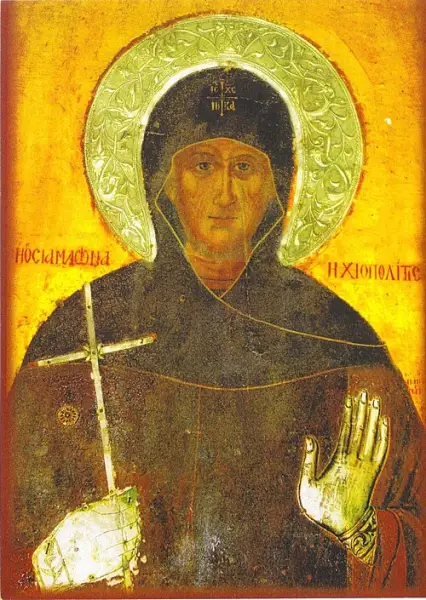
Overview
Matrona of Chios, honored as a venerable saint of the Eastern Orthodox Church, first saw the light in Volissos, a village on the island of Chios, arriving as the seventh and last child of Leon and Anna, respected and prosperous Christians. Baptized Mary, she turned toward the monastic life from her youth and refused the marriage her parents arranged. To escape it she withdrew to Katavasis, a spot above her village where a women's monastery stood, and though her family found her and brought her home, she held to her refusal until her parents consented to her calling. After their death she distributed most of her inheritance to the poor and devoted what was left to raising a monastery within the Palaiókastro quarter of Chios town, taking the name Matrona. Elected abbess after enlarging the church and raising cells for her growing community, she became renowned across the island for holiness, charity to the poor, and the healing of the sick. Forewarned in a dream of her own death, she fell ill for seven days, guiding her nuns like a mother, and died sometime before 1455. Her tomb became a source of reported cures.
The Complete Life
The Youngest of Seven in Volissos
The girl who would take the name Matrona was born in Volissos, a village in the northwest of the island of Chios, the village, moreover, that had already given the church its martyr Markella, put to death in 1462. The record places her birth in the fourteenth century, within the long era in which the Aegean islands passed among Latin and Byzantine rulers. Her parents, Leon and Anna, were Christians of standing and means, and Mary, as she was first called, grew up the youngest of their seven children in a household where the faith was kept with respect and substance. From her earliest years she showed an inclination not toward the married life that awaited the daughters of such families but toward monasticism, a turning of heart unusual in one so young and so comfortably situated. When her parents reached the age at which they would arrange her marriage, she refused. Virginity, not wifehood, was the desire of her life, and she was prepared to defy convention, and her family's plans, to keep it. The refusal set the course of everything that followed, and the village of her birth still remembers her alongside the martyr Markella as one of its own.
§ Life
Flight to Katavasis and a Family's Consent
To escape the marriage her parents had planned, Mary left Volissos and withdrew to a place overlooking the village called Katavasis, where a women's monastery stood. There she intended to disappear into the common life. Her family searched everywhere until they located her, and then, by persuasion rather than force, convinced her to return home. She complied, and the record notes the shape of her obedience: she yielded to her parents' wishes in everything except one, for she refused absolutely to wed. Her mother and father, seeing that her desire for the monastic life was not a childish whim but a settled purpose, at last gave their consent. The episode is a small study in the negotiation between family and vocation in late Byzantine society: a daughter with no independent claim against an arranged marriage could still, by patience and refusal, win her parents over to God's claim on her. Mary returned to Katavasis and the monastic path. Only later, when her parents had died and she stood free to dispose of the family's substance, did the vocation they had finally blessed come to its full flower.
§ Life
Foundress and Abbess
When death released Mary from her parents' authority, she distributed the greater share of her inheritance among the poor and applied what was left to founding a monastery in Chios town, in the quarter called Palaiókastro. At this point her name was changed to Matrona, marking her entrance into the life she had chosen. Within the community she surpassed the other nuns in devotion, spirituality and understanding, and her sincerity drew other girls to join the same manner of life. The church of the monastery was small, and the abbess agreed to Matrona's plan to enlarge it and build cells for the sisters. To fund the work Matrona sold the remaining farmland and her personal belongings, and with the proceeds the monastery constructed a public bath, where the poor and travelers might wash — a form of charity widespread in that age. The church was rebuilt aided, as the account says, by St. Artemios, whose name the finished church took, and on its completion the abbess died. The nuns elected Matrona in her place. As abbess she was revered throughout Chios for a virtuous and holy life, showing charity to the poor and, the record attests, healing the sick.
§ Life
The Foretold Death of the Abbess
The end of Matrona's life came, like so much else in her story, through a dream: she saw her own death beforehand. When it arrived she was afflicted with an illness that lasted seven days, and through the whole of that week she did for her nuns what a dying mother does for her children, advising them, ordering the life of the community, and preparing them for her absence. She died sometime before 1455, and her body was laid to rest in the monastery's own church, the walls that had held the largest share of her days. From her tomb, the tradition holds, miracles began to occur in honor of the great saint, and crowds of the afflicted sought out that church and went away cured. At Katavasis, the village of her first ascetic beginnings, a church was later raised to mark the spot, and later a larger church was built beside it while the original served as a cemetery chapel. Thus the two landscapes of her life, the village of her flight and the town of her abbacy, both kept her memory in stone.
§ Life
The Monastery of 1470 and Her Feasts
Matrona's memory took living form in a foundation that postdates her by a generation. In 1470 the noble Roidis built the Holy Monastery of St. Matrona near the village of Mesa Didima. He had originally intended a summer villa, but the saint, as the story goes, stood by him while he slept and bade him raise a monastery there instead. His sisters became the first two nuns to enter it. During the Turkish Occupation the monastery's abbot was the holy Nikephoros of Chios, who composed the twenty-four Hymns of Agia Matrona in her honor, and four nuns dwell there today. The community keeps her feast each year on October 20, the day the whole Church of Chios celebrates her memory, while July 15 marks a second feast, the finding of the head of St. Matrona, one of those recoveries of sacred remains that islands treasure. A church at Katavasis honors the place of her first ascetic struggles. Few saints of the Aegean leave so continuous a trace: foundress, abbess, benefactress of the poor, healer, and after death an abba in absentia who could still redirect a nobleman's ambitions from villa to monastery.
§ Monastery of St. Matrona
Timeline
- 1455
Died sometime before this year after a seven-day illness foretold in a dream, and was buried in the church of her monastery.
§ Life
- 1470
The noble Roidis, directed by an appearance of the saint in a dream, built the Holy Monastery of St. Matrona near Mesa Didima.
§ Monastery of St. Matrona
The Record
- Major works
- Monastery founded by Matrona in the Palaiókastro quarter of the town of Chios·public bath for the poor and wayfarers
- Patron of
- Chios·those resisting arranged marriage
- Canonization
- Pre-congregation veneration in the Eastern Orthodox Church
Prayer
Bibliography
Show 5 sources
- "Venerable Matrona of Chios". Orthodox Church in America.
- Koukouni, Ioanna. Chios dicta est... et in Aegæo sita mari: Historical Archaeology and Heraldry on Chios. Archaeopress Publishing Ltd, 2021, p. 50. ISBN 9781789697476.
- Melichar, Petra. "Adolescent Behavior in Byzantine Sources", Coming of Age in Byzantium (Despoina Ariantzi, ed.). Walter de Gruyter GmbH & Co KG, 2017, p. 106. ISBN 9783110576498.
- Argenti, Philip P., The Folk-lore of Chios. CUP Archive, 1949, p. 179.
- "St. Matrona of Chios". Antiochian Orthodox Christian Church of North America.
Profile text adapted from the Wikipedia article, licensed CC BY-SA 4.0.
Pray with this saint every day
Save St. Matrona of Chios to your favorites, read the full profile, and get feast-day reminders in the Saints app.
Get the Saints AppFree on the App Store for iPhone and iPad