
c. 424 – c. 524·Feast November 9
St. Matrona of Perge
Cross-Dressed Ascetic and Abbess of Emesa
Overview
Matrona of Perge was a Byzantine saint of the fifth and sixth centuries, born around 424 in Perge in Asia Minor. Faithful and given to almsgiving, she became the wife of Domitianus and bore a daughter, Theodote, but the marriage became an obstacle to the ascetic life she desired. She persuaded her husband to move to Constantinople, where she frequented the churches and night vigils; his jealousy grew until he accused her of prostitution, and she left home, entrusting her daughter to her friend Susanna. Fearing discovery, she cut her hair, put on men's clothing, and entered the monastery of St. Bassianus as a supposed eunuch named Babylos, working in the garden for some three years until the abbot detected the ruse. To escape her searching husband she became abbess of a women's monastery in Emesa, famed for miraculous healing, though he hounded her through Jerusalem, Syria and Beirut; in that last city she lodged within a deserted heathen sanctuary and lived there the ascetic life. Bassianus at last founded a monastery for her community in Constantinople, clothing the nuns in men's belts and mantles. An opponent of the Monophysite policy of Emperor Anastasios I, she died at about one hundred years of age, around 524.
The Complete Life
A Wife of Perge in Constantinople
Matrona was born at Perge, a city of Asia Minor, around the year 424, into a world where the great christological controversies of the age were already stirring. She grew up pious and charitable, but her life did not at first take the shape she would have chosen: she was married to a man named Domitianus, and bore him one daughter, whom they named Theodote. The record presents the marriage as an obstacle rather than a partnership in holiness. Matrona persuaded her husband to move to Constantinople, the capital, where she would be able to visit the churches, and it was in the city's liturgical life that her true calling declared itself. She attended the night vigils with a devotion that her husband read as disorder rather than grace. Jealous and suspicious, Domitianus accused her of being a prostitute, an accusation that destroyed whatever trust remained between them. For a woman of the fifth century, a marriage that barred the churches and impugned her character left only one honorable path: flight. Matrona took it, arranging her daughter's future with care before she went, and stepped out of the wife's role into one no one had imagined for her.
§ Life
Babylos the Gardener
Leaving her home, Matrona placed Theodote in the care of an acquaintance named Susanna and then took the precautions that made her story famous. Dreading her husband's pursuit, she cropped her hair and put on male attire, then sought entry to the monastery of St. Bassianus in the guise of a eunuch called Babylos. The brothers took her in unawares, and she joined their number, assigned to labor in the garden. For roughly three years the disguise held: a woman among men, known by a borrowed name, laboring in the vegetables and silence of a Constantinopolitan monastery while her abandoned husband searched the city. The choice echoes the celebrated transvestite ascetics of early Byzantium, women who took male habit to secure the solitude and anonymity that the ascetic life required. In the garden of Bassianus, Matrona found what her marriage had denied her: a life ordered to prayer. The ruse ended only when the abbot himself came to perceive it, after about three years. Even then the discovery did not return her to Domitianus; it began instead a long negotiation between the saint, the abbot, and the husband who would not relinquish his claim.
§ Life
Abbess of Emesa and Fugitive Ascetic
Discovered at the monastery of St. Bassianus, Matrona returned for a time to Susanna's keeping; but her husband continued the search, and Bassianus proposed a farther refuge: a women's monastery in Emesa, where Matrona went and in course of time became abbess. There her reputation flowered. She became famous for a miraculous gift of healing, and pilgrims sought the woman who had entered Asia Minor's monastic memory as a disguised gardener. Peace, however, did not last. Domitianus found her again and followed her from place to place, to Jerusalem, to Syria, to Beirut, while she in turn moved on, settling finally in Beirut, where her asceticism took shelter in an old heathen sanctuary — Christian prayer occupying a forsaken shrine. When Bassianus learned where she was, he resolved to end her wandering: he established a small monastery for Matrona and her companions not far from his own. To the community under her leadership he granted a privilege the record preserves with care: no woolen girdles nor the veils customary for women, but the broad black leather belts and white mantles of men, which the sisters wore without ceasing, a visible sign of the strange, sanctioned in-betweenness of their mother's vocation.
§ Life
A Century of Life, a Contested Memory
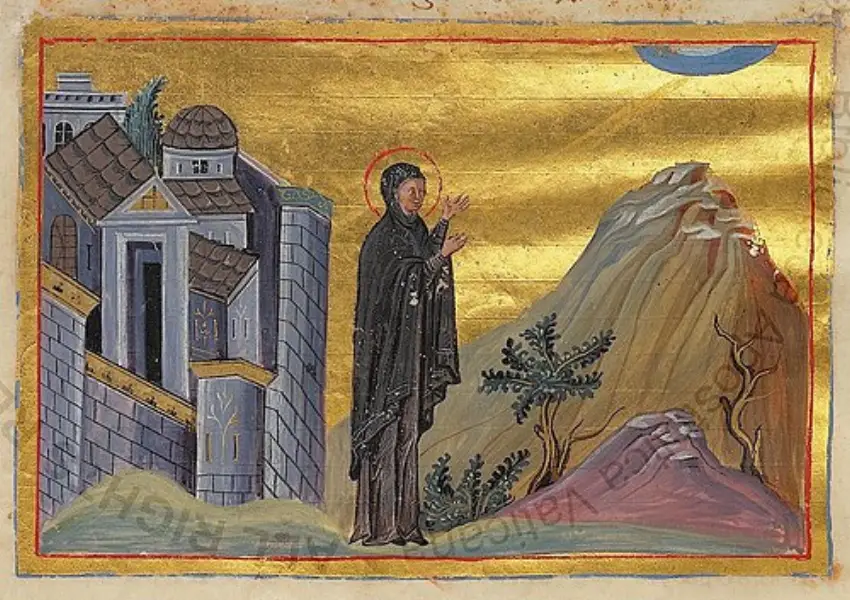
The vita relates that Matrona died at the age of one hundred, around the year 524, having lived through the reign of Anastasios I, whose Monophysite policy she is remembered for opposing, a stance that placed her with the Chalcedonian faithful of the capital in a politically dangerous season. Her century of life, from Perge through Constantinople, Emesa, Jerusalem, Syria and Beirut, reads as a single sustained flight toward God, interrupted by the pursuits of a husband who figures in her story as the world's stubborn claim upon the consecrated. Her memory did not pass unchallenged. Her story has come down through a vita prima whose writer and date of composition are alike lost, and the Bollandist scholar Hippolyte Delehaye judged the text to be of dubious value, a caution that modern readers of her cult have inherited. Yet the Eastern Orthodox Church kept her feast on November 9, and her story, whatever the precise fabric of the narrative, preserves a real phenomenon of early Byzantine monasticism: women who crossed the gendered boundaries of the ascetic world. She is pictured in the Menologion of Basil II, the tenth-century imperial manuscript, among the saints of the tradition.
§ Life
The Saint of the Menologion
Matrona of Perge endures in the Church's memory chiefly through two monuments: the illustrated Menologion of Basil II, where her portrait stands among the saints of the Byzantine year, and the written Life whose difficulties scholars have weighed for over a century. Both testify that her cult was no village accident but a devotion carried in the highest registers of Byzantine culture. Her story has drawn modern attention as a document of gender and sanctity: a wife who became a garden laborer under a man's name, an abbess whose nuns wore men's belts by an abbot's deliberate grant, a mother who arranged her daughter's welfare before claiming her own freedom. She belongs to the company of holy transvestites, from Pelagia to Euphrosyne, whose legends asked what holiness might look like when a woman refused the roles available to her. The Church keeps her on November 9. Behind the disputed text stands a figure the tradition found worth keeping: an ascetic of Perge and Constantinople, famed for healing, unhoused by choice, who at the age of one hundred was remembered as having run her race to its very end.
§ Life
Timeline
- 424
Born at Perge in Asia Minor, and later married to Domitianus, with whom she had a daughter, Theodote.
§ Life
- 524
Died at about the age of one hundred, according to her vita, after a lifetime of ascetic flight and leadership.
§ Life
In Their Own Words
He did not give her woolen girdles and veils such as women were accustomed to wear, but men's wide black leather belts and men's white mantles. And these they wore continuously.
The Record
- Major works
- women's monastery founded for her community by St. Bassianus near Constantinople
- Patron of
- women in difficult marriages·ascetics
- Symbols
- men's monastic habit
- Canonization
- Pre-congregation veneration in the Eastern Orthodox Church
Prayer
Bibliography
Show 5 sources
- Talbot, Alice-Mary (1996). Holy Women of Byzantium: Ten Saints' Lives in English Translation. Washington: Dumbarton Oaks. p. 22. ISBN 9780884022411.
- The Life of St. Matrona of Perge, d. c. 510. Fordham University.
- Bennasser, Khalifa Abubakr (1984). Gender and Sanctity in Early Byzantine Monasticism: A Study of the Phenomenon of Female Ascetics in Male Monastic Habit with a Translation of the Life of St. Matrona. Rutgers The State University of New Jersey. p. 112.
- Byzantine Garden Culture, (Antony Robert Littlewood, Henry Maguire, Joachim Wolschke-Bulmahn, eds.) Dumbarton Oaks, 2002, p. 59. ISBN 9780884022800.
- The Cambridge History of Medieval Monasticism in the Latin West, (Alison I. Beach, Isabelle Cochelin, eds.) Cambridge University Press, 2020, p. 66. ISBN 9781108770637.
Profile text adapted from the Wikipedia article, licensed CC BY-SA 4.0.
Pray with this saint every day
Save St. Matrona of Perge to your favorites, read the full profile, and get feast-day reminders in the Saints app.
Get the Saints AppFree on the App Store for iPhone and iPad