
died c. 68·Feast September 21
St. Matthew the Apostle
Tax Collector Called to Be Evangelist and Martyr
Overview
Matthew the Apostle stood among the twelve men Jesus chose and sent out, and by widespread Christian tradition also one of the four Evangelists, the author of the Gospel of Matthew, first among the synoptic Gospels, which hands down in full the Sermon on the Mount with its Beatitudes. The New Testament introduces him as a tax collector at his customs booth in Capernaum of first-century Galilee, when the call of Jesus reached him; the parallel passages of Mark and Luke describe the same calling of Levi, the son of Alphaeus, and Eastern Orthodox tradition, noting that both men had a father named Alphaeus, regards Matthew and James the son of Alphaeus as brothers. After the ascension he remained with the disciples in Jerusalem, proclaiming Jesus as the promised Messiah. Church Fathers including Irenaeus and Clement of Alexandria relate that Matthew preached to the Jewish community of Judea before carrying the gospel to other lands, with nearly all ancient sources naming Ethiopia, probably meaning the region south of the Caspian. Catholic and Orthodox tradition alike holds that he died a martyr, around the year 68, in Ethiopia or Persia. His tomb lies in the crypt of Salerno Cathedral, and his western feast falls on September 21.
The Complete Life
The Tax Collector of Capernaum
Matthew's life as recorded begins at a customs post in Capernaum, the Galilean fishing town that became the center of Jesus's ministry. The Gospel bearing his name tells of a tax collector sitting at the receipt of custom, called by Jesus with the words that sent him after the Lord; Mark and Luke recount the same scene with the name Levi, son of Alphaeus, and the three accounts are so similar that the tradition has always read them together. Tax collectors in first-century Judea collected tolls for the occupying power and were regarded as collaborators and ritual outsiders, which makes the call both startling and characteristic: Jesus seated at table with publicans and sinners, and one of them becoming a fisher of men. The name Matthew, from the Hebrew Mattityahu, means 'Gift of YHWH', and appears in the listings of the Twelve in Mark, Luke and Acts without further identification of his background. Because Alphaeus is named as father to both Matthew — the Levi of the parallel accounts — and to James the son of Alphaeus, the Eastern Orthodox Church has held the two apostles to be brothers. The Babylonian Talmud, in Sanhedrin 43a, preserves among five disciples of 'Jeshu' the name 'Mattai', an independent echo of his memory.
§ In the New Testament
Apostle of the Upper Room
As a disciple Matthew followed Jesus through the Galilean ministry, and after the ascension he is found with the rest of the Twelve, who withdrew to the upper room in Jerusalem, the chamber tradition identifies with the Cenacle, where they devoted themselves to prayer as recorded in Acts. From that room the apostolic church went out to proclaim that Jesus was the promised Messiah, and Matthew remained in and about Jerusalem with his fellow apostles in the first years of the mission. The witness of the sub-apostolic age is consistent about what followed: Irenaeus, writing in Against Heresies, and Clement of Alexandria both relate that Matthew proclaimed the good news first among the Jews of Judea and then carried it into other lands. His apostolate therefore took shape among his own people first, the tax gatherer become teacher of the nation he had been presumed to betray. Ancient writers did not agree about which foreign lands received him next, but almost all of them mention Ethiopia, a name ancient geography applied variously, more likely to the region south of the Caspian Sea, in ancient Persia, than to the African nation that now bears it. There, in that wider mission, his apostleship was consummated.
§ Ministry
Ethiopia, Ephigenia and the King's Fury
The fullest account of Matthew's martyrdom comes to the tradition through the Golden Legend. According to it, Matthew, preaching in Ethiopia, converted and then consecrated to God Ephigenia, the virgin daughter of King Egippus, enrolling her in the consecrated life. When King Hirtacus succeeded Egippus, he desired Ephigenia for himself and asked the apostle to persuade her to marriage. Matthew's answer was to bring the king to the liturgy on the following Sunday, and there to rebuke him to his face: the girl was a nun, and therefore the bride of Christ, not to be given to any earthly bridegroom. The enraged Hirtacus ordered his bodyguard to kill Matthew where he stood at the altar, and so the former tax collector of Capernaum died a martyr in the exercise of his priesthood, between the rebuke and the sanctuary. The tradition is univocal that Matthew died for the faith; the Catholic Church and the Orthodox Church each hold it, and the Babylonian Talmud seems itself to record how he was put to death. Muslim exegesis preserves a related memory, that Matthew and Andrew were the two disciples sent to preach the message of God in Ethiopia. In Christian art the scene of his calling, painted by Caravaggio for San Luigi dei Francesi in Rome, remains among the landmarks of Western painting.
§ Ministry
Pre-Congregation Saint of the Whole Church
Matthew was never canonized by process, for he belongs to the company of saints venerated from the church's earliest generations; his canonization is pre-congregational, resting on his apostleship and martyrdom rather than any decree. Veneration embraced him across every ancient communion: the Catholic Church, the Eastern Catholic Churches, Eastern Orthodoxy, Oriental Orthodoxy, the Church of the East, the Anglican Communion, Lutheranism, and even the Druze faith, which honors him as a prophet. The western Churches keep his feast on September 21, a date that coincides with the autumnal equinox, a conflation of solar points with feasts common in early Christianity; the Coptic Orthodox Church keeps October 22, and the Eastern Church November 16, besides the Synaxis of the Twelve Apostles on June 30. His remains rest in the crypt of the cathedral of Salerno, in the Italian south, where the relics of the evangelist draw pilgrims to this day. In the Roman basilica of St. John Lateran, Camillo Rusconi's statue of the saint stands among the apostles, and in the Basilica of the Annunciation in Nazareth a carved capital depicts his mission to the royal house of Ethiopia. Few apostles are so widely honored across the divisions of Christendom.
§ Veneration
The Gospel and the Winged Man
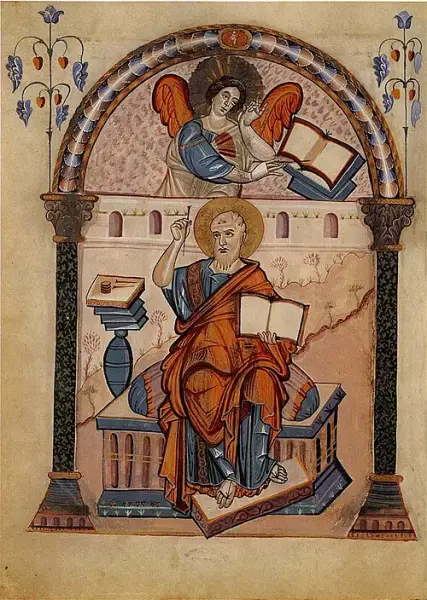
Matthew's chief legacy is the book that bears his name. The earliest Christian testimony assigns the Gospel of Matthew to the apostle himself, a claim first attested among extant writings by Papias of Hierapolis, cited by Eusebius: Matthew, he said, collected the oracles in the Hebrew language, each being interpreted as best he could, and Origen likewise indicates that the first gospel was composed by Matthew, in Hebrew near Jerusalem, for Hebrew Christians, a text once kept in the Library of Caesarea. Modern scholarship mostly regards the Gospel as written anonymously, with the superscription 'according to Matthew' added in the second century, though traditional authorship still has its defenders, and the gospel may incorporate a source from the disciple himself. Jewish-Christian gospels attributed to Matthew circulated among the Nazarenes and Ebionites into the third century, fragments of them surviving in Jerome and Epiphanius. In art Matthew is shown accompanied by one of the four living beings from Revelation — the winged man, his emblem among the evangelists; Rembrandt, Guido Reni and above all Caravaggio gave the tradition its most famous images. The Quran names no disciples but Muslim exegesis includes Matthew among them, and Druze doctrine numbers him among the five first-century messengers of wisdom, carriers of the gospel that faith esteems and praises.
§ The Gospel of Matthew
In Their Own Words
Matthew collected the oracles [logia: sayings of or about Jesus] in the Hebrew language, and each one interpreted them as best he could.
Matthew also issued a written Gospel among the Hebrews in their own dialect.
The Record
- Major works
- Gospel of Matthew (by traditional attribution)
- Patron of
- accountants·bankers·tax collectors·perfumers·civil servants·Salerno, Italy·Osorno, Chile
- Symbols
- angel·winged man
- Canonization
- Pre-Congregation
Prayer
Bibliography
Show 7 sources
- Easton, Matthew George (1897). "Matthew". Easton's Bible Dictionary (New and revised ed.). T. Nelson and Sons.
- Jacquier, Eugène (1911). "St. Matthew". In Herbermann, Charles (ed.). Catholic Encyclopedia. Vol. 10. New York: Robert Appleton Company.
- Swayd, Samy (2009). The A to Z of the Druzes. Rowman & Littlefield. p. 109. ISBN 978-0-81086836-6.
- Muddiman, John; Barton, John (2010). The Gospels. Oxford University Press. ISBN 978-0-19-958025-5.
- Edwards, James R. (2009). The Hebrew Gospel and the Development of the Synoptic Tradition. Wm. B. Eerdmans Publishing. ISBN 978-0-8028-6234-1.
- Schneemelcher, Wilhelm, ed. (2003). New Testament Apocrypha: Writings relating to the Apostles; Apocalypses and related subjects. Translated by Robert McLachlan Wilson. Westminster John Knox Press. ISBN 978-0-664-22722-7.
- Ehrman, Bart D. (23 September 1999). Jesus: Apocalyptic Prophet of the New Millennium. Oxford University Press. p. 45. ISBN 978-0-19-802888-8.
Profile text adapted from the Wikipedia article, licensed CC BY-SA 4.0.
Pray with this saint every day
Save St. Matthew the Apostle to your favorites, read the full profile, and get feast-day reminders in the Saints app.
Get the Saints AppFree on the App Store for iPhone and iPad