
died c. AD 80·Feast May 14
St. Matthias the Apostle
Apostle chosen by lot to replace Judas
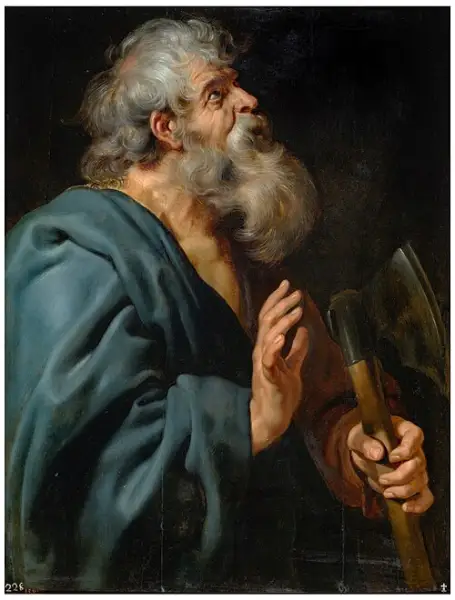
Overview
Matthias stands in the New Testament as the man called to fill the place Judas forfeited. The Acts of the Apostles relates that after the ascension Peter urged the gathered community of about one hundred and twenty to nominate two candidates who had accompanied Jesus from his baptism by John to the day he was taken up. Joseph called Barsabbas, surnamed Justus, and Matthias were put forward; the believers prayed for guidance, lots were cast, and Matthias was enrolled with the eleven. Nothing else about him appears in the canonical scriptures, and his very name wavered in early memory: one Syriac tradition called him Tolmai, Clement of Alexandria once spoke in terms that some read as identifying him with Zacchaeus, and the Clementine Recognitions equated him with Barnabas. Later centuries handed on conflicting accounts of his field of labour, setting him in Judaea, in Cappadocia, along the Caspian coasts, or in the region of Colchis, and of his end, whether martyrdom by stoning and the sword, crucifixion in Colchis, or a peaceful death in Jerusalem. Fragments of a lost Gospel of Matthias survive, and his relics were honoured at Rome, Padua, Trier, and Gonio in Georgia.
The Complete Life
A Companion Hidden in the Crowd
None of the four gospels lists a Matthias among the followers of Jesus, yet the account in Acts insists that he had been present from the very beginning of the public ministry, from the day the Lord was baptized in the Jordan until the morning he rose from the Mount of Olives. He belonged, therefore, to the wider company of disciples who had witnessed the preaching, the miracles, the passion, and the risen appearances, even if his name never surfaced in the narrative. After the ascension, with the eleven still shaken by the treason of Judas, Peter stood up among roughly one hundred and twenty believers and proposed that a successor be chosen. Two men qualified by those hidden years were presented: Barsabbas, surnamed Justus, and Matthias. The community prayed, asking the Lord who knows what is in every heart to declare which of the two he had set apart, and then they drew lots. The lot fell to Matthias, and he was reckoned with the eleven apostles. Early Christian writers never ceased to wonder at this election, and some attempted to attach to him better-known names: Tolmai in one Syriac text, Zacchaeus in a suggestion of Clement, Barnabas in the Clementine Recognitions, Nathanael in a modern conjecture.
§ Biography
Called After the Ascension
Matthias' calling differs from that of every other apostle, for he was not summoned personally by Jesus during the earthly ministry but selected by the infant Church acting under God's direction after the ascension. Peter framed the choice with scriptural seriousness, and the community committed the decision to prayer before casting lots, an ancient way of leaving the outcome to heaven. Clement of Alexandria later drew the lesson of the episode: the apostles were not picked for any conspicuous quality of nature, since Judas too had been among the chosen, but were made capable of their office by the one who foresees every end. Matthias, not chosen at the first round, proved himself worthy when the moment came and so took the traitor's place. In this the Church read a lasting encouragement, that fidelity sustained in obscurity can be raised suddenly to public service. What Matthias did with his apostleship in the following years the New Testament does not record; his story passes at once from scripture into the varied memory of the ancient Churches, each of which preserved its own account of where he preached and how he died.
§ Biography
To Cappadocia and the Caspian Shores
The traditions concerning the apostle's missionary field disagree, but all carry him far from Jerusalem. Greek memory had him announcing Christ through Cappadocia and along the coasts of the Caspian Sea, dwelling chiefly near the port of Hyssus on the Black Sea's southern shore. Nicephorus records that he preached first in Judaea and then in a distant Aethiopia, which in that usage meant the region of Colchis, on the eastern edge of the Black Sea in what is now the republic of Georgia, and that there he was crucified. A Coptic work, the Acts of Andrew and Matthias, situates his activity in the so-called city of the cannibals within that same Aethiopia, a romance of apostolic daring among savage peoples. The Synopsis of Dorotheus preserves a fuller itinerary, saying that he carried the gospel to barbarian and meat-eating nations in the interior, near the harbour of Hyssus at the mouth of the river Phasis, and that he died at Sebastopolis and was buried close to the temple of the Sun. A modern marker in the ruins of the Roman fortress of Gonio, or Apsaros, in the Georgian region of Adjara claims that the apostle's grave lies there.
§ Ministry and death
Stoned, Beheaded, or Crowned with Old Age
How Matthias died depends on which ancient voice one follows. A passion narrative recounts that he was hauled before a council of high elders as a deceiver for proclaiming Christ the Son of God; filled with the Holy Spirit, he argued so firmly that the crucified Jesus was indeed the Son of God that his judges fell into rage and condemned him to be stoned. He was driven outside the city while the stones flew, and a Roman soldier cut off his head while he lingered half alive. An older tradition, recorded by Tillemont from the sources of the first centuries, likewise holds that he was stoned at Jerusalem by the populace and then beheaded. Against both stands the testimony of Hippolytus of Rome, according to which the apostle died peacefully of old age in the holy city. Even his relics became entangled with another man's story, for the Bollandist Bollandus suspected that the remains honoured at Rome belonged not to the apostle but to a Matthias who governed the church of Jerusalem around the year 120, whose history had been confused with his. The contradictions were never resolved; they simply mark how widely his memory travelled.
§ Martyrdom
Relics, a Lost Gospel, and a Feast in Eastertide
Devotion to Matthias crystallised around his relics and his calendar day. It was said that the empress Helena carried his remains westward to Rome, while part came to rest at Trier on the Moselle, where an abbey still bears his name; part was also laid to rest in the abbey of Santa Giustina in Padua, while Greek sources locate the body in the castle of Gonio-Apsaros in Georgia. A Gospel circulated under his name in the second century, of which only fragments survive; the Fathers classed it among heretical writings, yet its very existence shows how strong the desire was to hear more from the apostle of the lot. His feast entered the Roman Calendar in the eleventh century, kept on 24 February, or the 25th in leap years. When the calendar was revised in 1969 the celebration was moved to 14 May, so that it might fall in Eastertide near the solemnity of the Ascension, the event after which Acts recounts his election. Anglicans, Lutherans, and Episcopalians keep him on one day or the other, and he is invoked against smallpox and for hope and perseverance, with an axe as his emblem.
§ Veneration
Timeline
- 80
Died; one tradition holds he was stoned and beheaded at Jerusalem, another that he was crucified in Colchis
§ Martyrdom
- 1969
His feast was transferred from 24 February to 14 May in the revised General Roman Calendar, placing it in Eastertide
§ Veneration
In Their Own Words
Thou, Lord, which knowest the hearts of all [men], shew whether of these two Thou hast chosen, that he may take part of this ministry and apostleship, from which Judas by transgression fell, that he might go to his own place.
Matthias, accordingly, who was not chosen along with them, on showing himself worthy of becoming an apostle, is substituted for Judas.
Matthias preached the Gospel to barbarians and meat-eaters in the interior of Ethiopia, where the sea harbor of Hyssus is, at the mouth of the river Phasis. He died at Sebastopolis, and was buried there, near the Temple of the Sun.
The Record
- Major works
- Gospel of Matthias (lost; only fragments survive)
- Patron of
- patron of alcoholics·patron of carpenters·patron of tailors·against smallpox·patron of hope·patron of perseverance·patron of Great Falls-Billings, Montana·patron of Trier
- Symbols
- axe·martyr's palm
- Canonization
- Pre-congregation; honoured as one of the Twelve from the apostolic age
Prayer
Bibliography
Show 5 sources
- Jacquier, Jacque Eugène. "St. Matthias." The Catholic Encyclopedia. Vol. 10. New York: Robert Appleton Company, 1911.
- Butler, Alban (1864). "Saint Matthias, Apostle". The Lives of the Fathers, Martyrs, and Other Principal Saints. D. & J. Sadlier & Company.
- Clarke, Hyde (1874). "On the Egyptian Colony and Language in the Caucasus, and its Anthropological Relations". The Journal of the Anthropological Institute of Great Britain and Ireland. 3: 178–200. doi:10.2307/2841305.
- "Calendarium Romanum" (Libreria Editrice Vaticana, 1969), p. 92; cf. p. 117
- Kakhidze, Emzar (2008). "Apsaros: A Roman Fort in Southwestern Georgia". In Bilde, Pia Guldager; Petersen, Jane Hjarl (eds.). Meetings of Cultures – Between Conflicts and Coexistence. Black Sea Studies. 8. Aarhus University Press. pp. 303–332.
Profile text adapted from the Wikipedia article, licensed CC BY-SA 4.0.
Pray with this saint every day
Save St. Matthias the Apostle to your favorites, read the full profile, and get feast-day reminders in the Saints app.
Get the Saints AppFree on the App Store for iPhone and iPad