
died c. 300·Feast November 1
St. Maturinus
Gallo-Roman exorcist who freed the possessed
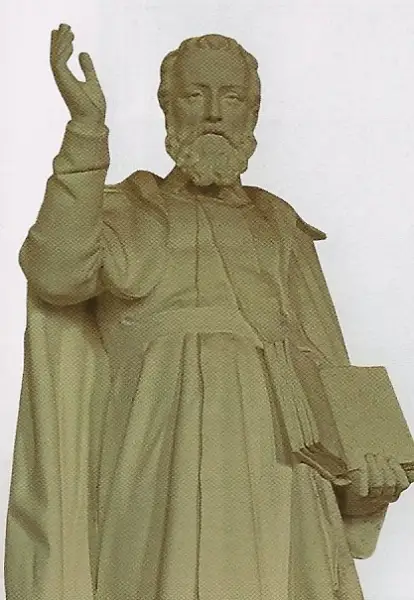
Overview
Maturinus, also called Mathurin, was a Gallo-Roman exorcist and missionary whose cult flourished in medieval France. The first written witness to him is the Martyrology of Usuard of 875, and a life was composed in the following century. According to his legend he was born at Liricantus, the modern Larchant in the Île-de-France, the son of pagan parents entrusted by the emperor Maximian with suppressing the Christians of the region. Secretly baptised at the age of twelve by Polycarp, the boy soon showed a strange gift: he worked miracles, expelled demons, and pacified the disorderly, and in time he won both his father and his mother to the faith. Ordained a priest at twenty, he administered the diocese during the bishop's absence in Rome. Fame carried him to the imperial capital itself, where Maximian summoned him to heal his stepdaughter Flavia Maximiana Theodora of a possessing spirit; the demon was driven out, and Maturinus remained three years in Rome, pleading with the emperor for the persecuted Christians. He died on 1 November and was buried in a Roman cemetery, but signalled his wish to rest at Larchant, whither his body was brought by way of Sens. His relics, kept at the basilica of Saint-Mathurin, were destroyed by the Huguenots.
The Complete Life
Born into a Persecutor's House
The story of Maturinus begins in a household set against the Church. He was born, his legend says, at Liricantus, the settlement now known as Larchant, and his father held from the emperor Maximian the grim commission of exterminating the Christians of the district. His parents, Marinus and Euphemia, were pagans, and by every expectation the boy should have grown up in his father's creed. Instead, when he was twelve years old he was baptised in secret by a priest named Polycarp, a detail the medieval biographer did not trouble to reconcile with chronology, since the bishop of that name belonged to the second-century Church of Asia. From his baptism flowed an extraordinary career of wonder. The child began to perform miracles, to cast out demons, and to quiet people in the grip of rage or tumult, gifts that made him conspicuous in a countryside livid with persecution. The most remarkable of his conquests was domestic: little by little he brought his own parents to Christ, so that the man charged with destroying the faith of others saw his son become the instrument of its arrival in his own home. The legend thus frames the whole of his life as an exchange of hostility for grace.
§ Life
Priest and Keeper of the Diocese
At the age of twenty Maturinus was ordained a priest, and his gifts, already famous, found an official field. When the local bishop travelled to Rome, the young priest took charge of the diocese in his absence, an unusual burden for a man so young and a sign of the confidence his holiness inspired. His reputation as an exorcist spread beyond his native region. The emperor Maximian himself, hearing of the wonder-worker in his own administrative orbit, summoned him to Rome because his stepdaughter Flavia Maximiana Theodora was possessed by an evil spirit. Before the court that had sponsored the persecution of the Church, Maturinus confronted the demon and expelled it, and the princess was freed. The victory changed the shape of his life: instead of returning to Gaul he stayed in Rome, where for about three years he used his standing with the emperor to intercede for the Christians then being hunted. The persecutor's commission once given to his father had come full circle, for now the son of that house stood daily in the palace pleading for the faith his family had been raised to crush.
§ Life
Death in Rome, Rest at Larchant
Maturinus died on the first of November, in Rome, after his years of advocacy at the imperial court. He was buried in a Roman cemetery, as visitors to the city ordinarily were, but the story of his last wishes refused such an ending. The saint, the legend relates, miraculously made known that he wanted to lie in the soil of his native Larchant, and his body was accordingly taken from Rome to Sens and then home to Liricantus. The translation made his grave a centre of pilgrimage and anchored his cult firmly in the French countryside rather than in the capital of the empire where he had died. There his remains were venerated for centuries in the basilica of Saint-Mathurin, until the wars of religion brought devastation: the relics were destroyed by the Huguenots. What survived was the network of devotion that had grown around his name, the churches of Larchant and of the Latin Quarter in Paris, and a calendar day, 1 November, kept by Latins and by Eastern Christians alike. The boy secretly baptised at twelve had become one of the most familiar saints of medieval France.
§ Life
Madness, Laughter, and the Mathurins
Because his life had been a war against unclean spirits, Maturinus became the saint to whom the mentally afflicted were carried, and he was invoked for centuries against madness and against infertility. From the same association came his strangest patronages: as the foe of derangement he was adopted by those whose profession was controlled folly, and comic actors, jesters, and clowns honoured him as their protector. Sailors in Brittany, tinmen in Paris, and plumbers also claimed him. His Paris church in the Latin Quarter acquired a learned connexion of its own, for the University of Paris stored the great seal of its medical faculty there in safekeeping. When the Trinitarian friars established themselves at Saint-Mathurin in Paris from 1228 onward, the order itself took his name and was popularly called the Mathurins. The basilica at Larchant, belonging to the chapter of Notre-Dame de Paris since 1005 and rebuilt from 1153, drew crowds of pilgrims, among them kings: Louis XI and Henry IV both visited. The shrine was famous enough that Chaucer's Harry Bailey could swear by the precious corpus Madrian, an echo that carries the saint's name into English literature.
§ Veneration
Timeline
- 1 Nov 300
Died in Rome on 1 November after about three years at the imperial court; buried in a Roman cemetery, his body later returned to Larchant
§ Life
- 875
First mentioned in writing in the Martyrology of Usuard
§ Introduction
- 1005
The Larchant church of the saint passed into the keeping of the cathedral chapter of Paris
§ Veneration
- 1153
Rebuilding of the basilica of Saint-Mathurin at Larchant began; the church grew into a popular pilgrimage site
§ Veneration
- 1228
The Trinitarian friars, installed at the Paris church of Saint-Mathurin, became known in France as Mathurins
§ Veneration
The Record
- Patron of
- patron of comic actors·patron of jesters·patron of clowns·patron of sailors in Brittany·patron of tinmen in Paris·patron of plumbers·invoked against mental illness·invoked against infertility
- Canonization
- Pre-congregation; venerated as a saint since at least the ninth century
Prayer
Bibliography
Show 6 sources
- "Mathurin (Maturinus)". November 1. Latin Saints of the Orthodox Patriarchate of Rome.
- "Saint Mathurin"
- "San Maturino"
- Butler, Alban; Burns, Paul. Butler's Lives of the Saints. Continuum International Publishing Group, 2000.
- J. Henriet, "Le Choeur de Saint-Mathurin de Larchant et Notre-Dame de Paris", Bulletin Monumentale 136 (1976: 289–307).
- Highsmith, Patricia (1980). The Boy who Followed Ripley. Lippincott & Crowell. pp. 94–5. ISBN 9780393332117.
Profile text adapted from the Wikipedia article, licensed CC BY-SA 4.0.
Pray with this saint every day
Save St. Maturinus to your favorites, read the full profile, and get feast-day reminders in the Saints app.
Get the Saints AppFree on the App Store for iPhone and iPad