
died c. 488·Feast April 25
St. Maughold
Penitent Irish captain who became Manx bishop
Overview
Maughold, whose name survives in a host of forms including Macaille, Maccaldus, Machalus, and Macc Cuill, died around 488 and is honoured as the chief patron of the Isle of Man. Tradition makes him an Irish prince and the captain of a band of freebooters whose life was overturned by his encounter with Saint Patrick. According to the legend, he tried to mock the missionary by placing a living man in a shroud and demanding that Patrick raise him; the man died instead, and Maughold's band was driven to repentance and baptism, after which the dead man was restored to life. As penance Patrick ordered the former raider to put to sea from Ireland in a currach without oars, abandoning himself to God. The sea carried him to the island, where Patrick's missionaries Romuil and Conindri had already planted the faith, and he withdrew to live as a hermit in a cave beneath the headland now called Maughold Head. The Manx people eventually chose him to succeed those missionaries as their bishop. He is remembered above all for his gentleness toward the islanders, and a parish, a holy well, and a ceremonial chair on the island bear his name.
The Complete Life
A Prince of Freebooters
Before he was a saint, Maughold was a terror of the Irish coasts. Tradition describes him as a prince and the captain of a company of freebooters, men who lived by plunder and answered to no law but their own. His original name is in fact uncertain; the many forms under which he is venerated, from Macaille and Maccaldus to Machalus, Machaoi, Machella, Maghor, and Macc Cuill, seem to have been adapted from that of Bishop MacCaille of Croghan in County Offaly, the cleric who received Brigit of Kildare into religious life. The legend that fixed his memory turns on a cruel joke. Wishing to make a fool of Patrick, Maughold had a living man wrapped in a shroud, then summoned the missionary and demanded that he raise the supposedly dead man. Patrick came, laid a hand on the shroud, and withdrew without a word. When the pranksters opened the cloth they found that the man had truly died in the interval. One of the band, a companion named Connor, went to Patrick's camp and apologised; the saint returned, baptised the assembled men, blessed the dead man, and saw him come back to life. Then he rebuked Maughold: the raider should have been teaching his men to lead good lives, and now he had an evil to make up for.
§ Legend
Adrift Without Oars
The penance Patrick imposed on the penitent captain was as dramatic as his crime. Maughold was ordered to abandon himself entirely to the Christian God by putting out from Ireland in a currach, the skin-covered boat of the western seas, without oars to steer or row. It was a sentence that could end only in drowning or in providence, and the legend intends exactly that choice. The wind and tide carried the boat across the water to the Isle of Man, where the Church had already taken root: two of Patrick's own disciples, Romulus and Conindrus, known in the native form as Romuil and Conindri, were established on the island. Maughold landed at its northeastern corner near Ramsey, at the foot of a great headland that has borne his name ever since as Maughold Head. There he did not seize authority but embraced obscurity, withdrawing to a hermit's cave on the mountain above the sea. The man who had commanded a band of raiders now commanded nothing but his own soul. In time the Manx Christians came to him, and by their choice he succeeded Romuil and Conindri as bishop of the island, the raider transformed into its chief shepherd.
§ Legend
The Gentle Bishop of the Island
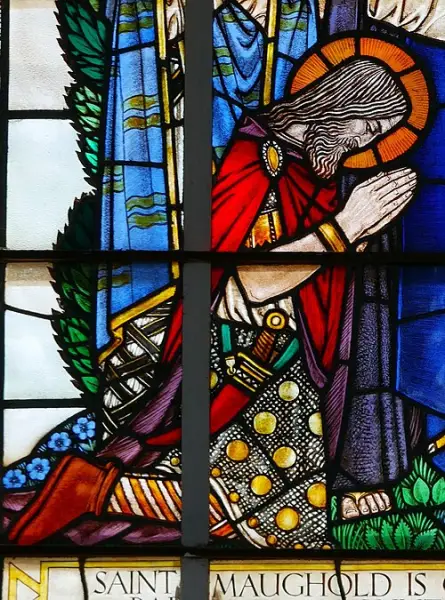
Of Maughold's episcopate the sources say little, but they preserve the quality for which the island remembered him: a kind disposition toward the Manx natives. The convert who had once preyed on the helpless governed them instead with gentleness, and the island repaid him with an uncommon devotion. He died around the year 488, and his memory settled into the very geography of the land. Maughold parish keeps his name on the eastern coast; St Maughold's Well marks the spring associated with him; and St Maughold's Chair recalls the place of his prayer on the cliffs. In the stained glass of the island he appears beside Patrick, depicted at the moment of his baptism, the decisive scene of his conversion. His feast is kept on 25 April in the Catholic and Orthodox calendars, though an older observance fell on 28 December, and Anglicans keep him on 31 July. Medieval writers joined his story to the legends of Celtic saints elsewhere, and modern scholars still debate whether the Maughold of Man is one man or a name shared among several holy figures of the Irish Sea world. On the island itself the question is settled by affection rather than argument.
§ Legend
The Record
- Patron of
- patron of the Isle of Man
- Canonization
- Pre-congregation; venerated from the early medieval period
Prayer
Bibliography
Show 6 sources
- Monks of Ramsgate. "Maughold". Book of Saints, 1921. CatholicSaints.Info. 8 December 2014.
- Butler, Rev. Alban, "St. Macull, of Ireland, Confessor", The Lives of the Saints, Volume IV, 1866.
- Lewis, Barry (16 December 2015). "St Mechyll of Anglesey, St Maughold of Man and St Malo of Brittany". Studia Celtica Fennica. 11 (2014): 24–38.
- MacKillop, James. "A Dictionary of Celtic Mythology" OUP, 2004. ISBN 9780198609674.
- Kennedy, Patrick. "Conversion of the Robber Chief Macaldus", Legendary Fictions of the Irish Celts, London. Macmillan and Co., 1866, p. 327.
- Duffy, Patrick. "St. Maughold", CatholicIreland.net.
Profile text adapted from the Wikipedia article, licensed CC BY-SA 4.0.
Pray with this saint every day
Save St. Maughold to your favorites, read the full profile, and get feast-day reminders in the Saints app.
Get the Saints AppFree on the App Store for iPhone and iPad