
died 7 May 644·Feast May 7
St. Maurelius of Voghenza
Syrian prince who died bishop and martyr of Voghenza
Overview
Maurelius of Voghenza, remembered in Italian as San Maurelio, was a priest from Syria who rose to the bishopric of Voghenza near Ferrara and died, probably on 7 May 644, a death his Church honours as martyrdom. The little that is told of him comes chiefly from a Latin legendary written in 1489, which dresses his life in romance: a son of Theobald, pagan king of Mesopotamia, born at Edessa, converted to Christianity against his father's will, and heir to a throne he abandoned to Hippolytus his brother so that he might follow the faith more closely. Under Theophilus of Antioch, bishop of Smyrna, he took spiritual instruction and priestly ordination, was sent to examine the disobedient abbot Severinus of Noricum, and was summoned to Rome by Pope John IV to explain the affair. There, in a dramatic turn, the pope chose him at a public audience, on the word of a vision of Saint George, to succeed Oldrado as bishop of Voghenza. Historical sources prefer a soberer account, in which he fell victim to the chronic conflict between the exarchs of Ravenna and the Roman see, siding with Rome at the cost of his life. His cult made him patron of Ferrara in 1463.
The Complete Life
A Pagan King's Son at Edessa
The life of Maurelius reaches us wrapped in legend, for the earliest full account, a Latin Legendary composed only in 1489, tells his story in the colours of late medieval romance rather than of history. According to that narrative he was born at Edessa, the great city of Osrhoene, as one of the sons of Theobald, a pagan king of Mesopotamia. When he was eighteen his father begot two more sons, Hippolytus and Rivallus, so that the three brothers grew up heirs of a kingdom and of a father's religion. At thirty Maurelius came to the decisive act of his youth: he revealed to Theobald that he had become a Christian. The king refused to permit his son to go on living as one, and the contradiction between throne and faith opened before the prince. On his father's death Maurelius did succeed to the crown, but he held it only briefly, passing the kingdom soon afterwards to Hippolytus so that he might pursue the Christian calling without the encumbrance of rule. The gesture, whatever its historical weight, fixed the theme by which the Church remembered him: a man who renounced earthly honours for the sake of the faith, and who would pay for that renunciation with his blood.
§ Life
Formation under Theophilus of Antioch
Freed of his crown, Maurelius placed himself under spiritual direction, beginning his formation with Theophilus of Antioch, bishop of Smyrna, who in time ordained him a priest. The bishop then entrusted him with a delicate commission: to examine the heretic abbot Severinus of Noricum, who had refused to obey the summons to appear and answer for himself. The mission drew the Syrian priest into the wider government of the Church, and it led directly to Rome. Pope John IV summoned Maurelius to explain how such heterodoxy had arisen and how it might best be countered. The journey became a pilgrimage of visions. On the road an angel appeared to him and revealed that Severinus had died, rendering the inquiry moot; Maurelius turned back toward Smyrna, but a storm drove his ship into Ostia, the port of Rome, and he went up to the city to receive the pope's blessing instead. Providence, the legend suggests, had arranged the detour. At the papal audience he found himself standing among pilgrims from Voghenza, a small see near Ferrara whose bishop Oldrado had recently died and who had come to ask the pope for a successor.
§ Life
Chosen by a Vision of Saint George
At the audience the story reaches its climax. Saint George appeared in a vision to Pope John IV, commanding that the stranger from Syria be named successor of Oldrado, and the pope, obedient to the sight, conferred the see upon him rather than upon any local candidate. Maurelius accepted and travelled to his small diocese in the Ferrarese lowlands. There the Legendary surrounds his first mass as bishop with signs from heaven: as he celebrated, a hand appeared in blessing over him, and words were heard praising him because he had renounced earthly honours to embrace Christianity, an audible echo of the abdication with which his story began. His ministry continued in the same register, for he cured a blind girl, and another vision foretold a season of sufferings awaiting him. Behind the marvels, historical sources preserve a more prosaic but weightier memory: Maurelius governed Voghenza at a time when the Exarchate of Ravenna and the papacy contended for the territories of Byzantine Italy, and he gave his allegiance to the papal side. In that loyalty, more than in any legend, the Church has seen the cause both of his martyrdom and of his canonisation.
§ Life
Two Deaths, One Martyrdom
On how Maurelius died the tradition divides, though every version ends in blood. The Legendary tells of messengers arriving from Edessa with terrible news: Rivallus, his brother, had apostatised from Christianity and killed Hippolytus. Maurelius returned to his native city to confront the catastrophe, and there Rivallus arrested him, tortured him, and put him to death, so that the former king of Mesopotamia perished at a brother's order for the faith he had embraced. Other and more historical sources offer a different theatre: they make the bishop a casualty of the chronic conflict between the exarchs of Ravenna and the Roman see over the provinces of Byzantine Italy. Because Maurelius favoured the papal cause, the political enemies of that party destroyed him, and his death was received by the Church as martyrdom in the fullest sense, a life laid down for loyalty to Peter's successor. He died on 7 May 644, so the calendars of Ferrara record, and his feast has kept that date ever since. Whether the murder was hatched in a palace at Edessa or in the chanceries of the exarchate, the Church of his diocese never doubted that its bishop had died a confessor's death.
§ Life
Patron of Ferrara
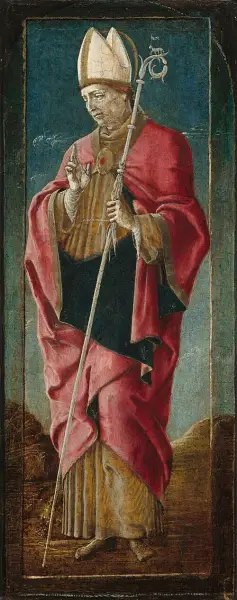
The cult of Maurelius grew slowly into one of the great civic devotions of Emilia. In 1106 the emperor Henry V, who had experienced a vision of the saint, caused his relics to be translated to the church of San Giorgio in Ferrara, and veneration intensified from that day. The city recognised in the Syrian bishop a protector of its own, and in 1463 Ferrara formally declared him its patron saint. His cult then blossomed into art: he became a commanding subject of the Ferrarese school, most famously in Cosmè Tura's Saint Maurelius Altarpiece, painted for San Giorgio around 1470, and in the panels of that master and his circle that show scenes from the saint's trial and glory. Painters delighted in the romance of his story, the prince-bishop from Edessa crowned with a martyr's palm. His relics rest today in the basilica of San Giorgio fuori le mura at Ferrara, where the civic and the sacred have long intertwined around his name. A saint of whom almost nothing historical is known thus occupies one of the most visible places in the religious memory of his adopted city, honoured each 7 May as the witness who chose the papal cause and lost his life for it.
§ Cult
Timeline
- 7 May 644
Died on 7 May, martyred according to tradition at Edessa at the hands of his brother Rivallus
§ Life
- 1106
Emperor Henry V, after a vision of the saint, had his relics translated to the church of San Giorgio in Ferrara
§ Cult
- 1463
Proclaimed patron saint of Ferrara, his veneration having grown markedly since the translation
§ Cult
- 1470
Cosmè Tura executed the Saint Maurelius Altarpiece for the church of San Giorgio in Ferrara
§ Cult
- 1489
A Latin account of his life and miracles, the Legendary, was written
§ Life
The Record
- Patron of
- patron of Ferrara
- Canonization
- Pre-congregation; canonised after a martyrdom tied to the struggle between Ravenna and the papacy
Prayer
Bibliography
Show 4 sources
- Carlo Bassi, Ferrara rara: Perché Ferrara è bella, Cernobbio, Archivio Cattaneo, 2015, ISBN 978-88-98086-23-8, pages 26-27.
- José-Apeles Santolaria de Puey y Cruells, Annuario Diocesano 2017. Arcidiocesi di Ferrara-Comacchio, Ferrara, Archidiocesis Ferrariensis, 2016.
- Romeo Sgarbanti, Ferrara nascita di una città (dopo le leggende, la storia), edited by Carlo Bassi, Sabbioncello San Pietro (Ferrara), 2G Editrice, 2008.
- Carlo Bassi, Breve ma veridica storia di Ferrara, Ferrara, 2G Libri, 2015, ISBN 88-89248-06-8.
Profile text adapted from the Wikipedia article, licensed CC BY-SA 4.0.
Pray with this saint every day
Save St. Maurelius of Voghenza to your favorites, read the full profile, and get feast-day reminders in the Saints app.
Get the Saints AppFree on the App Store for iPhone and iPad