
c. 250-287·Feast September 22
St. Maurice
Commander of the Theban Legion and Martyr
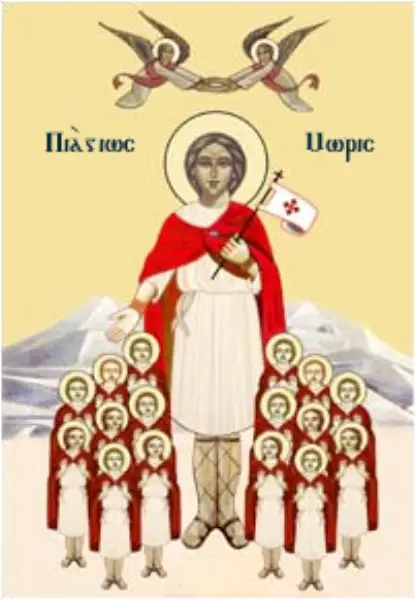
Overview
Maurice, known also as Moritz, Morris, Maurits or Mauritius, was an Egyptian military leader who commanded the legendary Theban Legion of the Roman army in the third century, and stands among the most widely honoured of the martyrs of that corps. According to the hagiographical tradition he was born around 250 at Thebes in Upper Egypt and raised in the region of Luxor. Enlisting as a soldier, he rose through the ranks until he headed the legion, an entirely Christian body of roughly a thousand men summoned from Egypt to Gaul to help Emperor Maximian suppress a rising of the bagaudae. Ordered to clear the Great St Bernard Pass, the soldiers were then required to offer sacrifice to the pagan gods and honour the emperor before battle. Maurice promised the emperor his soldiers' military allegiance, yet insisted that obedience to God outranked every other duty, that Christians could take no part in wanton slaughter, and that the legion would never worship the deities of Rome. When Maximian commanded them to murder local Christians and they refused, the unit was decimated twice and finally put to death entire. The place of their execution, Agaunum, is now Saint-Maurice in Switzerland, crowned by the abbey that bears his name, and the emperor Otto I translated his relics to Magdeburg Cathedral in 961.
The Complete Life
An Officer from Thebes
The hagiographical tradition places Maurice's birth around the year 250 at Thebes, the ancient city of Upper Egypt, and says that he was brought up at Luxor in the Theban region. He grew to manhood in a land whose Christian communities were among the oldest in the Church, and he became an acknowledged Christian at a time when the faith was regarded by the Roman state as a danger to the empire. Entering the army, he advanced steadily through its ranks until he reached command of the Theban legion, a force of approximately a thousand men drawn from his Egyptian homeland. The legion was entirely composed of Christians, a circumstance that would determine its fate. In the third century the empire's armies still moved along the old roads of conquest, and an Egyptian corps could be summoned to the far side of the Mediterranean; it was precisely such an order that carried Maurice and his men from Thebes to Gaul, where Emperor Maximian was struggling to put down a revolt of the bagaudae and needed every reliable soldier he could gather.
§ Early life
The Legion That Would Not Sacrifice
From Egypt the legion marched under orders to open the Great St Bernard Pass through the Alps for Maximian's campaign. Before battle could begin, sacrifice to the pagan gods and homage to the emperor were demanded of the troops, a routine demand of Roman military discipline. Maurice answered for his men in words the tradition has kept: he promised Rome the legion's military allegiance, while insisting that obedience to God came before everything, that Christians could not take part in wanton slaughter, and that his soldiers would never worship the deities of Rome. The emperor's response was to test that refusal with blood. When Maximian ordered the legion to murder local Christians, the soldiers refused. He punished the unit by decimation, the execution of every tenth man, and when the survivors, encouraged by Maurice, again declined to comply, a second round of decimation followed. Because the Theban Christians still would not turn their swords upon fellow believers, Maximian directed that every man left alive in the legion be put to death, and the sentence was carried out at Agaunum, in what is now Switzerland.
§ Career
Martyrdom at Agaunum
The earliest account of the legion's martyrdom is contained in the public letter which Bishop Eucherius of Lyon, who held that see from about 434 to 450, addressed to his fellow bishop Salvius, and it locates the execution at Agaunum, the modern Saint-Maurice in Switzerland, where the Abbey of Saint-Maurice stands today. Other versions of the story vary the circumstance of the refusal: in one, the legion defies Maximian only after discovering that innocent Christians had inhabited a town the soldiers had just destroyed; in another, the emperor has them executed when they will not sacrifice to the Roman gods. Historians have long debated the truth behind the tale. The Bollandist Hippolyte Delehaye classed Eucherius' account among the historical romances, while Donald F. O'Reilly has argued that coins, papyri and Roman army lists support the legion's existence, and L. Dupaz, weighing the stories against what has been dug up at Agaunum, judged the martyrdom historical, with the martyrs' relics conveyed to the site between 286 and 392 through the agency of Bishop Theodore. The twelfth-century bishop Otto of Freising recorded that many legionaries escaped and only some were killed at Agaunum, the rest perishing later at Bonn and Cologne.
§ Martyrdom
A Saint of Emperors
Veneration of Maurice arose at the place of his death and spread with extraordinary reach. He became a patron saint of the German Holy Roman Emperors: in 926 the abbey of Saint-Maurice received from Henry the Fowler, in exchange for the saint's lance, sword and spurs, the canton of Aargau in what is now Switzerland; those insignia served at the coronations of the Austro-Hungarian emperors down to 1916. Some emperors received their anointing before the Altar of Saint Maurice at St Peter's Basilica in Rome. In 929 Henry held a royal assembly at Magdeburg while a monastery in Maurice's honour was founded there, and in 961 Otto I, then building and enriching Magdeburg Cathedral as his own resting place, had the saint's body conveyed to him at Regensburg and sent on to Magdeburg, where the relics were received with great honour by the whole populace and remain venerated. The major shrine of the saint passed accordingly from the Abbey of St Maurice at Agaunum, where it had rested until 961, to Magdeburg Cathedral, where it remains. No formal canonization was ever needed: the martyr of Agaunum was honoured from the earliest centuries by the unanimous devotion of the Church.
§ Veneration
Foundations, Orders and Images
More than 650 religious foundations dedicated to Saint Maurice stand in France and other European countries, and fifty-two towns and villages in France alone bear his name. Within Switzerland he is honoured by seven churches or altars in Aargau, six more in the Lucerne canton, four in Solothurn and one in Appenzell Innerrhoden, and his feast is a cantonal holiday in Appenzell Innerrhoden. Several orders of chivalry were founded under his patronage, among them the Order of the Golden Fleece, the Order of Saint Maurice of 1434, and the Order of Saints Maurice and Lazarus, whose red cross badge appears on his emblazoned armour in Italian art. He gives his name to St Moritz in the Engadin and to numerous places called Saint-Maurice in French-speaking lands. From the thirteenth century he was portrayed as a dark-skinned African in knight's armour, the oldest surviving such image being the statue sculpted for Magdeburg Cathedral about the mid-1200s beside the grave of Otto I; scholars such as Jean Devisse and Gude Suckale-Redlefsen have traced how and why this imagery arose and why it died out in the mid-sixteenth century. In 1941 Pope Pius XII named him patron of the Italian Alpini, who celebrate his feast annually, and Coptic Orthodox churches in Egypt bear his name still.
§ Legacy
Timeline
- 250
Tradition holds that Maurice was born at Thebes in Upper Egypt and brought up at Luxor
§ Early life
- 287
He and his Theban Legion are executed at Agaunum in the Alps after twice refusing Maximian's orders
§ Martyrdom
- 926
In exchange for the lance, sword and spurs of the saint, the canton of Aargau is ceded by Henry the Fowler to the abbey
§ Veneration
- 929
Henry the Fowler holds a Reichsversammlung at Magdeburg, where a monastery in Maurice's honour is founded
§ Legacy
- 961
Otto I conveys the body of St Maurice and relics of his companions from Regensburg to Magdeburg Cathedral
§ Veneration
- 1591
Charles Emmanuel I, Duke of Savoy, arranges the triumphant return of part of the saint's relics from the monastery of Agaune
§ Patronage
- 19 Jul 1941
Pope Pius XII declares Maurice the patron saint of the Italian Army's Alpini mountain infantry corps
§ Veneration
In Their Own Words
in the year 961 of the Incarnation and in the 25th year of his reign, in the presence of all of the nobility, on the vigil of Christmas, the body of St. Maurice was conveyed to him at Regensburg along with the bodies of some of the saint's companions and portions of other saints
The Record
- Patron of
- soldiers·armies·infantrymen·alpine troops·swordsmiths·armorers·weavers·dyers·clothmakers·salt miners·against gout·against cramps·House of Savoy·Pontifical Swiss Guards·Holy Roman Emperors·Piedmont, Italy·Saint-Maurice, Switzerland·St. Moritz·Appenzell Innerrhoden
- Symbols
- banner·knight in armour with a red cross on his breast·soldier in full armour bearing a standard and a palm·soldier being executed with other soldiers
- Canonization
- Pre-congregation; venerated in the Catholic, Eastern Orthodox and Coptic Orthodox Churches
Prayer
Bibliography
Show 7 sources
- Atiya, Azia S., ed. The Coptic Encyclopedia, volume 5, p. 1572. New York, Macmillan Publishing Company, 1991. ISBN 0-02-897034-9.
- Mershman, Francis. "St. Maurice," The Catholic Encyclopedia, Vol. 10. New York City: Robert Appleton Company, 1911.
- Thietmar of Merseburg (2001). Ottonian Germany: The Chronicon of Thietmar of Merseburg. David A. Warner (tr., ed.). Manchester: Manchester University Press. p. 104. ISBN 0-7190-4925-3.
- Butler's Lives of the Saints, New Full Edition, September, p. 206. Collegeville, MN: The Liturgical Press, 1999. ISBN 0-8146-2385-9.
- Leclercq, Henri. "Agaunum." The Catholic Encyclopedia. Vol. 1. New York: Robert Appleton Company, 1907.
- O'Reilly, Donald F., Lost Legion Recovered, Pen & Sword Military, 2011, ISBN 9781848843783
- Van Berchem, Denis, The Martyrdom of the Theban Legion, Basel, 1956.
Profile text adapted from the Wikipedia article, licensed CC BY-SA 4.0.
Pray with this saint every day
Save St. Maurice to your favorites, read the full profile, and get feast-day reminders in the Saints app.
Get the Saints AppFree on the App Store for iPhone and iPad