
1117 – 1191·Feast October 13
St. Maurice of Carnoet
Breton Cistercian abbot of the twelfth century
Overview
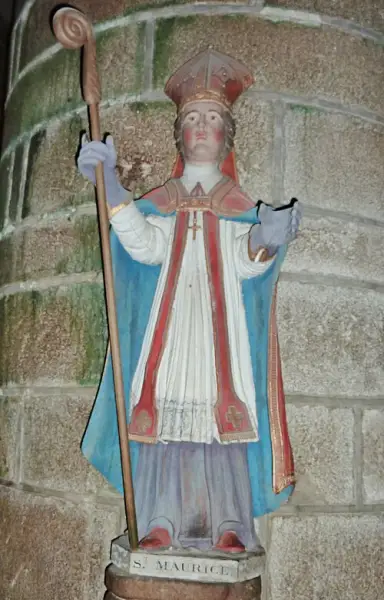
Maurice of Carnoet was a Breton Cistercian abbot of the twelfth century, born at Kerbarth in the parish of Croixanvec in 1117 and dead in 1191 after a lifetime given to the White Monks. Sent to study at the University of Paris, he completed his education in the schools and then, instead of pursuing an ecclesiastical career, entered the monastery of Langonnet in Brittany as a religious in 1144. For more than thirty years he lived as a Cistercian there, until the death of the abbot brought the community to choose him as its head in 1176. In the same year his life took a further turn: Duke Conan IV of Brittany built the abbey of Carnoet for him, and Maurice became the new foundation's first abbot. He thus governed, in quick succession, two houses of his order, leading the monks of Langonnet and then transplanting his experience to the ducal foundation on the Breton coast. His feast is kept in the Roman Catholic Church on 13 October, and he is numbered among the saints whom medieval Brittany produced in remarkable abundance, a son of the Breton interior whose holiness was recognised first by his monks and then by the ducal house itself.
The Complete Life
A Breton Boy in the Schools of Paris
Maurice was born in 1117 at Kerbarth, in the Breton parish of Croixanvec, a countryside of moorland and small holdings in the interior of the peninsula. That a boy of that region made his way to the University of Paris says something both of his gifts and of the reach of the schools in the twelfth century, when Paris was becoming the intellectual capital of western Christendom and students crossed from the Celtic lands to hear the masters. There Maurice completed the course of studies that prepared a man for the service of the Church, and he might reasonably have looked forward to a career among the clergy of his native Brittany, perhaps even to episcopal favour. He chose a harder road. Education in the schools, the Cistercians warned, could puff a soul up with vanity, yet it could also equip a monk to govern and to teach. Maurice put his learning at the disposal of God rather than of ambition, and the decision defined the rest of his long life. The student from Croixanvec never forgot his province: everything he later built as abbot would rise on Breton soil, in monasteries whose names, Langonnet and Carnoet, still mark the map of the peninsula.
§ Introduction
Entering Langonnet
In 1144, when he was twenty-seven, Maurice entered the monastery of Langonet in Brittany, a house of the Cistercian order, the reform of White Monks that had swept Europe in the preceding decades with its ideal of strict poverty, manual labour, and solitude in remote valleys. The order had reached Brittany early, and Langonnet stood in the wooded interior where such foundations flourished. For Maurice the profession meant the exchange of the scholar's disputations for the monk's discipline: the sevenfold office sung in choir, silent labour in field and workshop, and the daily ascent of humility that the Rule of Saint Benedict charted. He lived this life for thirty-two years before any office was laid upon him, a long noviciate of obedience in which his Paris learning was slowly converted into wisdom of another kind. When the abbacy of Langonnet fell vacant, the community did not look elsewhere; in 1176 the monks elected Maurice abbot, the recognition of a fidelity proven over a generation. The Cistercian habit of choosing men who had grown old in the cloister guided their choice, and the former student of Paris accepted a burden he had spent a lifetime preparing to carry well.
§ Introduction
First Abbot of Carnoet
The same year that raised him to govern Langonnet brought Maurice a second and stranger honour. Duke Conan IV of Brittany, the last duke of the old Breton house to rule in his own right, determined to found a monastery for the Cistercians and built the abbey of Carnoet for Maurice himself, an act of ducal piety that showed how far the abbot's reputation had travelled beyond his cloister. Royal and ducal founders of the age sought out abbots of proven holiness to plant their new houses, convinced that the merit of the founding father would secure both the community's spirit and the founder's soul. Maurice became the first abbot of Carnoet in 1176, leaving the community that had formed him to gather a new one from the beginning. The work of a founding abbot was the sternest in monastic life: clearing land, raising buildings, recruiting novices, and impressing on a young community the full discipline of the order with none of the momentum an old house could supply. Maurice gave Carnoet fifteen years of such labour, from the foundation until his death, and the abbey grew under him into a settled possession of Brittany's religious landscape.
§ Introduction
Death and Remembrance
Maurice died in 1191, having passed from the schools of Paris through thirty-two years of hidden obedience to fifteen years of abbatial rule, first at Langonnet and then at the abbey that bore the name by which he is remembered. His brethren and successors preserved his memory, and the Church of Brittany enrolled him among its saints, assigning his feast to 13 October in the Roman Catholic calendar. The brevity of the surviving record, a handful of dates and names, conceals a life that medieval Brittany considered exemplary: the noble use of education, the total gift of a promising career to the cloister, and the patient government of two monastic houses in a century when the Cistercians were transforming the economy and spirituality of the West. His two abbeys continued after him as centres of prayer and agriculture in Brittany, and his story was kept alive in the lists of the order's holy abbots and in the popular devotion of the region around Carnoet. He remains one of the Breton saints whose cult was born of monastic esteem, remembered not for writings or miracles in the sources that survive, but for a life spent faithfully in the discipline of Langonnet and Carnoet.
§ Introduction
Timeline
- 1117
Born at Kerbarth in the parish of Croixanvec, Brittany
§ Introduction
- 1144
Entered the Cistercian monastery of Langonnet after completing his studies in Paris
§ Introduction
- 1176
Elected abbot of Langonnet monastery
§ Introduction
- 1176
Became first abbot of Carnoet Abbey, a new foundation built for him by Duke Conan IV of Brittany
§ Introduction
- 1191
Died after fifteen years governing the abbey of Carnoet
§ Introduction
The Record
- Canonization
- Pre-congregation; venerated as a saint of the Cistercian order
Prayer
Bibliography
Show 1 sources
- "St. Maurice of Carnoet". Catholic Online.
Profile text adapted from the Wikipedia article, licensed CC BY-SA 4.0.
Pray with this saint every day
Save St. Maurice of Carnoet to your favorites, read the full profile, and get feast-day reminders in the Saints app.
Get the Saints AppFree on the App Store for iPhone and iPad