
c. 336 – 453·Feast September 13
St. Maurilius of Angers
Bishop of Angers in Christianizing Gaul
Overview
Maurilius was a priest from Milan who became bishop of Angers around 423 and led that church until his death in 453. He took an early part in bringing the Christian faith to the lands of Gaul. Little of his daily activity has survived; the only Life regarded as authentic was written around 620 by Magnobodus, one of his successors in the see, and it preserves chiefly the outline of his Milanese origin and his long episcopate. His memory took firm root at Angers. In 873 his remains were carried into the cathedral of the city, a church long dedicated to St. Maurice, and for two centuries he and Maurice were named together as the church's patrons. His remains were placed in a new urn in 1239, scattered when the cathedral was vandalized in 1791, and partly recovered; the surviving fragments are kept there still. He is honored as patron of Angers, invoked by fishermen and gardeners, and shown in art as a bishop accompanied by a fish that carries a key, or by a spade for the garden.
The Complete Life
A Milanese in Gaul
Maurilius was born at Milan around the year 336, while the imperial city beside the Po still ranked among the chief seats of the late Roman world. Of his parents, his schooling and his youth, almost nothing has come down; the only early account of him judged authentic, written three centuries after his death, is content to name his city and move on to the work that made him known. What later tradition insisted upon was his place in the spiritual family of Martin of Tours. Writers of Anjou ranked him among Martin's disciples and allowed that scarcely any of them shone more brightly in the memory of the western church. Whatever the exact form of his connection with Tours, he belonged to the company of priests who carried the ascetic and missionary zeal of that movement north and west into Gaul. He left Italy as a young priest and settled in the lands of the lower Loire, where the church of Angers, set on the river Maine, became the field of his life's labor. There the young Milanese found the people and the tasks to which he would give the remaining thirty years of his life.
§ Introduction
Bishop of Angers
In 423 Maurilius was raised to the bishopric of Angers, and he governed that see until his death thirty years later. His episcopate fell in one of the most unsettled stretches of Gallic history: the century in which imperial authority in the west was dissolving and the Christian Church, diocese by diocese, was becoming the most durable frame of public life. The sources credit him plainly with playing an early part in the Christianization of Gaul, the long work by which the villages and towns between the Loire and the sea received the faith and the institutions to sustain it. To hold a bishopric steadily for three decades in such years was itself a form of achievement. Bishops of his generation were arbitrators, builders, teachers and refuges for their people, and the stability of a long tenure allowed the Christian life of a city to put down roots. When Maurilius died at Angers in 453, he left behind a church that had grown old in the faith under his care, and a memory that his successors in the see would continue to cherish and, in time, to write down.
§ Introduction
The Close of a Thirty-Year Ministry
The last years of Maurilius cannot be narrated in detail, for the earliest biography of him was written only around 620, by Magnobodus, one of the bishops who succeeded him at Angers. That distance of nearly two centuries meant that whatever the writer recorded of the old bishop's closing days, the church of Angers received it as the residue of a long and faithful ministry rather than as contemporary report. What is certain is the span: from 423 to 453 Maurilius bore the burden of the see, an exceptionally long tenure by the standards of any age, and one that carried him from the vigor of mid-life into old office in a Gaul increasingly left to govern itself. He died in 453, in the same city that had been the whole stage of his episcopate. The generation that buried him did not forget him. Within lifetimes his grave was a place of resort for the faithful of Anjou, and the account of his life that Magnobodus eventually set down was itself the fruit of a devotion that had never been allowed to fade in the cathedral town.
§ Introduction
An Ancient and Enduring Cult
Maurilius belongs to the company of bishops venerated from the first generation after their deaths, without formal process. A distinct devotion to him is attested by the seventh century, and it was in that climate that Magnobodus composed, around 620, the Life that remains the only one modern scholars accept as authentic. The tangible expression of the cult followed. In 873 his body was transferred into the Cathedral of Angers, a church already dedicated to St. Maurice, and from then on the two saints stood side by side as patrons of the building; for roughly two hundred years they were named together, before Maurice gradually became the cathedral's primary patron. On 16 August 1239 the remains of Maurilius were placed in a new urn, a mark of continuing honor. The French Revolution brought violence: in 1791 the cathedral was vandalized and the relics scattered. Only a few small portions could be gathered up again, and these are preserved at the cathedral today, a fragmentary but unbroken link between the church of Anjou and the bishop who served it in the fifth century.
§ Legacy
Fishermen, Gardeners and Glass
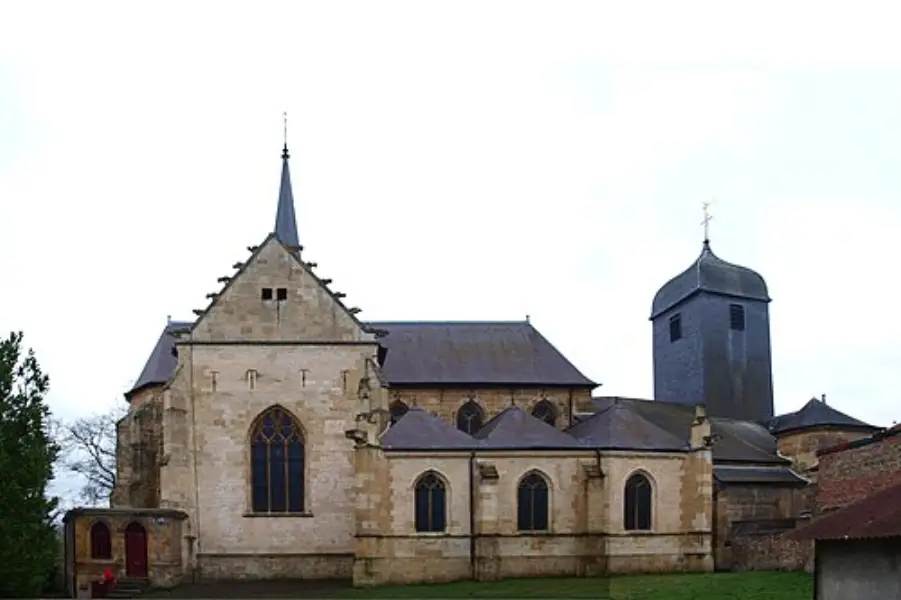
The memory of Maurilius has lived longest in Angers and its countryside. He is honored as patron of the city, and the faithful invoke him especially for two humble trades, fishing and gardening, an association that shaped the way artists pictured him: in art he appears as a bishop accompanied by a fish holding a key, or carrying a garden spade. His image fills the buildings of the region. Among the windows of stained glass along the southern side of the choir in the cathedral of Angers, scenes from his story appear, and the great tapestries of Angers from the fifteenth and sixteenth centuries also depict him, so that his story was woven and painted into the fabric of the city he served. Devotion reached beyond Anjou as well. At Vouziers in the Ardennes, the church of Saint-Maurille received its dedication to him in the twelfth century, its founders remembering him as one of those who prepared Gaul to become Christian France, and his statue stands in the church of Saint-Martin-de-Vertou at Grez-Neuville. Few bishops of the fifth century are so widely present in the art and place-names of their region.
§ Veneration
Timeline
- 336
Born at Milan, according to the tradition preserved in his early Life
§ Introduction
- 423
Became bishop of Angers, an office he would hold for three decades
§ Introduction
- 453
Died after thirty years governing the see of Angers
§ Introduction
- 620
Magnobodus, one of his successors, composed the Life of him considered the only authentic one
§ Legacy
- 873
His remains were moved into the cathedral of Angers, a building already dedicated to St. Maurice
§ Legacy
- 16 Aug 1239
His remains were placed in a new urn within the cathedral
§ Legacy
- 1791
His relics were scattered when revolutionary vandals desecrated the cathedral
§ Legacy
The Record
- Patron of
- Patron of Angers·Invoked by fishermen·Invoked by gardeners
- Symbols
- Bishop's vestments·A fish holding a key·A garden spade
- Canonization
- Pre-congregation; devotion to him attested from the seventh century
Prayer
Bibliography
Show 6 sources
- Alban Butler, Butler's Lives of the Saints, Volume 9: September, edited by Paul Burns (Collegeville, Minnesota: The Liturgical Press, 2000), ISBN 0-8146-2385-9, pages 114-115
- David King, "Angers Cathedral" (book review of Karine Boulanger's 2010 book, Les Vitraux de la Cathédrale d'Angers, volume 11 of the Corpus Vitrearum series from France), Vitemus, Issue 48, February 2011, retrieved 17 December 2013
- Dominique Auzias and Jean-Paul Labourdette, Champagne-Ardenne 2010 Petit Futé (Paris: Le Nouvelles Editions de l'Université, 2010), ISBN 2746928841, page 145
- François Chamard, Les vies des saints personnages de l'Anjou (Paris: J. Lecoffre, 1863), pages 162-163
- Painton Cowen, "Angers Cathedral", The Medieval Stained Glass Photographic Archive
- Louis de Farcy, Les tapisseries de la Cathédrale d'Angers (Angers: Josselin-Belhomme, 1901), pages 120-125
Profile text adapted from the Wikipedia article, licensed CC BY-SA 4.0.
Pray with this saint every day
Save St. Maurilius of Angers to your favorites, read the full profile, and get feast-day reminders in the Saints app.
Get the Saints AppFree on the App Store for iPhone and iPad