
9th century·Feast June 10
St. Maurinus of Cologne
Ninth-Century Abbot and Martyr of Cologne
Overview
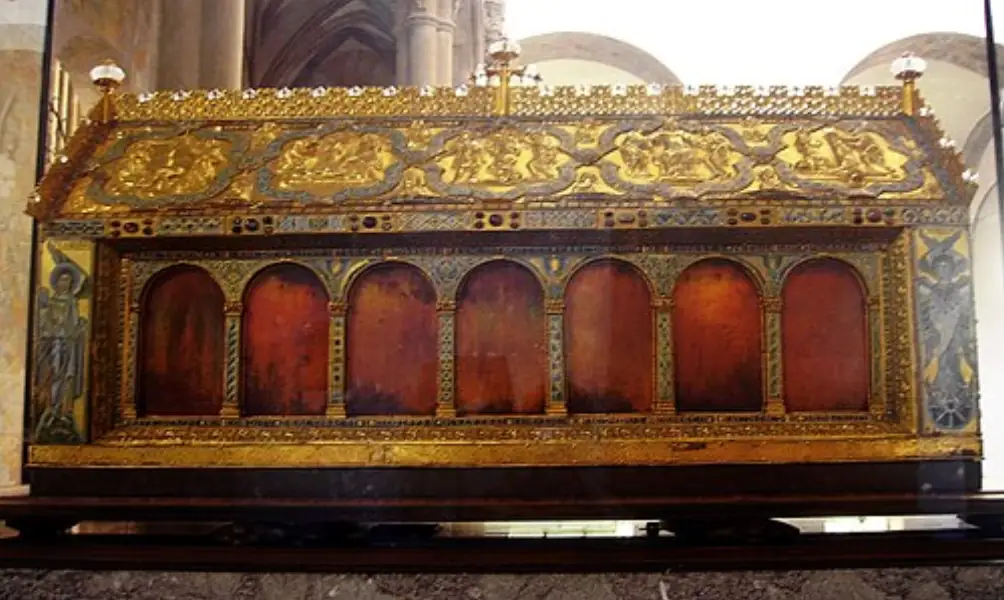
Maurinus was a German abbot of the ninth century whose life is known almost entirely through the manner of its ending. He lived in connection with the Benedictine monastery in Cologne on whose site the church of Saint Pantaleon later rose, and tradition holds that he died a martyr. The inscription carved on his first tomb records that he met his death at the entrance of the monastery church on the tenth of June, and the body recovered from the tomb bore marks of torture and a violent death. His martyrdom has been connected, though without certainty, with the Viking raids that struck the Rhineland in 881 and 882. When construction of Saint Pantaleon's Church began in 966, a tomb containing his bones was unearthed together with the remains of St. Pantaleon and Bruno the Great. In the years around 1170 to 1180 a richly decorated shrine was made to house his relics, and it remains in the church to this day. In 1820 his relics were translated to the Church of Saint Mary, Our Lady of Peace in the Schnurgasse of Cologne. He is venerated by Catholics and Orthodox alike, and a church at Lützenkirchen bears his name.
The Complete Life
An Abbot of Troubled Times
Little is known about the life of Maurinus, and even his dates are matters of inference rather than record. What can be said is that he was a German abbot of the ninth century, a man charged with the government of a monastic community in the Rhineland at a moment when the Carolingian order was straining under attack from every quarter. The monastery with which his name is joined stood in Cologne, on the ground where the church of Saint Pantaleon was later built, and Maurinus is remembered as one of its abbots. To hold such an office in that century was to be responsible not only for prayer and discipline but for the material survival of a community living in an age of insecurity. The sources that preserve his memory pass over his origins, his formation and the years of his administration; they fix instead on the single event for which the church has kept his name. In an age that produced many anonymous victims of violence, it is the manner of his death, recorded on his own tomb, that carried the memory of this abbot forward to later generations of Christians in Cologne.
§ Introduction
Martyrdom at the Church Door
On Maurinus' first tomb an inscription keeps the memory of how he died: slain for the faith at the entrance way of his monastery's church, upon the tenth day of June. The body laid in that tomb bore visible traces of torture and of a violent end, corroboration in bone of what the inscription asserted in words. The date on which the church commemorates him, the same tenth of June, is thus the day his community recorded as the day he was killed. Historians have connected his martyrdom, tentatively, with the Viking raids of 881 and 882, when marauding fleets moved up the Rhine and left the great towns and monasteries of the region in ruins; if that connection is right, he perished in one of the waves of violence that swept over Cologne in those years. Nothing more is told. The picture that remains is stark and sufficient: an abbot who met his attackers at the entrance of his own church and died there, at the threshold of the house he had served, in witness to the faith he had professed.
§ Introduction
The Shrine in Saint Pantaleon's
The memory of Maurinus endured in Cologne through the discovery of his grave. In 966, as builders started Saint Pantaleon's Church over the ground of the old Benedictine monastery, their digging uncovered a tomb that held his bones, found together with the remains of St. Pantaleon and Bruno the Great, three holy men of different eras joined in one place of burial. The finding confirmed that he had been honored as a saint from the beginning. In the years between about 1170 and 1180, craftsmen made a richly decorated shrine to house the relics, and that twelfth-century vessel remains in the church to the present day. In 1820 the relics were translated once more, to the Church of Saint Mary, Our Lady of Peace in the Schnurgasse of Cologne. Veneration of Maurinus is not confined to the Catholic Church; the Eastern Orthodox Church also recognizes him as a saint, and his feast is kept on 10 June. At Lützenkirchen, the church of Saint Maurinus is dedicated to his name, carrying the memory of the murdered abbot beyond the city where he died.
§ Introduction
Timeline
- 10 Jun 881
Said to have been slain for the faith at the entrance of his monastery's church on 10 June; his death may be linked to the Viking raids of 881/882
§ Introduction
- 966
A tomb containing his bones was found as construction of Saint Pantaleon's Church began, together with the remains of St. Pantaleon and Bruno the Great
§ Introduction
- 1170
An ornate reliquary shrine was crafted for his relics, and it stays in Saint Pantaleon's Church even now
§ Introduction
- 1820
His relics were translated to the Church of Saint Mary, Our Lady of Peace in the Schnurgasse in Cologne
§ Introduction
The Record
- Symbols
- Abbot's habit·Martyr's palm·Reliquary shrine
- Canonization
- Pre-congregation; recognized as a saint by the Roman Catholic Church and the Eastern Orthodox Church
Prayer
Bibliography
Show 5 sources
- "Maurinus von Köln", Ökumenisches Heiligenlexikon (in German)
- "Shrines & Places - Cologne", Treasures of Heaven: Saint, Relics and Devotion in Medieval Europa, Columbia University
- "Hl. Maurinus", St. Pantaleon, Köln (in German)
- "S Maurinus", Kirchenlateinisches Wörterbuch, Georg Olms Verlag, 1996 (in German)
- "Maurinus (St) Abbot, M (June 10)", The Book of Saints, Aeterna Press, 1966
Profile text adapted from the Wikipedia article, licensed CC BY-SA 4.0.
Pray with this saint every day
Save St. Maurinus of Cologne to your favorites, read the full profile, and get feast-day reminders in the Saints app.
Get the Saints AppFree on the App Store for iPhone and iPad