
fl. c. 398 – 407 or later·Feast Not recorded
St. Mauritius II of Trier
Bishop of Trier in an Age of Upheaval
Overview
Mauricius, also called Mauritius, governed the see of Trier beginning in 398 or 399, certainly through 407, perhaps even to 419. Of the man himself the record tells almost nothing beyond the fact of his office. He was elected to the see following the resignation of Bishop Felix, at the moment when the city the Romans called Augusta Treverorum was losing its rank: as the fourth century closed, Trier no longer housed the emperor's court, and after 410 Germanic armies overran the country around it. Against that background the significance of the church of Trier diminished within the empire, though it doubtless kept a real importance locally. A letter of Pope Boniface I, written about the church at Arles, is thought to have been addressed to him, the single piece of correspondence tying him to the wider affairs of the western church. How long he remained bishop is unclear: a successor may have taken the see in 407, yet he might equally have held it into 419. He is recorded in the episcopal lists of Trier, flanked by his predecessor Felix and his successor Leontius.
The Complete Life
Elected After Felix
The life of Mauricius before his election is wholly unknown to history; no source records his birthplace, his family or his training, and even his dates rest on the fixed points of his episcopate. What the records of the church of Trier preserve is the fact of his advancement: following the resignation of Bishop Felix, Mauricius was elected to the see in 398 or 399. He thus took charge of one of the principal churches of Gaul at a moment of profound transition. Trier, the Augusta Treverorum of the Romans, had for generations been a favored residence of emperors and an administrative center of the west; by the close of the fourth century it was ceasing to be an imperial seat at all. A man elected bishop there in those years accepted leadership of a community whose civic world was contracting around it. Whatever qualities commended Mauricius to his electors, they could not have been the patronage of a court that was departing; they must have been the qualities of a pastor for a church learning to stand on its own.
§ Introduction
A Church in a Diminishing City
The episcopate of Mauricius coincided with a time of political upheaval that reshaped the setting of his ministry. At the end of the fourth century the imperial court withdrew from Augusta Treverorum, stripping the city of the presence and the expenditure that had made it a capital, and from the year 410 the surrounding region was invaded by Germanic peoples. In that changed world the significance of the church of Trier inevitably paled beside what it had been, yet the sources judge that it doubtless retained a genuine local importance: the Christian community of the Moselle looked to its bishop still, even if the bishop's voice carried less far than it once had. One thread binds Mauricius to the wider church of his day. Boniface I, bishop of Rome, is thought to have directed a letter to him about affairs at Arles, evidence that Trier's bishop belonged to the correspondence network through which the Roman see dealt with the affairs of the Gallic provinces. Beyond these facts the record is silent about the substance of his governance. For a bishop serving through those years, the daily work of ordaining clergy, keeping worship and consoling a diminished flock mattered more than any surviving line of correspondence suggests.
§ Introduction
An Uncertain End, A Fixed Place in the Lists
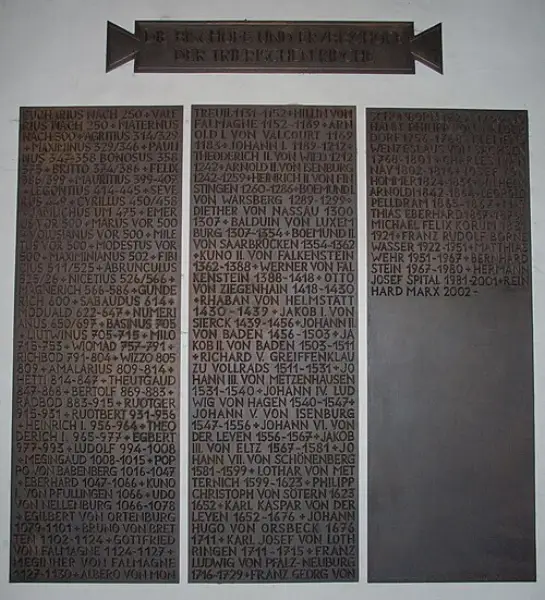
Even the length of Mauricius' service remained unsettled for those who came after. No one can say when his service ended: the see may have passed to a successor in 407, a tenure of some eight or nine years, yet he could equally still have governed it in 419, which would rank him among the longest-serving bishops of Trier in that disturbed era. The uncertainty is itself eloquent, for it reflects the shaking of the institutions, including ecclesiastical record-keeping, amid the invasions that followed 410. What did not dissolve was his place in the succession. The episcopal lists of Trier, preserved in the Tabula Episcoporum Trevirensium, record Mauritius of Trier between his predecessor Felix and his successor Leontius, a fixed point in the chain of shepherds of one of the oldest churches north of the Alps. He was born, by the same tradition, in 398, the year of his election according to some reckonings, a chronological puzzle that the thinness of the sources leaves unresolved. His memory rests in the lists and in the continuity of the see he governed.
§ Titles of the Great Christian Church
Timeline
- 398
Elected bishop of Trier following the resignation of Bishop Felix
§ Introduction
- 407
His episcopate is attested at least to this year, by which a successor may have been appointed
§ Introduction
- 419
May still have been in office as late as this year, if no successor had yet taken the see
§ Introduction
The Record
- Canonization
- Pre-congregation; remembered as an early bishop of Trier
Prayer
Bibliography
Show 5 sources
- Hans Hubert Anton, The Trier church and northern Gaul in late Roman and Frankish times (Supplements of Francia 16.2, 1989), p. 59
- Hans Hubert Anton, Trier in the Middle Ages (Paderborn, Munich et al, 1987), p. 81
- GCatholic.org, Diocese of Trier
- Saarland-biografien.de, "Mauricius" (in German)
- Catholic Encyclopedia: Trier
Profile text adapted from the Wikipedia article, licensed CC BY-SA 4.0.
Pray with this saint every day
Save St. Mauritius II of Trier to your favorites, read the full profile, and get feast-day reminders in the Saints app.
Get the Saints AppFree on the App Store for iPhone and iPad