
634 – 702·Feast May 5
St. Maurontius of Douai
Nobleman Turned Benedictine Abbot of Flanders
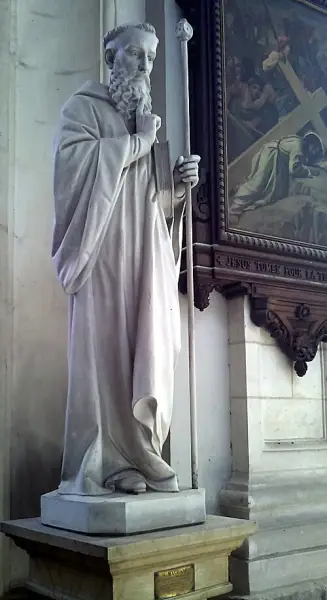
Overview
Maurontius, whose name appears in many forms including Maurontus and Mauront, was born in 634 into one of the great noble families of the Frankish north: his parents were Rictrude and Adalbard, and his sisters Clotsinda, Adalsinda and Eusebia are likewise honored as saints. Baptized by the hermit Richarius and raised partly at the court of Clovis II, he became lord of Douai on his father's death in 652. A sermon of Amandus on the vanity of the world turned him from an arranged marriage to the monastic life. He received the tonsure at Marchiennes Abbey, founded by his parents, served as deacon and prior of Hamage, and built a new monastery at Breüil on his estate of Merville, of which he became the first abbot. Out of reverence for Amandus, exiled by King Theodoric III, he resigned his abbacy into the elder bishop's hands and lived under his obedience, resuming the charge at Amandus' death in 690. He governed Marchiennes while his sister Clotsinda led its house of nuns, and died there on 5 May 702, in his seventy-third year. His relics were later translated to Douai, where he is especially venerated.
The Complete Life
A Son of a Holy House
Maurontius was born in 634, the eldest son of Adalbald of Ostrevent and Rictrude, a couple whose household became one of the nurseries of Frankish sanctity: his sisters Clotsinda, Adalsinda and Eusebia are all numbered among the saints. Richarius, a hermit and monk devoted to the household, poured the baptismal water over the infant, an early sign of the religious world into which he was born. As the eldest son he passed his youth not in a cloister but at the court of King Clovis II, among the great men of the Neustrian kingdom, where a nobleman's heir learned the arts of command and society that his station required. His father's brothers moved in the same world: Sigefrid was count of Ponthieu, and Archenald served as Mayor of the Palace under Clovis II, Dagobert's son, a king bound to them by kinship. Everything in Maurontius' upbringing pointed toward a career of territorial lordship and dynastic marriage. Yet the family in which he grew up had already consecrated itself in part to God, having founded Marchiennes Abbey, and the son would in time choose the monastery over the inheritance his birth had prepared for him.
§ Life
Turned by a Sermon
In 652 Adalbald died, and Maurontius became lord of Douai, succeeding to that town and to other large estates across the family's lands. Coming home into Flanders to settle his affairs, he moved toward the marriage that had already been arranged for him with a rich young lady, the conventional next step for a lord of his rank. The course of his life was altered by a sermon. Amandus, who led Elnon Abbey, preached a sermon on how fleeting and perilous worldly things are, and the young lord heard in it a judgment on the settlement he was concluding. Instead of a wife, the text of his future life came from the monastery his parents had founded: Maurontius entered Marchiennes Abbey and received the tonsure from Amandus himself, the preacher who had unsettled him. After some years of monastic formation he was made a deacon and appointed prior of Hamage, a house half a league from Marchiennes on the river Scarp, which had been founded by a relative, Gertrude of Hamage. The heir of Douai had become, in succession, monk, deacon and prior within the family's own religious foundations.
§ Life
Abbot of Breüil and Servant of Amandus
Maurontius' monastic career culminated in a foundation of his own. At Merville, an estate of his and a town of some size close to Saint-Venant within the diocese of Thérouanne, he built a new monastery called Breüil, and when the work was finished the community chose him as its first abbot. His most striking act of governance, however, was a renunciation. When Amandus was banished by King Theodoric III and committed to Maurontius' care, the abbot honored the exiled bishop so deeply that he resigned his abbacy into Amandus' hands and lived under his obedience, a nobleman-turned-monk making himself subject to the old missionary in his disgrace. Only the death of Amandus in 690 obliged Maurontius to take up his charge again. The monks of Marchiennes likewise had him as their abbot, while at the neighboring convent his sister Clotsinda ruled the nuns in the same place, for Marchiennes was then a double monastery, brothers and sisters joined under one dedication though living in distinct communities. He was styled at times deacon and at times abbot, and it seems he never received priestly ordination, content to exercise his authority in the diaconate.
§ Life
Death at Marchiennes
Maurontius closed his life where much of it had been spent, in the monastic world of the Scarpe valley. His death came at Marchiennes on 5 May 702, when he was seventy-two years old, after roughly half a century divided between the lordship he had inherited and the cloister he had chosen. His sister Clotsinda was abbess of the nuns of the same double monastery at the time, so that the family's sanctity was present on both sides of the community that received his last breath. The body was kept at Breüil, the monastery he had built at Merville. Toward the end of the ninth century, when Danish or Norman raiders plundered Merville, the ancient Minariacum of Antoninus, King Charles the Simple of France moved the brethren from Breüil to Our Lady's church in Douai, which Maurontius' uncle Archenald had founded after rebuilding the castle that gave rise to the town. At the same time the body of Maurontius, together with that of St. Amandus, was translated from Breüil to Douai, and both saints were enshrined in the church of Saint Amatus.
§ Life
Feast and Veneration at Douai
Maurontius was never canonized by any formal process; he belongs to the long company of confessors whose reputations for holiness were settled by local devotion in the generations after their deaths. His feast is kept on 5 May, the day of his death, and he has been especially venerated at Douai, the town of which he had been lord and in which his relics came to rest. The church of Saint Amatus, where his body was enshrined beside that of St. Amandus, became a collegiate church of canons after the secularization of the monastery in 940, his body rested there within a costly shrine, and a chapel adjoining it held his statue stood between those of his parents, Rictrude and Adalbard, the whole holy family displayed together. A fourteenth-century litany from Douai witnesses to his place in the prayer of the town. The accounting of his life, however, rests on an earlier text: the Vita Rictrudis, which Marchiennes Abbey commissioned and Hucbald set down in 907, the work from which nearly every account of him flows. The shrine, the chapel and the statues of the family kept his memory visible to every generation of canons and pilgrims who entered the building.
§ Introduction
Relics, Images and a Scholarly Question
The material traces of Maurontius spread through the churches of the old Flemish lands. Artists depict him with a sceptre grasped in his right hand, emblem of the lordship he gave up, and clutching in the left the image of a belfried church, sign of the monasteries he raised and ruled. At Saint Guislin abbey in Hainault his skull was treasured within a silver-gilt reliquary, and the cathedral of Arras, together with other churches, showed particles of his relics to the faithful. His name survives in many spellings, Maurontus, Mauruntius, Maurantius, Mauront and Maurant, evidence of the breadth of his cult across the region. Modern scholarship has raised one sober question about him. Karine Ugé has argued that naming Maurontius among Rictrude's sons could arise from an accidental blending with another man of identical name whom Alcuin's Vita Richarii confessoris Centulensis mentions, where a woman called Rictrude also appears, though not necessarily as anyone's mother. Whatever the resolution of that question, the cult at Douai preserved him for more than a millennium as one of the confessors of Flanders. Few noblemen of the seventh century left so many houses, relics and images spread across so many churches of one small region.
§ Sources
Timeline
- 634
Born into the noble family of Rictrude and Adalbald of Ostrevent; baptized by the hermit-monk Richarius
§ Life
- 652
On the death of his father, became lord of Douai and inherited large estates
§ Life
- 690
On the death of Bishop Amandus, was obliged to resume the abbacy he had resigned to him
§ Life
- 5 May 702
Died at Marchiennes on 5 May, having reached seventy-two years
§ Life
- 907
Hucbald wrote the Vita Rictrudis for Marchiennes Abbey, the source of most information about him
§ Sources
- 940
The monastery at Douai was secularized, becoming a collegiate church of canons where his body was enshrined
§ Life
The Record
- Patron of
- Especially venerated in Douai, France
- Symbols
- Sceptre in his right hand·A building with a tower or belfry in his left hand
- Canonization
- Pre-congregation; ancient cult, especially venerated at Douai
Prayer
Bibliography
Show 8 sources
- Cristiani, Léon. "Liste chronologique des saints de France, des origines à l'avènement des carolingiens", Revue d'histoire de l'Église de France, 1945, p. 81
- David Hugh Farmer, Butler's Lives of the Saints (May) (1996), p. 30
- "Saint of the Day - May 5", St. Patrick Catholic Church, retrieved 11 November 2018
- Litany from Douai, 14th century
- "Den hellige Maurontus av Douai (634-~701)", Katolsk (in Norwegian), retrieved 11 November 2018
- "Sant' Eusebia", Santiebeati.it (in Italian), retrieved 6 January 2025
- Alban Butler, "Saint Mauront, Abbot", Lives of the Fathers, Martyrs, and Principal Saints, 1866, CatholicSaints.Info, 4 May 2013
- Gillingham, John (2001). Anglo-Norman Studies XXIII: Proceedings of the Battle Conference 2000. Boydell & Brewer. ISBN 978-0-85115-825-9
Profile text adapted from the Wikipedia article, licensed CC BY-SA 4.0.
Pray with this saint every day
Save St. Maurontius of Douai to your favorites, read the full profile, and get feast-day reminders in the Saints app.
Get the Saints AppFree on the App Store for iPhone and iPad