
c. 512-584·Feast January 15
St. Maurus
First Disciple of Benedict of Nursia
Overview
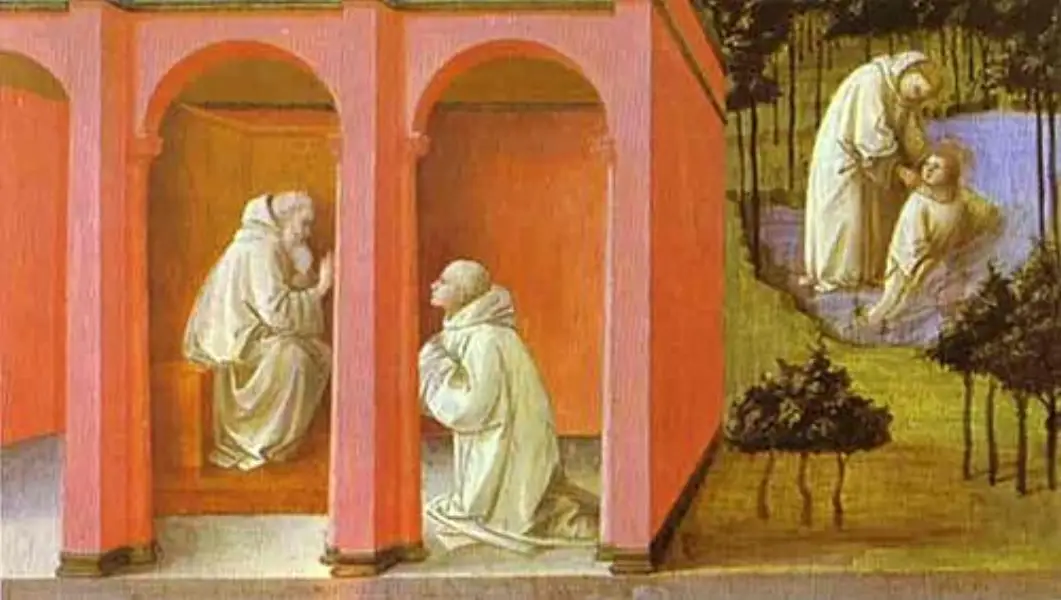
Maurus was a Benedictine monk of the sixth century, remembered above all as the first disciple of Benedict of Nursia. Gregory the Great's biography of Benedict shows him to us as the first oblate, given while still a boy by his noble Roman family so that he might be reared in the cloister. Gregory preserves four stories about Maurus which set the pattern for the shaping of a Benedictine monk; the best known tells how Maurus, sent by Benedict to save the young oblate Placidus from drowning, ran out upon the waters of the lake and brought the boy safely to shore. Born around 510, the son of the Roman nobleman Equitius, Maurus was entrusted to Benedict at Subiaco at about the age of twelve, was ordained a deacon, and served as Benedict's coadjutor at Subiaco before being summoned to Monte Cassino around 528. Around 543 he was sent to Gaul at the request of the bishop of Le Mans and, through the generosity of King Theudebert, founded Glanfeuil Abbey on the south bank of the Loire, the first Benedictine monastery in Gaul according to his Life. He governed it for many years, resigned the abbacy in 581 for a life of solitude, and died there on 15 January 584. His cult spread through all Benedictine monasteries, and the Congregation of St. Maur took its name from him.
The Complete Life
A Noble Boy Given to God
Maurus was born around 510 into the aristocracy of Rome, the son of Equitius, a Roman nobleman. While he was still a boy of about twelve, his parents made the offering that fixed the course of his whole life: after the custom Gregory the Great would later celebrate, they handed their son over to the cloister as an oblate, that under Benedict at Subiaco he might be reared to the monastic state. He thus stands in the tradition as the first of Benedict's disciples, the earliest living stone of the edifice the founder was then raising among the hills south of Rome. Gregory's Dialogues kept the memory of those formative years, and four of the stories, all centred on Maurus, showed later ages what the shaping of a Benedictine monk should look like. The best known recounts how the young oblate Placidus, a boy given to Benedict along with Maurus, went down to draw water from the lake and was carried off by the current. Seeing the danger, Benedict sent Maurus to the rescue: hurrying to reach the child, Maurus ran out upon the water itself and brought Placidus back to land. Each claimed the miracle belonged to the other, Maurus ascribing it to Benedict's prayers, the abbot to his disciple's obedience.
§ Benedictine tradition
Coadjutor at Subiaco
Under Benedict's direction Maurus grew from gifted boy into trusted man. He was ordained a deacon, and when Benedict prepared to leave Subiaco for Monte Cassino he appointed Maurus coadjutor of the Subiaco community, placing the cradle of Benedictine monasticism in his first disciple's hands. Throughout that time his prayers were credited with many wondrous cures, an early sign of the reputation for holiness that would follow him all his days. In about 528 the call came to follow Benedict to Monte Cassino, transferring him from the government of Subiaco to the ranks of the founder's own community at the abbey that would become the head of Western monasticism. There he lived through the years in which the Rule took its definitive shape and the Monte Cassino school gathered its first teachers. The bond between the master and the disciple remained unbroken, and when the call came from Gaul for monks formed in Benedict's way of life, no one was better fitted than Maurus to carry the Rule beyond the Alps: he had known the monastic life from childhood, had governed a community in his master's name, and had already been marked out as a vessel of healing prayer.
§ Benedictine tradition
Apostle of the Loire
About the year 543 Adenard arrived at Monte Cassino as envoy of Innocentius, Bishop of Mans, seeking monks for the evangelisation and monastic planting of Gaul. Maurus was dispatched, and his long journey from Italy to France, recounted with a host of adventures and miracles, saw Benedict's youthful disciple become a wonder-working holy man standing on his own; on the road he healed the sick and injured who were brought to him. With King Theudebert's help he established Glanfeuil Abbey on the Loire's southern bank, a few miles east of Angers, which his Life celebrates as the first Benedictine monastery in Gaul. He governed the community for many years, and the abbey, later called St. Maur-sur-Loire, became the fountainhead from which the Rule of St Benedict spread through Frankish lands. Tradition adds a homelier gift to his French legacy: according to local memory the chenin grape was first cultivated at the monastery, whose thirteenth-century church nave and some of its vineyards survive to this day. The account of this Gallic mission rests on the long Life supposedly composed by one of Maurus's sixth-century contemporaries, completed around 604 and republished, reworked into more polished Latin, by Abbot Odo of Glanfeuil in 863.
§ Life of Saint Maurus
Solitude and Death at Glanfeuil
Having governed Glanfeuil for the better part of four decades, Maurus laid down the burden of office in 581. Abbot's rule was set aside for a closing season of solitary prayer, the last movement of a soul that had passed from oblate to coadjutor to missionary abbot and now returned to the quiet from which all his work had sprung. He died at Glanfeuil Abbey on 15 January 584 and was buried in the abbey church there. His relics were discovered in 845 by Gauzlin, one of the predecessors of Abbot Odo, and in 868, when Viking marauders were ravaging along the Loire and Odo and the community sought refuge in Paris, carrying the body of their founder with them; it found a new home at the abbey of Saint-Pierre-des-Fossés, the house thenceforth called Saint-Maur-des-Fossés for the saint it guarded. A second translation in 1750 brought the relics to Saint-Germain-des-Prés, where they stayed until revolutionary violence in Paris scattered them. Glanfeuil's neighbourhood had long joined it to two other celebrated Benedictine centres, Fleury with the relics of Saint Benedict and Le Mans with those of Scholastica, a triad of shrines that anchored his memory in the sacred geography of France.
§ Veneration
An Ancient and Debated Cult
Maurus was never formally canonized; his feast, which the 2001 Roman Martyrology assigns to 15 January and which Benedictine Mass books keep on the same day in company with St Placidus, rests on immemorial veneration. The authenticity of the Vitathat carries his French mission has, however, been debated. Hippolyte Delehaye famously called Odo's work a forgery in an off-hand comment, yet no general academic consensus condemns it: the Bollandists observed that Odo would have earned greater gratitude had he published the text as he found it, and scholars such as Beda Adlhoch defended a more reliable Odo. Every writer from the ninth century onward, Amalarius among them, has agreed that the French abbot Maurus of Anjou and Benedict's disciple were one and the same man — a claim Thierry Ruinart argued at length against certain modern critics. From the eleventh century the cult was adopted at Monte Cassino itself, together with a revived cult of Placidus, and by the late Middle Ages it had reached every Benedictine monastery, often in association with the memory of Placidus. The ancient observance of the saint has thus survived both the criticism of scholars and the storms of revolution.
§ Life of Saint Maurus
From Saint-Maur to Kerala and Yokohama
The name of Maurus has attached itself to institutions across the world. The Congregation of St. Maur, the great French Benedictine congregation of the Maurists, took its name from him, and the surname Seymour is said to derive from Saint Maur. Japan's first international school owed its 1872 foundation to French and Irish sisters of the Congregation of the Infant Jesus, the Dames of Saint Maur, who named it for him: Saint Maur International School of Yokohama. In southern India his cult flourishes in unexpected warmth: the village of Koothrappally in Kerala is dedicated to St Maurus, villagers of every religion honour him as patron of the place, his feast is observed in the parish church of St Mary, and a chapel in his name was raised there in 1890 by Palakunnel Valiyachan, founder of the Koothrappally Church. Christian iconography depicts him as a young man in the Benedictine habit, holding an abbot's pectoral cross, or with a spade alluding to Saint-Maur-des-Fossés, or with a crutch for his patronage of the disabled, or with the scale that measured a monk's daily bread, the implement Benedict gave him for the journey to France. When the Blessing of Saint Maur is bestowed on the sick it is customarily with a relic of the True Cross; since 1959 the medal of St Benedict may stand in for the relic.
§ Veneration
Timeline
- 512
Born into the Roman nobility, son of Equitius, and offered to Benedict as his first oblate
§ Benedictine tradition
- 522
Placed, a boy of about twelve, under Benedict's tutelage at Subiaco
§ Benedictine tradition
- 528
Summoned by Benedict to join the community at Monte Cassino
§ Benedictine tradition
- 543
Dispatched to Gaul at Bishop Innocentius of Mans's request; founds Glanfeuil Abbey, the first Benedictine monastery in Gaul
§ Life of Saint Maurus
- 581
Gives up governing the abbey for closing years given to silence and prayer
§ Benedictine tradition
- 15 Jan 584
Dies at Glanfeuil Abbey on 15 January
§ Benedictine tradition
- 845
Relics of Saint Maurus are discovered at Glanfeuil by Gauzlin, one of Abbot Odo's predecessors
§ Life of Saint Maurus
- 863
Abbot Odo of Glanfeuil publishes his reworked Latin edition of the Life of St Maurus
§ Life of Saint Maurus
- 868
Fleeing Vikings marauding along the Loire, Odo and his monks translate the relics to Saint-Pierre-des-Fossés, later Saint-Maur-des-Fossés near Paris
§ Veneration
- 1750
The relics are relocated from Saint-Maur-des-Fossés to Saint-Germain-des-Prés in Paris
§ Veneration
The Record
- Major works
- Life of St. Maurus (Vita Mauri), long attributed to a sixth-century contemporary and republished by Abbot Odo of Glanfeuil in 863
- Patron of
- disabled people·charcoal burners·cobblers·coppersmiths·shoemakers·Azores·invoked against rheumatism·invoked against epilepsy·invoked against gout·invoked against hoarseness·invoked against cold
- Symbols
- crutch·Benedictine habit·abbot's cross·spade·scale
- Canonization
- Pre-congregation; feast kept on 15 January in the 2001 Roman Martyrology and, with St Placidus, in the Proper Masses of the Benedictine Confederation
Prayer
Bibliography
Show 7 sources
- Faustus van Cassino, "Vita Sancti Muari", in: Acta Sanctorum, Januarii, tom. 2, 1864, pp. 321-332.
- Hippolyte Delehaye, The Legends of the Saints: an introduction to Hagiography, London, New York: Longmans, Green, and Co, 1907, p. 106.
- Jean Mabillon, Annales Ordinis Sancti Benedicti, tom. 2, 1704, pp. 176 & 277-278.
- Adlhoch Beda, "Zur Vita S. Mauri", in: Studien und Mitteilungen zur Geschichte des Benediktinerordens und seiner Zweige, 1905, bd. 26, pp. 3-22, 207-226, 509-524.
- Thierry Ruinart, Apologie de la mission de S. Maur, Parijs: Chez Pierre de Bats, 1702.
- Mershman, Francis. "St. Maurus." The Catholic Encyclopedia Vol. 10. New York: Robert Appleton Company, 1911.
- Rosa Giorgi; Stefano Zuffi (ed.), Saints in Art (Los Angeles: Getty Publications, 2003), 272.
Profile text adapted from the Wikipedia article, licensed CC BY-SA 4.0.
Pray with this saint every day
Save St. Maurus to your favorites, read the full profile, and get feast-day reminders in the Saints app.
Get the Saints AppFree on the App Store for iPhone and iPad