
3rd century·Feast November 21
St. Maurus of Parentium
First Bishop and Martyr of Poreč
Overview
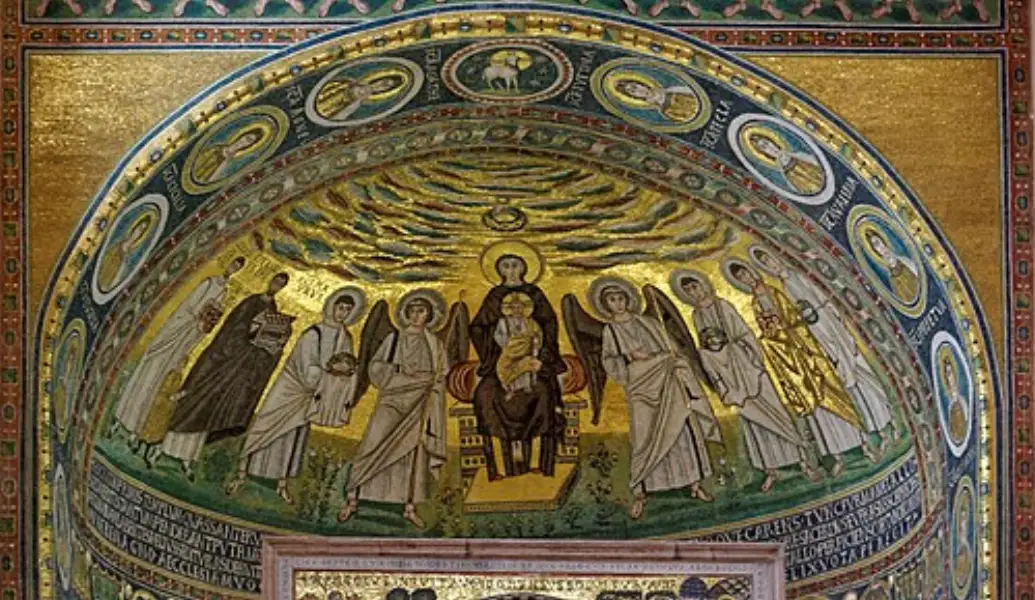
The Istrian city of Poreč, known to the Romans as Parentium and now Croatian territory, honors Maurus as its patron saint. Two traditions describe his origin. According to one account he sprang from Roman nobility and served as the city's first bishop. A Passion of St. Maurus survives within the ninth-century Martyrologium compiled by the Benedictine Rabanus Maurus that describes him instead as a pilgrim from Africa who was caught up in the Diocletian persecution and died a martyr. However his story began, the church of Parentium honored him from the earliest Christian era: the first basilica of the city, built in the second half of the fourth century, was dedicated to him and held his relics. When the present Euphrasian basilica was constructed in 553, Maurus took his place in the mosaics of the apse, holding in his hand the martyr's crown, close beside the Mother of God with her Child. Genoese raiders carried off his remains in 1354 and laid them in the Church of San Matteo; not until 1934 did they come back to Poreč and rest today in a votive chapel beside the sacristy. He is commemorated on 21 November.
The Complete Life
Two Stories of One Saint
The origins of Maurus reach back to the third century, beyond the reach of continuous record, and the church of Parentium preserved two differing accounts of where he came from. According to one tradition, he was of noble Roman birth, a man of the governing people of the empire who crossed the Adriatic to the small Istrian harbor town and became its first bishop. The other account is preserved in the Passion of St. Maurus contained in the ninth-century Martyrologium of Rabanus Maurus, the great Benedictine scholar of Mainz: it describes him as a pilgrim from Africa, a traveler from the proconsular lands of the church's oldest Latin heartland, who found himself in Parentium when the Diocletian persecution broke over the Christian world. The two stories are not easily reconciled, and the sources do not attempt to force them together. What both share is the essential shape of the man: a Christian of the third century, drawn to a modest Adriatic city, who gave that city the faith and, in the tradition of his martyrdom, his life. Everything else about Poreč's patron rests on that shared foundation.
§ Narrative
First Bishop of Parentium
In the account that makes him a Roman noble, Maurus became the first bishop of Parentium, the founding shepherd of the Christian community on the Istrian coast. The office he thus filled was in its infancy: the churches of the Adriatic seaboard were still young when he ministered, and a first bishop stood closer to the apostolic model of the missionary founder than to the diocesan ordinary of later centuries. The other tradition presents him not as an office-holder but as a pilgrim, one of the wandering faithful who traveled from Africa across the sea toward Rome or the holy places, and whose journey ended in arrest when the emperor Diocletian's edicts unleashed the last and fiercest of the Roman persecutions. On either showing, Maurus' vocation was bound to the beginning of things: the planting of the church in a small provincial city, at the cost, in the martyr tradition, of his own blood. The Christians of Parentium answered with an enduring loyalty. From the second half of the fourth century their first basilica was dedicated to him, and it held his relics, making his grave the center of the city's worship within a few generations of his death.
§ Narrative
A Martyr Honored from the Beginning
Maurus' veneration was never the product of a process; it belongs to the earliest layer of the Church's memory of its dead. The fourth-century basilica built in his honor and the relics it enshrined show that the Christians of Parentium reckoned him among the martyrs within living memory of the persecutions, and the ninth-century Passion preserved by Rabanus Maurus fixed the story of his African pilgrimage and his death under Diocletian for the later middle ages. His feast is kept on 21 November. The most magnificent tribute, however, was architectural. When the present basilica of Poreč was constructed in 553, the building known ever since as the Euphrasian basilica, the designers placed Maurus in the mosaics of the apse itself: he stands there third from the left, with a crown of martyrdom held in his hand, beside the Mother of God and Child at the center of the composition. To set a local bishop and martyr within an imperial-quality apse mosaic was to declare that the holiness of Parentium's own son ranked with the great figures of the universal church, and the mosaic preserves that judgment to this day.
§ Narrative
Stolen Relics and a Long Return
The relics of Maurus have led a restless life. From the fourth-century basilica they passed into the church raised in 553; in the votive chapel adjoining its sacristy they may be venerated today. In 1354, in the era of Adriatic rivalry between maritime powers, Genoese hands carried the relics off and buried them far from Istria in the Church of San Matteo, so that Poreč lost the treasure it had guarded for eight centuries. The separation lasted longer than any kidnapper could have expected: only in 1934 were the relics returned to Poreč, restoring the patron to the city that had never ceased to call itself his. His image, meanwhile, traveled further than his bones. An apse mosaic in the Chapel of San Venanzio, part of the Lateran Baptistry at Rome, likewise shows him; Pope John IV, himself Dalmatian by birth, ordered that chapel built to honor the saints of his native coast and of Istria, the coastline across the Adriatic from his native region. Thus the first bishop of Parentium stands both in the apse of his own cathedral and among the saints of the Adriatic world honored at the heart of Latin Christendom.
§ Narrative
Timeline
- 553
The present basilica of Poreč was constructed, and Maurus was depicted in the mosaics of its apse
§ Narrative
- 1354
Genoese thieves seized his remains and laid them to rest in the Church of San Matteo
§ Narrative
- 1934
His relics were returned to Poreč, more than five centuries after they were taken
§ Narrative
The Record
- Patron of
- Poreč/Parenzo, Croatia
- Symbols
- Bishop holding the crown of martyrdom in his hand
- Canonization
- Pre-congregation; martyred during the Diocletian persecution, venerated since antiquity
Prayer
Bibliography
Show 4 sources
- Stracke, Richard. "Saint Maurus of Parentium", Christian Iconography, Augusta University
- Imperial Spheres and the Adriatic (Mladen Ančić, Jonathan Shepard, and Trpimir Vedriš, eds.) Routledge, 2017, ISBN 9781351614290
- Mackie, Gillian Vallance. Early Christian Chapels in the West: Decoration, Function and Patronage, University of Toronto Press, 2003, p. 220, ISBN 9780802035042
- Naklada Naprijed, The Croatian Adriatic Tourist Guide, pp. 12-13, Zagreb (1999), ISBN 953-178-097-8
Profile text adapted from the Wikipedia article, licensed CC BY-SA 4.0.
Pray with this saint every day
Save St. Maurus of Parentium to your favorites, read the full profile, and get feast-day reminders in the Saints app.
Get the Saints AppFree on the App Store for iPhone and iPad