
c. 1000 – c. 1075·Feast October 25
St. Maurus of Pécs
First Hungarian-Born Abbot and Bishop
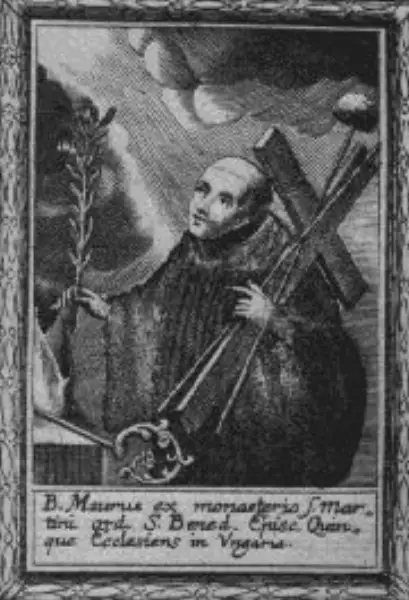
Overview
Maurus, known in Hungarian as Mór, was the first known prelate born in the Kingdom of Hungary, a Benedictine monk who rose from the abbey school of Pannonhalma to govern both that monastery and the diocese of Pécs. Born around 1000 and sent to Pannonhalma as a child, he was a friend of Crown Prince Emeric, who greeted him with seven kisses in honor of his chastity. By 1029 at the latest King Stephen I had appointed him abbot of Pannonhalma, and from there he sent four monks to help Bishop Gerard organize the new diocese of Csanád. In 1036 the Annales Posonienses record his appointment as the second bishop of Pécs. There he completed the city's earliest cathedral, survived the pagan uprising that ended King Peter's rule, and joined the three surviving bishops at the coronation of Andrew I in Székesfehérvár in 1046. His signature stands just after the archbishop of Esztergom's on the founding deed of Tihany Abbey in 1055. Around 1064, at Prince Géza's request, the elderly bishop wrote the Legend of the hermits Benedict of Szkalka and Andrew Zorard. He died around 1075, and his cult was confirmed by Pope Pius IX in 1848.
The Complete Life
A Child Offered at Pannonhalma
Maurus was born around the year 1000, in the first generation of Hungarians who could be born into a Christian kingdom. Historians such as János Karácsonyi have suggested that his family came from the region of Nyitra, in the north of the realm, though Maurus himself, notably, never refers to it as his birthplace in the work he wrote about two hermits from that same region. While yet a small boy he was handed over by his parents to the Benedictine community of Pannonhalma, the great monastery of the young kingdom, offering him to its life in the manner of the age. There he grew up as a monk of the royal foundation, and there he formed the friendship that the sources most love to record: with Emeric, the crown prince of Hungary and the king's only son, himself raised in piety and later canonized. During one of the prince's visits to the monastery, Emeric greeted Maurus alone among the monks with seven kisses, a gesture contemporaries understood as the prince's public conviction that Maurus had kept his vow of chastity inviolate. The childhood oblate thus grew into a monk whom the royal family both trusted and honored.
§ Life
Abbot of Pannonhalma, Bishop of Pécs
Maurus' monastic career advanced quickly within the structures of the new Christian kingdom. Stephen I, the first king of Hungary, appointed him abbot of Pannonhalma by 1029 at the latest, placing a monk of the house, still under thirty, at the head of its community. From the abbey Maurus took part in the king's grand work of church-building across the realm: the Greater Legend of Saint Gerard tells that four monks went out from Pannonhalma at his direction to help Gerard, first bishop of Csanád (today Cenad in Romania), set in order that newly founded diocese, a small commission that shows the abbot lending his monastery's best to the missionary frontier. In 1036 the Annales Posonienses record his appointment as the second bishop of Pécs, succeeding Bonipert in the see of southern Hungary. The move from abbot to bishop carried him from the cloister to the cathedral, but the sources suggest he carried Pannonhalma's discipline with him. He held the see of Pécs for nearly forty years, from 1036 until his death around 1075, making him one of the longest-serving prelates of eleventh-century Hungary and the first known prelate born in the kingdom itself.
§ Life
Shepherd in a Kingdom in Crisis
Maurus' episcopate spanned the fiercest crisis the young Hungarian church endured. In the reign of Peter I, Stephen I's successor, he finished the construction of the earliest cathedral of Pécs, completing the material seat of his diocese. When a pagan uprising put an end to King Peter's rule, Maurus was one of only three bishops in the realm to survive the turmoil, and as a trio they offered the crowning of the new king, Andrew I, at Székesfehérvár in 1046, a small college of survivors restoring the sacred order of the kingdom. His standing at the new court is measured by documents: the founding deed of the Benedictine Tihany Abbey, drawn up in 1055, carries his signature immediately after that of the archbishop of Esztergom, ahead of every other prelate, and in 1056 Radó, the palatine, willed a portion of his property to Maurus and to the see of Pécs, a bequest ratified by King Andrew I and by his brother and successor Béla I. After Béla's death Maurus mediated between the dead king's sons, Géza and Ladislav, and Andrew's son Solomon: at Pécs, on Easter 1064, the princes agreed, Géza and Ladislav accepting Solomon's right to the throne, though the cathedral and bishop's palace were burnt the very next day.
§ Life
The Legend of the Two Hermits
In the aftermath of the peace of 1064, with his cathedral in ashes but his authority undiminished, the elderly bishop received a literary commission that became his title to remembrance. Prince Géza asked Maurus to compose the lives of Benedict and Andrew-Zorard, two solitary monks of the Nitra country in present-day Slovakia, that same district from which Maurus' own family may have come. The bishop was unusually well placed for the task: in addition to the narration of abbot Philip of Zobor, he could draw on his own memory of talks with Benedict, whom he had met during his young years at Pannonhalma abbey, where the hermit once lived. The work that resulted, the Legend of Benedict of Szkalka and Andrew Zorard, made Maurus the first Hungarian-born author of a saint's life, a witness writing about a holiness he had seen at first hand. He governed the diocese of Pécs until his death around 1075, closing a career that had run from the court friendships of Stephen I's day, through the pagan reaction of 1046, to the consolidation of the kingdom under Andrew I and Béla I.
§ Life
A Cult Confirmed After Eight Centuries
Maurus' cult began shortly after his death, nourished by the monasteries and the diocese that had known him. It never required invention, because it never stopped: what Pope Pius IX confirmed at the Holy See on 22 July 1848 was a tradition of local veneration that had run continuously for nearly eight centuries. In confirming the cult the pope pointed to the written witnesses of the middle ages, pointing out that service books of 1499 already proclaim Blessed Maurus's praise, and that Martyrologies likewise preserve his name. The form of his feast changed with the liturgical ages. The Diocese of Pécs first kept his feast each year on October's fourth Sunday, an observance maintained until 1913, when 25 October became his fixed feast day. Among the evidences of his cult the sources count his own literary work: a saint's life written by his hand secured him a place in the memory of the Hungarian church independent of the offices sung in his honor. He stands among the earliest confessed saints of Hungary, honored as blessed and as saint under the name of Mór, bishop of Pécs.
§ Life
First of Hungary's Own
Maurus occupies a singular place in the religious history of Hungary as the first known prelate born in the kingdom. The church of St. Stephen had been led in its first decades by prelates who came from beyond the kingdom's borders, and Maurus is the evidence that within one lifetime the mission had produced a shepherd of native stock, formed in a Hungarian monastery, speaking for a Hungarian see. Every generation of Hungarian monks and bishops has stood, in some sense, on ground he was the first of their own people to occupy. The institutions he touched kept his mark: Pannonhalma, which he governed as abbot; the diocese of Csanád, whose organization his monks assisted; the cathedral of Pécs, which he completed and later rebuilt in spirit after the fire of 1064; Tihany Abbey, whose founding deed preserves his signature; and the literature of Hungarian sanctity, which begins with his Legend. As patron of the Diocese of Pécs he has been venerated for nearly a thousand years, and the city where he built the first cathedral still keeps his feast each October.
§ Life
Timeline
- 1000
Born around this year; still a boy when his parents gave him over to the Benedictines of Pannonhalma
§ Life
- 1029
Appointed abbot of Pannonhalma by King Stephen I, at the latest by this year
§ Life
- 1036
Appointed the second bishop of Pécs, as narrated by the Annales Posonienses
§ Life
- 1046
One of three bishops who survived the pagan uprising and together celebrated the coronation of King Andrew I in Székesfehérvár
§ Life
- 1055
Signed the founding deed of Tihany Abbey, his name preceded only by the archbishop of Esztergom
§ Life
- 1056
Radó the palatine left a share of his property to Maurus and the see of Pécs by his final testament
§ Life
- 1064
Hosted in Pécs the Easter agreement between Géza, Ladislav and Solomon, and soon after composed his Legend of the two Nitra hermits at Prince Géza's request
§ Life
- 1075
Died around this year, after nearly four decades as bishop of Pécs
§ Life
- 22 Jul 1848
The Holy See confirmed his cult on 22 July, on the basis of continuous local veneration
§ Life
- 25 Oct 1913
October 25 became his feast day, replacing the fourth Sunday of October kept in the Diocese of Pécs until then
§ Life
In Their Own Words
there are mass-books from 1499 which sing Blessed Maurus's praises, and his name was also recorded in Martyrologies
The Record
- Major works
- Legend of Benedict of Szkalka and Andrew Zorard, two hermits of the region of Nitra
- Patron of
- Diocese of Pécs
- Symbols
- Bishop's vestments·Abbot's crosier
- Canonization
- Cult confirmed by Pope Pius IX on July 22, 1848
Prayer
Bibliography
Show 4 sources
- Berend, Nora; Laszlovszky, József; Szakács, Béla Zsolt (2007). "The kingdom of Hungary". In Berend, Nora (ed.). Christianization and the Rise of Christian Monarchy: Scandinavia, Central Europe and Rus', c. 900-1200. Cambridge University Press. pp. 319-368. ISBN 978-0-521-87616-2
- Koszta, László (2009). "Szt. Mór (1036-1070/1075 körül)" [=St. Maurus (1036-1070/c. 1075)]. In Fedeles, Tamás; Sarbak, Gábor; Sümegi, József (eds.). A Pécsi Egyházmegye története I: A középkor évszázadai (1009-1543) (in Hungarian). Fény Kft. pp. 59-62. ISBN 978-963-88572-0-0
- Sümegi, József (2008). "Mór, Pécs szent életű püspöke" [=Maurus, the holy bishop of Pécs]. In Sümegi, József (ed.). A Pécsi Egyházmegye ezer éve [=Millennium of the Diocese of Pécs] (in Hungarian). Fény Kft. pp. 26-31. ISBN 978-963-85841-5-1
- Diós, István. "Boldog Mór" [Blessed Maurus]. A szentek élete [=Lives of Saints]. Szent István társulat. Archived from the original on 2003-03-25. Retrieved July 11, 2013
Profile text adapted from the Wikipedia article, licensed CC BY-SA 4.0.
Pray with this saint every day
Save St. Maurus of Pécs to your favorites, read the full profile, and get feast-day reminders in the Saints app.
Get the Saints AppFree on the App Store for iPhone and iPad