
c. 650 – 670·Feast November 13
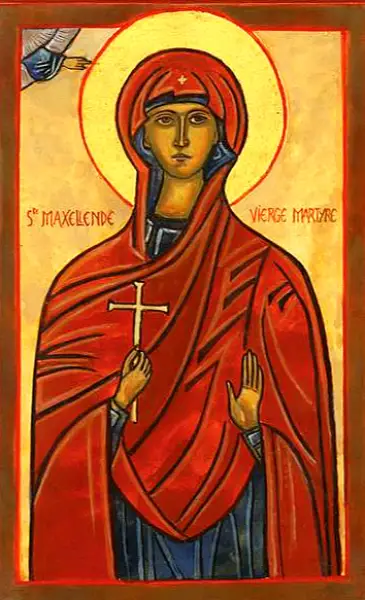
St. Maxellende of Caudry
Thaumaturgist martyr and healer of the blind
Overview
Saint Maxellende of Caudry was a Frankish virgin and martyr of the Merovingian era, daughter of Huinlinus, a wealthy landowner of the village of Caudry in the region of Cambrai. Bound by her family to a marriage with Harduin d'Armeval, the future lord of Solesmes, she declined the match out of fidelity to the religious life she had embraced. When she would not yield, Harduin killed her on the thirteenth of November in the year 670. Struck blind after the murder, he recovered his sight only years later, when her remains were carried in procession back to Caudry and he wept before them. Vindicianus, bishop of Arras and Cambrai, recognized her sanctity and canonized her in 673. Her relics were honored at Cambrai, at Le Cateau-Cambrésis, and finally at Caudry, where a great basilica bears her name. Because her murderer's blindness was healed at her relics, she became the patroness of those afflicted with diseases of the eyes and of the visually impaired, and she remains beloved by the people of Caudry, who keep her feast each November.
The Complete Life
A Daughter of Caudry
Maxellende was born at Caudry around the year 650, in the Merovingian countryside between Cambrai and Arras. Her father, Huinlinus, was a landowner of substance, and the family's standing placed the girl among the most marriageable daughters of the region. Little else is recorded of her childhood, but the tradition is unanimous in presenting her as a young woman whose heart was already given to God before any question of marriage arose. She lived under the jurisdiction of the bishops of Arras and Cambrai, and her short life unfolded entirely within this small corner of the Frankish world. When the time came for her family to arrange her future, a match was proposed with Harduin d'Armeval, a nobleman who would one day be lord of Solesmes. For a daughter of a prosperous household such an alliance promised wealth, rank, and protection. Yet Maxellende had set her course toward another kind of life, and the prospect of marriage posed for her not an honor but a crisis of fidelity to the vow she had already made.
§ Martyr
Consecrated Rather Than Betrothed
The commitment Maxellende had made to the religious life set her at odds with the expectations of her family and class. In Merovingian society a wealthy landowner's daughter was expected to strengthen her house through marriage, and refusal of a suitable match was neither common nor easily forgiven. When she was promised to Harduin d'Armeval, she resisted the arrangement, and her resistance had a single ground: she had already given herself to God and would not take a husband. Her determination placed her among those virgin martyrs whose witness in the Frankish Church was born not in a Roman arena but in the conflicts of domestic life. Harduin's disappointment hardened into rage, for he regarded the promised union as his right. The quarrel between a young woman's vow and a nobleman's claim would end in violence, but the Church has always read the outcome in the opposite direction: the girl who would not renounce her consecration conquered, and the powerful man who would not accept her refusal lost both his prize and, for a time, his sight.
§ Martyr
The Murder of November 670
The violence came in the year 670. Harduin d'Armeval killed Maxellende at Caudry on the thirteenth of November, the date her feast day still keeps. The tradition records the deed without ornament: a woman who would not marry was slain by the man she had refused. But the account also preserves what followed, and it is here that the martyrdom acquired its enduring meaning. Harduin was struck blind, a judgment contemporaries read as heaven's verdict upon the killing. Maxellende was buried in the church of Saint-Souplet, and her grave began to draw the faithful. A few years later her bones were carried back to Caudry in a solemn procession, and Harduin himself came among the crowd. Overcome with tears before the relics of his victim, he miraculously recovered his sight. That miracle transformed the story from a domestic crime into a testimony of mercy: the saint's first recorded healing was granted to her own murderer, and it fixed forever her reputation as a heavenly physician of those who cannot see.
§ Martyr
Recognition, Relics, and Cult
In 673, three years after her death, Vindicianus, bishop of Arras and Cambrai, canonized Maxellende, an act that placed the formal recognition of her sanctity in the hands of the pastor with jurisdiction over the place of her martyrdom. Her relics were enshrined and honored first at Cambrai, then at Le Cateau-Cambrésis, and finally returned to Caudry itself, where her cult took deepest root. Throughout the Middle Ages she was revered as a thaumaturgist, a worker of wonders, and especially as an advocate for those afflicted in their sight. The blind and the partially sighted came to Caudry on pilgrimage, a movement of devotion that has never wholly ceased. She is the patroness of the people of Caudry and of the visually impaired everywhere, and the faithful invoke her against diseases of the eyes. The local liturgy keeps her feast on the thirteenth of November, or on the following Sunday, in memory of the traditional date of her murder. Few saints of the Frankish countryside can claim so continuous and affectionate a cult across thirteen centuries.
§ Martyr
The Basilica at Caudry
The basilica of Saint-Maxellende at Caudry stands as the lasting monument of her cult. A church dedicated to her rose on the site from the nineteenth century: construction began in the 1830s and was completed between 1887 and 1890 to the Gothic designs of the Lille architect Louis Cordonnier. The building stretches seventy-two meters in length, and its bell tower rises seventy-five meters, carrying a carillon of three bells. Within, the great nave reaches twenty meters to the keystone, flanked by two aisles of eight. The transept ends in two chapels, the left dedicated to Our Lady of the Rosary and the right holding the shrine of Saint-Maxellende herself. Two rose windows, each assembled from some 4,600 pieces of glass around 1921, fill the sanctuary with light. The choir is graced by a high altar of white marble, gilded copper, and mosaic that won distinction at the exhibition of high altars held at Antwerp in the nineteenth century. Among the treasures are stained glass by Master Charles Lorin made at Chartres between 1905 and 1946, the great organ built by Charles Mutin of the Cavaillé-Coll firm in 1913, and the fourteenth-century shrine of the saint, classified as a historic monument. On 3 September 1991 a pontifical brief raised the church to the rank of minor basilica, and pilgrims whose sight is weak or gone still make their way to it.
§ Basilica
Timeline
- 650
Born at Caudry, daughter of Huinlinus, a wealthy landowner of the region.
§ Martyr
- 13 Nov 670
Killed at Caudry by Harduin d'Armeval after refusing their arranged marriage.
§ Martyr
- 673
Canonized by Vindicianus, bishop of Arras and Cambrai.
§ Martyr
- 1887
Building work resumed to the Gothic plans of the Lille architect Louis Cordonnier.
§ Basilica
- 3 Sep 1991
A pontifical brief raised the church of Saint-Maxellende to the rank of minor basilica.
§ Basilica
In Their Own Words
St. Maxellende, virgin and martyr, you who have healed your murderer who had become blind, preserve us the precious gift of sight, heal those who are deprived of it, or who are in danger of losing it. Above all, obtain the light of the mind and the heart so that we may always walk on the paths of the Gospel. You who wanted to devote yourself to God enlighten those who seek their way here below. With the support of your prayer, they further peace and fulfill their vocation. Amen.
The Record
- Patron of
- against ocular diseases·the visually impaired·the people of Caudry
- Canonization
- Canonized in 673 by Saint Vindicianus, bishop of Cambrai-Arras
Prayer
Bibliography
Show 4 sources
- "The Basilica", City of Caudry
- "Sainte Patronne de la Paroisse", Sainte Maxellende en Cambrésis
- Roger Caron, Jean Lefebvre, Denise Leprêtre and Patrick Raguet (1997). Sainte Maxellende. Comité du Centenaire de la Basilique Sainte Maxellende de Caudry. ISBN 978-2-9511708-0-3.
- André Flament and Patrick Raguet (2001). Histoire de Caudry : Caudry d'hier et d'aujourd'hui. Cambrai, Nord Patrimoine Éditions. ISBN 978-2-912961-18-1.
Profile text adapted from the Wikipedia article, licensed CC BY-SA 4.0.
Pray with this saint every day
Save St. Maxellende of Caudry to your favorites, read the full profile, and get feast-day reminders in the Saints app.
Get the Saints AppFree on the App Store for iPhone and iPad