
499 – 556·Feast February 22
St. Maximianus of Ravenna
Archbishop of Ravenna in the age of Justinian
Overview
Saint Maximianus of Ravenna, born in 499, served as bishop of Ravenna during the years when the city stood as the capital of the Byzantine Empire's territories in Italy, a position that carried secular and political weight alongside its pastoral duties. A native of the Istrian town of Vistar near Pola, he was a deacon of that city, forty-eight years old, when Pope Vigilius consecrated him the twenty-sixth bishop of Ravenna at Patras in Greece in 546. The appointment, made at the instance of the emperor Justinian I, was at first resisted by his own flock, who had not chosen him; by discretion, generosity, and an ambitious program of church building he gradually won their respect. His episcopate brought to completion two masterpieces of early Byzantine architecture, the Basilica of San Vitale and Sant'Apollinare in Classe, and raised other churches in Ravenna and his native Istria. He revised the liturgical books, corrected the Latin text of the Bible, commissioned illuminated manuscripts, and adorned his cathedral with works of extraordinary splendor, above all the ivory cathedra that still bears his name. He died at Ravenna in 556 and is honored by Catholics and Orthodox alike, though his cult remains essentially local to Ravenna.
The Complete Life
A Deacon of Pola
Maximianus was born in 499 in the Istrian town of Vistar, known today as Veštar, near Pola, in territory then held by the Ostrogothic Kingdom and now part of Croatia. Of his family and education the surviving records say little, but by middle age he had taken his place among the clergy of Pola as a deacon, a position of trust and administration in one of the principal cities of the Adriatic. Istria in the sixth century lay at the meeting point of Latin tradition and the new order established at Constantinople, and Maximianus grew up fluent in both worlds. The ninth-century Ravennate priest Andreas Agnellus, whose book of the pontiffs of Ravenna preserves much of what is known of him, looked back on that Istrian beginning when he described the man who would become the city's twenty-sixth bishop. When the call came, he was already forty-eight years old, a mature churchman rather than an ambitious young courtier, and he left his native shore for the capital on the Adriatic where the most demanding episcopate of his generation awaited him.
§ Life
An Unwanted Bishop
In 546 Pope Vigilius consecrated Maximianus bishop of Ravenna, performing the rite at Patras in Greece. The choice was the emperor Justinian I's, and the people of Ravenna wanted none of it. According to Andreas Agnellus, the flock initially refused his leadership because he had been selected by the emperor and was not their own candidate. A capital city accustomed to privilege did not take kindly to an outsider imposed from above, and the new bishop began his ministry under open rejection. Later writers judged the affair coldly: the art historian Meyer Shapiro described him as a poor deacon of Pola raised high through political adroitness, a protégé of Justinian whom the Ravennates had never wanted as their archbishop. Yet the same judgment records what followed, for he outmaneuvered his critics, however, and gradually earned the Ravennates' esteem through his tact, his open-handedness, and the great enterprises of church building and decoration that transformed his see. What began as an unwanted appointment ended as one of the most fruitful episcopates of the sixth century, and the rejected deacon became one of Ravenna's own saints.
§ Life
Building the Byzantine City
Ravenna in Maximianus's day was the capital of the Byzantine Empire's Italian territories, and its bishop exercised functions that reached well beyond the sanctuary into the government of the city. Maximianus used that position to carry out a program of sacred architecture without rival in the West of his age. Under him the Basilica of San Vitale was brought to completion, together with Sant'Apollinare in Classe, the great suburban basilica that still ranks among the foremost monuments of early Byzantine art. He raised several other churches as well, including Santa Maria del Canneto in his native Istria, carrying his building enterprise back to the coast of his childhood. The scale of these works required money, craftsmen, mosaics, and the political skill to gather all three, and it was precisely this generosity of enterprise that turned the hostility of the Ravennates into respect. Every consecrated wall argued on his behalf. By the time the great buildings stood finished, the emperor's appointee had given the city a sacred face so splendid that opposition had become unthinkable, and the bishop whom Ravenna had not chosen had reshaped Ravenna forever.
§ Life
The Book, the Textile, and the Throne
Maximianus's piety expressed itself in the refinement of worship and the dignity of the sacred text. Part of his energy went into revising the service books and correcting the Latin Bible, so that his people would have the word of God in an accurate and worthy form; illuminated manuscripts in considerable numbers were likewise produced under his patronage for the use of his church. His love of beauty extended to furnishing: for the city's high altar he procured a cloth of exceptional richness, worked with scenes telling the whole gospel story of Jesus, while a second textile displayed the images of every bishop before him set against gold, binding his episcopate visibly to the line that preceded him. Most remarkable of all his episcopal furnishings is the Throne of Maximian, the bishop's cathedra, constructed entirely of ivory panels and probably carved in Constantinople before being shipped to Ravenna. Its decorative floral frames enclose figured panels, among them one bearing the complex monogram of the bishop himself, a signature in ivory of a prelate who understood that worship conducted in beauty is itself an act of faith.
§ Life
The Mosaic and the Memory
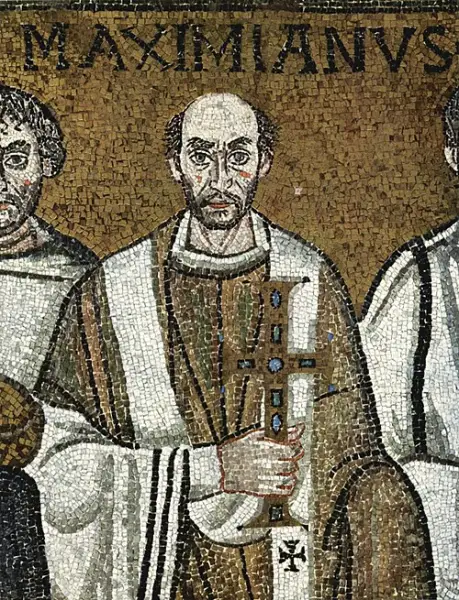
Maximianus died at Ravenna on the twenty-second of February in 556, aged fifty-seven, after an episcopate of a decade that had changed the face of the city. His memory was fixed in the most famous of all Ravennate images: in the sixth-century mosaic of San Vitale, the figure named above it as Maximian stands beside the emperor Justinian and his retinue, holding a jeweled cross and clothed in early versions of the alb, chasuble, and pallium. The inscription beneath which the portrait stands preserved his name for as long as the tesserae have held the wall, so that the unwanted bishop of 546 became the permanent neighbor of an emperor. Both the Catholic Church and the Eastern Orthodox Church regard him as a saint, though his cult remains essentially local to Ravenna. There his memory keeps a foothold in the living city: a church is dedicated to him at Piazza S. Massimiano in Punta Marina, and his feast is kept on the twenty-second of February in the West, while the East remembers him a day earlier, on the twenty-first.
§ Life
Timeline
- 499
Born at Vistar near Pola in Istria, in the Ostrogothic Kingdom.
§ Life
- 546
Consecrated the twenty-sixth bishop of Ravenna by Pope Vigilius at Patras in Greece.
§ Life
- 22 Feb 556
Died at Ravenna at the age of fifty-seven.
§ Life
In Their Own Words
a poor deacon of Pola who rose to a high position through his political adroitness
by shrewd maneuvers he overcame their opposition, and won their respect by his discretion, generosity, and great enterprises of church building and decoration
The Record
- Major works
- Completion of the Basilica of San Vitale at Ravenna·Completion of Sant'Apollinare in Classe at Ravenna·Church of Santa Maria del Canneto in native Istria·Revision of the liturgical books and emendation of the Latin Bible·Commissioned a large number of illuminated manuscripts·Throne of Maximian, the ivory cathedra of Ravenna
- Canonization
- Pre-congregation saint, venerated by the Roman Catholic and Eastern Orthodox Churches
Prayer
Bibliography
Show 3 sources
- Andreas Agnellus (2004). The Book of Pontiffs of Ravenna. Translated by Deliyannis Mauskopf. Washington, DC: Catholic University of America Press. ISBN 9780813213583.
- Schapiro, Meyer (1980). "The Joseph Scenes on the Maximianus Throne". Late Antique, Early Christian and Medieval Art: Selected Papers. London: Chatto & Windus. pp. 34–48. ISBN 0701125144.
- Simson, Otto von (1987). Sacred Fortress: Byzantine Art and Statecraft in Ravenna. Princeton, New Jersey: Princeton University Press.
Profile text adapted from the Wikipedia article, licensed CC BY-SA 4.0.
Pray with this saint every day
Save St. Maximianus of Ravenna to your favorites, read the full profile, and get feast-day reminders in the Saints app.
Get the Saints AppFree on the App Store for iPhone and iPad