
1894-1941·Feast August 14
St. Maximilian Kolbe
Priest, Franciscan, and Martyr of Charity
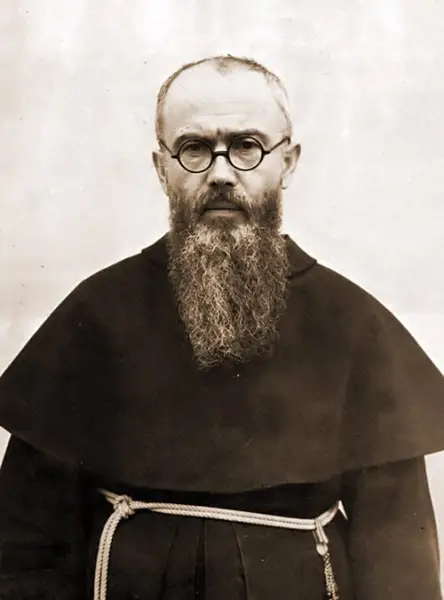
Overview
On 8 January 1894 Raymund Kolbe was born at Zduńska Wola in Russian-partitioned Poland, son of a German weaver father and a Polish midwife mother, and raised at nearby Pabianice. At nine he saw a vision of the Virgin offering two crowns, white for purity and red for martyrdom, and answered that he would accept them both. Joining the Conventual Franciscans in 1907, he took the name Maximilian, later adding Maria, studied philosophy and theology in Rome, and was ordained in 1918. In Rome in 1917 he founded the Militia Immaculatae, an association working for the conversion of sinners through Mary. Sent home after doctorates and interrupted by tuberculosis, he launched the monthly Knight of the Immaculata in 1922, built the great publishing monastery of Niepokalanów near Warsaw in 1927, and between 1930 and 1936 founded mission houses in Japan and India. As guardian of Niepokalanów he added a radio station, and after the 1939 invasion organized shelter for thousands of refugees, among them some two thousand Jews. Arrested in February 1941 and shipped to Auschwitz as prisoner 16670, he stepped out of the ranks at the end of July to take the place of Franciszek Gajowniczek, a condemned husband and father. Leading the doomed men in prayer through two weeks of starvation, he was finished off with a carbolic acid injection on 14 August 1941.
The Complete Life
Early Life
Raymund Kolbe was born on 8 January 1894 at Zduńska Wola, in the Russian partition of Poland, the son of a German weaver father and a Polish midwife mother, and was raised at nearby Pabianice in a household poor, pious, and politically conscious — his father would later be hanged by the Russians for the family's part in the independence cause, and his mother lived to see her son canonized. The defining event of his childhood came at the age of nine. Kneeling in the parish church, he afterward told his mother, the Virgin Mary had come to him holding two crowns, one white for purity and one red for martyrdom, and had asked whether he was willing to accept either; when he answered that he would accept them both, she vanished. The vision fixed the two lines — purity and sacrifice — along which his whole life ran.
§ Early life
Conversion and Vocation
In 1907 Kolbe entered the Conventual Franciscans, going with his elder brother Francis to the minor seminary at Lwów, and in the Order took the religious name Maximilian, later adding Maria to make the dedication explicit. His studies took him to Rome — the Order's international college — for philosophy and theology, and he was ordained priest in 1918. Rome in those years was also the scene of his first foundation: on 16 October 1917, in the face of freemasonic demonstrations in the streets, he and a handful of fellow students founded the Militia Immaculatae, an association pledged to the conversion and sanctification of souls through total consecration to the Immaculate Virgin. The little organization, begun with six or seven men and a hand-cranked press, would become one of the largest Marian apostolates in the Church.
§ World War I
Mission and Ministry
Doctorates completed and tuberculosis contracted, Kolbe returned to Poland and turned to the printed word. In 1922 he launched the monthly Rycerz Niepokalanej — the Knight of the Immaculata — which grew from a parish bulletin into a magazine with a circulation in the hundreds of thousands. To house the apostolate he built Niepokalanów, the 'City of the Immaculata,' near Warsaw, consecrated in 1927: a friary that was also a modern printing plant, staffed by brothers who lived the full Franciscan rule between the presses. Its scale made it the largest friary of its time in the world. Between 1930 and 1936 Kolbe himself served as a missionary, founding Mugenzai no Sono, the Garden of the Immaculata, on a hill outside Nagasaki in Japan, and beginning a further foundation in India. As guardian of Niepokalanów he added a radio station, and after the German invasion of September 1939 he organized shelter for thousands of refugees, among them some two thousand Jews.
§ Introduction
Spirituality and Teaching
Kolbe's spirituality was a theology of the Immaculate Conception worked out into machinery. His governing idea was that the Immaculata is the perfect instrument of the Holy Spirit, and that souls consecrated to her become her instruments in turn — 'the knight' placed wholly at her disposal for the conversion of the world. From this flowed everything distinctive in his work: the Militia's vow of total consecration, the mass circulation of print and later of radio rather than personal prestige, the building of whole communities whose labor was apostolic, and his deep interest in the technical means of his age, which he regarded simply as the fastest road from Mary to the human heart. His Franciscanism was austere and cheerful at once — poverty observed strictly, and a constant, almost buoyant confidence that the impossible was merely the next assignment.
§ References
Trial and Final Years
The Gestapo arrested Kolbe on 17 February 1941; on 28 May he was deported to Auschwitz as prisoner 16670. At the end of July, after a prisoner from his block got away, the camp commanders chose ten men to die of starvation in retaliation. Among them was Franciszek Gajowniczek, who cried out that he had a wife and children; Kolbe stepped out of the ranks and offered to take his place. The offer was accepted. In the starvation bunker he led the nine doomed men in prayer and hymns through two weeks, and when — after the others had died — he was found still alive, he was finished off with an injection of carbolic acid on 14 August 1941, the vigil of the Assumption. He was forty-seven.
§ Imprisonment and death
Canonization
News of the death in another man's place spread after the war, carried by survivors including Gajowniczek himself, who lived to old age. Pope Paul VI beatified Kolbe as a confessor on 17 October 1971. The question of whether he was a martyr — he had not been killed in odium fidei in the strict sense — was resolved by John Paul II, who canonized him on 10 October 1982 and formally declared him a martyr of charity, a category the Pope's own experience of occupied Poland made personal. At the canonization Gajowniczek was present in the square. His feast falls on 14 August, the day of his death and the vigil of the Assumption — the Marian feast of the month of his birth and of his Order's devotion.
§ Introduction
Legacy
Kolbe is among the most widely invoked saints of the twentieth century: patron of prisoners, of drug addicts and those with eating disorders, of families, journalists, and amateur radio operators, and of the pro-life movement. Niepokalanów still prints; the Nagasaki foundation he built on the far side of the hill survived the atomic bomb that destroyed the city below it; and the starvation bunker of Auschwitz has become a place of pilgrimage. His life made the argument he set out to make — that total consecration to the Immaculata is not sentiment but a program capable of martyrdom — and his death is remembered simply as the act of a man who asked to die for another.
§ References
Timeline
- 8 Jan 1894
Born at Zduńska Wola in Russian-ruled Poland and named Raymund
§ Early life
- 1903
Received a vision of the Virgin Mary offering him crowns of purity and martyrdom
§ Early life
- 1907
Joined the Conventual Franciscans with his elder brother Francis, enrolling at their minor seminary in Lwów
§ Franciscan friar
- 1910
Entered the novitiate, taking the religious name Maximilian
§ Franciscan friar
- 1911
Professed his first vows to the Franciscan order
§ Franciscan friar
- 1912
Sent to Rome to study at the Pontifical Gregorian University
§ World War I
- 1914
Professed final vows, adopting the additional name Maria
§ Franciscan friar
- 1915
Earned a doctorate in philosophy from the Gregorian University
§ World War I
- 16 Oct 1917
Founded the Militia Immaculatae in Rome to work for the conversion of sinners through Mary
§ World War I
- 1918
Ordained a priest in Rome
§ Priesthood
- Jul 1919
Went back to Poland after the war, joining the teaching staff of the Kraków Seminary
§ Priesthood
- Jan 1922
Founded the monthly devotional periodical Rycerz Niepokalanej
§ Priesthood
- 1927
Established near Warsaw a new friary of his order, which grew into a major publishing centre
§ Priesthood
- 1930
Arrived in Shanghai on missionary work before moving on to Japan
§ Missionary work in Asia
- 1931
Founded the Franciscan monastery Mugenzai no Sono outside Nagasaki
§ Missionary work in Asia
- Jul 1932
Left Japan for Malabar in British India, founding another monastery there
§ Missionary work in Asia
- 1933
Returned to Poland for the order's general chapter in Kraków
§ Return to Poland
- 1936
Appointed guardian of Niepokalanów at the Provincial Chapter, ending his Japanese work
§ Return to Poland
- 1938
Started the Radio Niepokalanów station at the monastery
§ Return to Poland
- 19 Sep 1939
Arrested by the Germans after they captured Niepokalanów
§ World War II
- 8 Dec 1939
Released by the Germans after refusing to sign the Deutsche Volksliste
§ World War II
- 17 Feb 1941
Gestapo shut down the monastery and arrested him; jailed at Pawiak prison in Warsaw
§ Imprisonment and death
- 28 May 1941
Transferred to Auschwitz as prisoner 16670
§ Imprisonment and death
- Jul 1941
Volunteered to take Franciszek Gajowniczek's place among ten men condemned to starve
§ Imprisonment and death
- 14 Aug 1941
Died in the bunker after guards gave the surviving prisoners lethal injections of carbolic acid
§ Imprisonment and death
- 15 Aug 1941
Cremated on the feast of the Assumption of Mary
§ Imprisonment and death
- 3 Jun 1952
Cause for his beatification opened at the local level
§ Canonization
- 12 May 1955
Recognized as a servant of God by Pope Pius XII
§ Canonization
- 30 Jan 1969
Declared venerable by Pope Paul VI
§ Canonization
- 17 Oct 1971
Raised to the altars by Pope Paul VI in 1971 as a confessor, in Rome
§ Canonization
- 10 Oct 1982
Canonized by Pope John Paul II, who declared him a martyr of charity
§ Canonization
In Their Own Words
That night I asked the Mother of God what was to become of me. Then she came to me holding two crowns, one white, the other red. She asked me if I was willing to accept either of these crowns. The white one meant that I should persevere in purity and the red that I should become a martyr. I said that I would accept them both.
Modern times are dominated by Satan and will be more so in the future. The conflict with Hell cannot be engaged by men, even the most clever. The Immaculata alone has from God the promise of victory over Satan.
No one in the world can change Truth. What we can do and should do is to seek truth and to serve it when we have found it.
Hate is not a creative force. Love is a creative force.
I want to be the greatest. But in what? In loving people and loving God!
He who loves will know the Immaculata much more than a philosopher or a theologian.
The Record
- Major works
- Founder of the Militia Immaculatae (1917)·Founder of the monthly Rycerz Niepokalanej (Knight of the Immaculata)·Founder of the monastery and press of Niepokalanów·Founder of Mugenzai no Sono monastery, Nagasaki
- Patron of
- Amateur radio operators·Prisoners·Political prisoners·Drug addicts·Families·Journalists
- Symbols
- Franciscan habit·The two crowns, white and red·The starvation bunker of Auschwitz
- Canonization
- Beatified by Pope Paul VI in 1971 as a confessor; canonized by Pope John Paul II on 10 October 1982 and declared a martyr of charity
Prayer
Bibliography
Show 2 sources
- ↑ Pronounced [ maksɨˌmʲilʲan ˌmarʲja ˈkɔlbɛ ] .
- ↑ After the friars learned that mugenzai was a homonym for "endless sin", the monastery's name was changed to Seibo no Kishi ( translation</span>"}]]}' id="mwAwc">transl. Knights of the Blessed Mother ). [ 21 ]
Profile text adapted from the Wikipedia article, licensed CC BY-SA 4.0.
Pray with this saint every day
Save St. Maximilian Kolbe to your favorites, read the full profile, and get feast-day reminders in the Saints app.
Get the Saints AppFree on the App Store for iPhone and iPad