
died 12 October 288·Feast October 12
St. Maximilian of Lorch
Missionary bishop and martyr of Noricum
Overview
Saint Maximilian of Lorch, also called Maximilian of Celeia, served Noricum, his Roman province on the Danube, as both bishop and missionary, and sealed that work with martyrdom in the year 288. Born at Celeia, in present-day Slovenia, he made a pilgrimage to Rome as an adult, and there Pope Sixtus II sent him north to Lauriacum, the Roman settlement known as Lorch, to preach there through the closing decades of the third century. In that frontier country he planted the church of Lorch and labored as a missionary among the people of the Danube provinces. Under the emperor Numerian he was brought before the Roman prefect, refused to abandon Christianity or to sacrifice to the pagan gods, and was condemned to death; he was beheaded on the twelfth of October in 288. His cult, attested at least from the seventh century in Bavaria and Salzburg, spread with his relics, which Saint Rupert enshrined at Bischofshofen and which were transferred to Passau in 985. He is remembered on the twelfth of October, and in some places on the twenty-ninth, and remains a patron of the church in Slovenia and Austria.
The Complete Life
A Son of Celeia
Maximilian was born at Celeia, a Roman town in the province of Noricum that lies in present-day Slovenia, where he is still beloved under the Slovene name Maksimilijan Celjski. The century and circumstances of his birth are not recorded, but his life belongs to the age of the soldier emperors, when the Christian faith was spreading along the roads and river towns of the Alpine and Danubian provinces. Celeia stood on an important route between the Adriatic and the Danube, and a young man raised there would have known both the commerce and the paganism of the frontier world. As an adult Maximilian undertook the journey that shaped his life: a pilgrimage to Rome, the city of the apostles, at a time when making such a journey exposed a Christian to real risk. There he came to the attention of Pope Sixtus II, the bishop of Rome whose own martyrdom would come in 258, and the pope discerned in the pilgrim from Noricum a man fitted for far harder work than any he could do at home. He was sent back north, not to Celeia but to Lauriacum.
§ Life
Sent by the Pope to the Danube
The commission Maximilian received in Rome made him one of the earliest missionary bishops of the upper Danube. Pope Sixtus II sent him to Lauriacum, the Roman town known in German as Lorch, in Noricum, and there he labored as a missionary through the closing decades of the third century. To be sent by the pope to a frontier posting was an act of trust in both directions: the bishop of Rome confided a whole province to one man, and the man accepted a task that offered no comfort, no security, and, as it proved, no natural old age. Noricum's garrisons and settlements along the river were loyal to the old gods, and the empire was then governed by emperors who required universal sacrifice. Maximilian went anyway. The tradition honors him as a bishop, meaning that he bore the full ministry of the church in a land where no Christian structure yet existed, and every sacrament he administered on the Danube had to be preceded by the slow work of preaching, persuading, and gathering a flock out of a pagan population.
§ Life
The Church of Lorch
At Lauriacum Maximilian founded the church of Lorch, the act for which his memory has been kept above all others. In the third century a Christian community on the Danube was a fragile thing: a handful of believers meeting in a river town far from any sister church, dependent entirely on their bishop's endurance. Yet from that foundation the faith would one day spread through the whole Alpine region, and later ages honored Maximilian as the apostle in whom that beginning was made. His missionary work among the people of Noricum continued through the turbulent years of the soldier emperors, and it was precisely the church he had planted that made his arrest inevitable. When the order came to sacrifice to the pagan gods, the Christians of Lorch had a visible shepherd whom they could not abandon and whom the authorities could not ignore. The church he founded outlived the Roman frontier itself, and when Christianity returned to these lands in force after the age of persecutions, it did so on ground that Maximilian had already claimed for Christ.
§ Life
Martyrdom under Numerian
The persecution that ended Maximilian's life came under the emperor Numerian. He was brought before the Roman prefect and required to abandon Christianity and to offer sacrifice to the pagan gods, the test by which the state then measured loyalty. He refused both demands, and for that refusal the sentence was death by beheading; he was executed on the twelfth of October in the year 288. He died as a bishop in full labor, not an old man recalled from retirement, and the church of Lorch was left the inheritance of his blood as well as his teaching. The date of his death, the twelfth of October, became the day of his feast, kept on that date across the churches that honor him and in some places on the twenty-ninth of the same month. Among the martyrs of the Danube lands his is among the earliest and best attested deaths, and the manner of it, a quiet refusal followed by the sword, has made him a model of steadfastness for the churches of Austria, Bavaria, and Slovenia ever since.
§ Life
An Ancient and Living Cult
Maximilian was never canonized by any formal process; the Church honored him as a martyr from the earliest times, and his cult is attested at least from the seventh century in Bavaria and Salzburg. In that same century Saint Rupert, the apostle of the Bavarian lands, raised a church to his memory at Bischofshofen, in the Salzach valley, and had the martyr's remains carried there, giving them a shrine in the heart of the country his example helped to evangelize. From Bischofshofen the relics were later transferred to Passau in the year 985, and the see of Passau, which carried the faith of the Danube into Austria, thus held the bones of the man who had first preached it. A cult that runs unbroken from the seventh century to the present, with relic translations recorded in three distinct epochs, is documentary evidence of the deepest kind: the people of the Danube never forgot the bishop who died at Lorch. He is honored liturgically on the twelfth of October, with some local calendars keeping him on the twenty-ninth, and his grave at Celje remains a place of veneration in his native land.
§ Devotion
Memory in Celje and Beyond
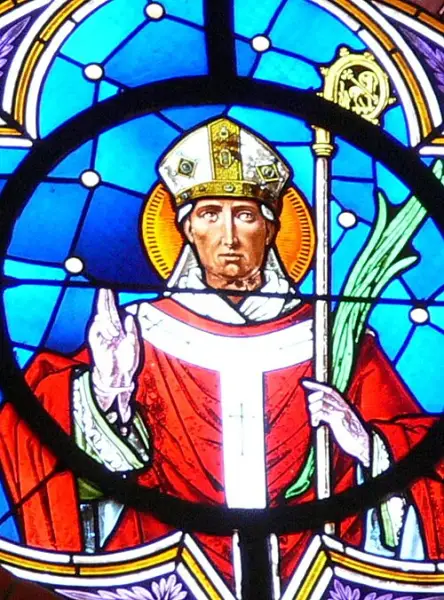
In the city that grew from his native Celeia, now Celje in Slovenia, Maximilian's memory is a living civic inheritance. Maximilian's Day, Maksimilijanov dan, is celebrated in Celje each year, keeping before the town the neighbor who left it for the Danube and returned to it only in his relics, which rest there still. The city park bears his name as well, designated by formal decree as the Park of Saint Maximilian of Celje, so that his memory occupies a place in the daily geography of the city and not merely in its church calendars. Beyond Slovenia his cult shaped the religious landscape of Bavaria and Austria, where the churches of Bischofshofen and Passau enshrined his relics and where his feast has been observed for well over a thousand years. Medieval artists portrayed him in glass, as the window of the parish church at Aigen in Upper Austria attests. For the churches of the Danube he stands as the first of their pastors, the man who carried the gospel to their river before the empire that condemned him fell, and whose faith proved more durable than the frontier it died defending.
§ Devotion
Timeline
- 12 Oct 288
Beheaded at Lorch by the Roman prefect of Emperor Numerian after refusing to sacrifice to the pagan gods.
§ Life
- 985
His relics, kept earlier at Bischofshofen, were transferred to Passau.
§ Devotion
The Record
- Major works
- Foundation of the church of Lorch
- Canonization
- Pre-congregation martyr; his cult is attested at least from the 7th century
Prayer
Bibliography
Show 6 sources
- Karlin, Alma Maximiliana (2025). Maksimilijan Celjski (in Slovenian). Translated by Jerneja Jezernik. Celje: Celjska Mohorjeva družba. ISBN 978-961-278-779-0.
- Čuk, Silvestar. "sveti Maksimilijan Celjski – škof in mučenec" [Saint Maximilian of Celje – bishop and martyr]. svetniki.org (in Slovenian). Retrieved 13 October 2025.
- "Vabljeni na Maksimilijanov dan v Celje, 11. in 12.10.2025". skofija-celje.si (in Slovenian). Diocese of Celje. Retrieved 13 October 2025.
- "Der heilige Maximilian, Bischof von Lorch". heiligenlegenden.de (in German). Retrieved 6 February 2006.
- Herbermann, Charles, ed. (1913). "Maximilian". Catholic Encyclopedia. New York: Robert Appleton Company.
- "Odlok o imenovanju Parka svetega Maksimilijana Celjskega v naselju Celje". Uradni list (in Slovenian). City of Celje. 13 December 2023.
Profile text adapted from the Wikipedia article, licensed CC BY-SA 4.0.
Pray with this saint every day
Save St. Maximilian of Lorch to your favorites, read the full profile, and get feast-day reminders in the Saints app.
Get the Saints AppFree on the App Store for iPhone and iPad