
died 346·Feast May 29
St. Maximin of Trier
Sixth Bishop of Trier and Foe of Arianism
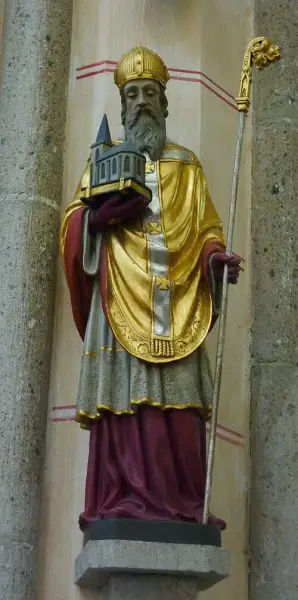
Overview
Maximin guided the church of Trier as its sixth bishop across the turbulent decades that followed Nicaea. A native of Silly in the Poitiers region of Gaul, he rose from the western provinces to one of the great sees of the Roman world, and there he earned the confidence of the emperors Constantine II and Constans. His episcopate was shaped by the fight against Arianism. Twice he opened Trier to Athanasius of Alexandria while that bishop was driven from his see, in 336–37 and again in 343. He had earlier sided with the circle of Paul I of Constantinople, and he joined the council held at Sardica under Pope Julius's convocation around 342. When four Arian bishops arrived from Antioch hoping to capture Constans for their cause, Maximin denied them an audience and prevailed upon the emperor to send them away empty-handed. He died on 12 September 346 and was laid to rest in the burial ground beyond the city's northern gate, where a church grew over his tomb and eventually became St. Maximin's Abbey, among the oldest monastic sites of western Europe. Gregory of Tours bears witness to the devotion shown at his grave within a few generations.
The Complete Life
A Son of Western Gaul
Maximin first saw the light of day at Silly, a village in the Poitiers region of western Gaul; the year of his birth has not come down to us. His family belonged to the orbit of the church's leadership in that part of the country, for a brother of his occupied the bishopric of Poitiers, placing the two siblings simultaneously on the episcopal bench of the province. The Christianity into which he was born was that of a Gallic church scarcely a generation past the Great Persecution, newly courted by imperial favour and still learning how to wield influence at court. Poitiers stood firm for the Creed of Nicaea, and Hilary, the city's great fourth-century bishop, would become the West's most eloquent adversary of the Arian party. The record is silent about whether Maximin and Hilary ever met, yet the bishop of Trier's lifelong war on Arian teaching plainly drew its strength from the same western loyalties. By the opening years of the 330s his gifts had brought him to the notice of the church on the Moselle, and Trier, the emperor's western residence, would be the stage for everything he accomplished.
§ Life
The Throne of Trier
In 335 Maximin took over the see of Trier as its sixth bishop, following Agricius, and with it a charge planted at the centre of imperial power in the West. Trier served again and again as a seat of the emperors, and the men who led its church moved with ease among courtiers and officials. Maximin held the trust of Constantine II as well as of Constans, and that access gave his advocacy of the Nicene faith a range that few bishops of the provinces could match. For a little more than a decade, from 335 until his death in 346, he directed a church whose years coincided with the bitterest stretch of the Arian conflict. The office he received was among the most conspicuous in Gaul, and its burdens were political as much as pastoral: giving shelter to fugitive champions of orthodoxy, weighing the approaches of imperial messengers, and keeping a fractured episcopate in one piece. He answered all three demands, marrying courtesy toward the throne to an immovable resistance against every enemy of the Creed. Bishops of Trier were expected to be statesmen as well as shepherds, and Maximin carried both burdens without apparent strain, nor did the emperor's favour ever tempt him to soften the message that had earned it.
§ Life
Sardica and the Arian Envoys
The struggle with Arianism set the course of Maximin's public career. His first allegiance in it was to the circle of Paul I of Constantinople, one of the deposed champions of the Nicene confession, and when Julius I, bishop of Rome, summoned the council that met at Sardica around 342, Maximin sat among its members. That assembly became a milestone in the West's resistance to the eastern Arian establishment, and its consequences arrived at Trier without delay: from Antioch came four Arian bishops, intent on drawing Emperor Constans into their cause. Maximin would not admit them to his table and pressed the emperor until their proposals were turned away. The affair reveals how far his voice carried — a churchman able to bend an emperor's ear against a rival delegation. In those years Trier served the battered defenders of Nicaea as a place of refuge, and Maximin kept its gate, determining which of the displaced the imperial city would welcome and which it would refuse. The refusal cost him nothing in the emperor's esteem and gained the Nicene cause everything it needed at that moment: an imperial decision, given in the West's greatest city, that the Arian emissaries would find no foothold there.
§ Life
Hospitality to the Exiled
On two occasions during Athanasius' banishment from Alexandria, in 336–37 and once more in 343, Maximin gave the exile a home within the church of Trier. The gesture was anything but ceremonial. Athanasius stood condemned in the judgement of much of the episcopate, and to shelter him invited real danger. Maximin welcomed him both times as an honoured guest, and the scene became the picture by which posterity recalled the bishop of the Moselle. His holiness expressed itself in protection rather than in speculation: the faith defined at Nicaea, kept safe by hiding its confessors, feeding them, and granting them ground from which their voices could still be heard. Within a church split by court factions he practised the more demanding virtue of loyalty to persons as well as to doctrines, remaining at the side of a man whom other bishops dared not touch. The same constancy appeared in his rebuff of the Arian envoys and his appeals to the emperor. Later generations fixed the image of Maximin welcoming Athanasius at Trier, a lasting portrait of friendship between bishops in a divided church.
§ Life
Death and Burial
On 12 September 346 Maximin's long resistance ended; he had governed Trier for some eleven years. Other dates for his passing appear in the sources, but the September date rests on the firmest authority. He was laid to rest in the burial ground beyond the city's northern gate, and the bishops who succeeded him at Trier were placed beside him there in a crypt of many chambers. Above the grave rose a church in honour of John the Evangelist, which in time received the dedication of St. Maximin's Abbey and grew into one of the oldest monastic settlements in the Latin West. The office he vacated passed to Paulinus, who carried the Trier church into the next stage of the Arian contest. The bishop who had given refuge during his episcopate to the banished confessors of the East was himself reckoned among their number within a single lifetime. His funeral was, in effect, the first act of his cult: the community that followed the bier beyond the gate had already begun to speak of him as they spoke of the martyrs, and the place of burial was chosen with that future in view.
§ Life
An Ancient and Unbroken Cult
Maximin stands among the saints recognised before any machinery of canonization existed, claimed by the church of Trier from the generations directly after his burial. In the sixth century Gregory of Tours attests the devotion offered to him both at his tomb and within the church of Saint John the Evangelist — proof that his cult had taken hold within a few generations of his death. This kind of early, local recognition, born of the affection of the community that laid him in the earth, is precisely how the saints of the first Christian centuries were made. His commemoration settled on 29 May, a date observed by Catholics and Orthodox alike. His cult always burned brightest near Trier and in Alsace, the regions where his abbey kept his memory alive through its liturgy. In the veneration that has never ceased around his tomb there survives, intact, the voice of a fourth-century congregation honouring the bishop who had sheltered its fathers in the faith. Gregory's testimony matters because it is early and disinterested: an antiquarian bishop, cataloguing the holy places of Gaul, found the memory of Maximin flourishing and saw no need to explain what every Christian of Trier took for granted.
§ Veneration
Abbey, Bear, and Golden Legend
The monastery raised above his grave grew into one of western Europe's oldest monastic houses and bore his name across twelve centuries. Normans razed it in 882; it rose again, underwent wholesale reconstruction in the 1680s, was emptied by secularisation in 1802, suffered under wartime bombs, and now stands only in part. Artists show Maximin as a bishop holding a book and a model of a church, welcoming Saint Athanasius, or directing a bear to shoulder his travelling bag — an emblem borrowed from the legend of Corbinian. The faithful sought his help against false oaths, shipwreck and ruinous storms, and his veneration was most intense near Trier and across the border in Alsace. In the Middle Ages his identity merged with that of Maximinus of Aix, so that to his name clung the romance of the Seventy Apostles, Mary Magdalene's wonder-working crossing to Provence, and the story of her retreat and death as the Golden Legend told it. French communes called Saint-Maximin keep the memory of one or the other of the two saints joined under that name. Through every one of those turns the constant element was the tomb itself, and the pilgrims who came to it — bishops, monks, and townspeople of the Moselle — kept alive the memory that an empire's turbulence could not touch.
§ Veneration
Timeline
- 335
Succeeded Agricius as the sixth bishop of Trier.
§ Titles of the Great Christian Church
- 336
Harboured Athanasius of Alexandria as an honoured guest during his first exile, in 336–37.
§ Life
- 342
Sat among the members of the council gathered at Sardica at Pope Julius's summons.
§ Life
- 343
Received Athanasius at Trier a second time during his exile.
§ Life
- 12 Sep 346
Died after about eleven years as bishop of Trier.
§ Life
- 882
Norman raiders destroyed the abbey built over his grave.
§ Veneration
The Record
- Major works
- Defence of the Nicene faith at the synod of Sardica·The burial church at Trier later raised into St. Maximin's Abbey
- Patron of
- Trier·against perjury·against loss at sea·against destructive rains
- Symbols
- book·model of a church·bear carrying his travelling pack·depicted receiving Saint Athanasius at Trier
- Canonization
- Pre-congregation saint, honoured at Trier from the generations after his death
Prayer
Bibliography
Show 5 sources
- Ott, Michael. "St. Maximinus." The Catholic Encyclopedia, Vol. 10. New York: Robert Appleton Company, 1911
- Gregory of Tours, De gloria confessorum, xciii, in Patrologia Latina lxii, cc. 898ff
- "Medieval Sourcebook: The Golden Legend: Volume 4 (full text)", Fordham.edu, retrieved 29 April 2010
- Herbermann, Charles, ed. (1913). "St. Maximinus". Catholic Encyclopedia. New York: Robert Appleton Company
- Sauser, Ekkart. "Maximinus". Biographisch-Bibliographische Kirchenlexikon (Schaff-Herzog)
Profile text adapted from the Wikipedia article, licensed CC BY-SA 4.0.
Pray with this saint every day
Save St. Maximin of Trier to your favorites, read the full profile, and get feast-day reminders in the Saints app.
Get the Saints AppFree on the App Store for iPhone and iPad