
1st century (traditional)·Feast June 8
St. Maximinus of Aix
Legendary First Bishop of Aix-en-Provence
Overview
Maximinus is honoured as the first bishop of Aix-en-Provence, though nearly everything told of him comes wrapped in legend. Tradition styled him steward of the Bethany household and one of the seventy-two whom the Lord sent out. Around 42 or 43, so the story goes, enemies of the Christians put him aboard a rudderless, sail-less ship with Lazarus, Martha and Mary — other tellings give the three Marys — and the vessel somehow carried them to the shores of Provence. Making his seat in the Roman colony of Aquae Sextiae, today's Aix-en-Provence, he is said to have evangelised the region with Mary Magdalene at his side and to have raised the first chapel where the cathedral now stands. Saint Alexander of Brescia came to visit him there. When Mary Magdalene withdrew to the cave of Sainte-Baume, the final ministry fell to him: on the day her death approached she came down to the plain, received communion from his hands, and was buried at his direction. His own death fell on 8 June. Critics date the Magdalene story to eleventh-century storytellers, yet devotion to Maximinus in Aix is of great age.
The Complete Life
The Steward of Bethany
His legend opens not in Gaul but in Bethany, where Maximinus is said to have managed the household of Lazarus, Martha and Mary. The same current of tradition counts him among the seventy-two disciples dispatched by the Lord in the Gospel of Luke. Historians of the saints warn that nothing in his dossier predates the age of legend-making, and that the historical figure is almost wholly hidden behind the story; still, the tale preserves a character vivid and coherent. In this account he stood within the closest circle of Christ's companions in Judea, and when that circle was scattered he underwent what the tradition assigns to its members: a battered boat, deprived of steering and sail, and the open water. About 42 or 43, the legend continues, enemies of the Christian faith loaded him onto that ship together with Lazarus, Martha and Mary, while rival versions name instead the three Marys — Mary Magdalene, the wife of Cleophas, and the mother of James — and abandoned the whole company to wind and wave. Which version a hearer received depended on the storyteller, but all agreed on the essentials: a disciple of the Lord, driven from the East by hatred of his faith, and carried westward by a power that no enemy could forbid the sea.
§ Legend
A Ship Without Rudder or Mast
The fantastic crossing from Palestine concluded on the Provençal coast, where the castaways stepped ashore against every natural likelihood. Deprived of rudder and canvas, the little vessel had been steered by the hand of God across the breadth of the Mediterranean, and its passengers landed as the first apostles of Gaul. Maximinus, a disciple of the apostolic generation, now turned missionary in a Roman province that had not yet heard the Gospel proclaimed in full. With him travelled the companions whom Provence would honour for a thousand years: Lazarus, whom Christ had raised; Martha, serving the infant churches as she had once served her guests; and Mary Magdalene, carrying with her the perfume of her devotion. Whatever historians make of the narrative, it supplied the earliest Christianity of the region with faces and names, and it set the memory of Maximinus at the head of the episcopal roll of Aix, the shepherd from across the sea whom the city would never forget. The legend made the landfall of that battered ship the true birthday of the Provençal church, and pilgrims who stood on the shore in later centuries believed they were looking at the ground where the Gospel first touched the soil of France.
§ Legend
Aquae Sextiae and the First Chapel
His headquarters, the legend relates, were fixed in the Roman colony of Aquae Sextiae Salluviorum — the Aix-en-Provence of today — and from that centre the conversion of the countryside began. Tradition couples his labour with that of Mary Magdalene, who joined him in winning Provence to the faith. Among the visitors recorded of him is Saint Alexander of Brescia, whose coming is said to have confirmed his strength of belief. The community he planted matured into one of the principal churches of southern Gaul, and its origin stayed bound to the ground of the city's cathedral: by ancient report it was Maximinus who put up the first chapel where Aix Cathedral would one day rise. Thus the legendary companion of the apostolic age became the seed from which the Christian life of Provence grew, and the thermal waters of the old Roman spa town gained a second life as the baptismal springs of a new religion. Whatever else may be said of the story, it explains the peculiar devotion of Aix to its first bishop, whose chapel — so the faithful held — was the seed from which the whole Christian city grew.
§ Legend
The Last Communion of the Magdalene
The last scenes of the story tie Maximinus to Mary Magdalene forever. She had retired to a lonely cave among the mountains, the spot known to pilgrims as Sainte-Baume. As the day of her death drew close she came down to the lowland so that Maximinus might bring her communion and see to her burial. Her sarcophagus now lies in the Basilica of St Mary Magdalene at Saint-Maximin-la-Sainte-Baume, alongside those of Marcella, Suzanne and Maximinus, whose name the town took for its own. His own passing fell on 8 June, kept ever after as his feast, and Sidonius — in the saints' calendar Saint Sidoine — followed him in the bishopric of Aix. During the third or fourth century what remained of him was sealed in a sarcophagus, and around it flowered the deeply rooted local devotion to Aix's first bishop, long before any tale of the Magdalene raised the shrine's medieval renown. The scene became a favourite of Provençal art: the first bishop of Aix attending the dying Magdalene, the apostle of the apostles receiving her last communion from the hands of her fellow-exile, so that their two legends were sealed together at the moment of her death.
§ Legend
Cult Confirmed by Pope Leo XIII
His canonization came by way of cult confirmation on 24 November 1900, when Leo XIII approved veneration of the group styled "Niketius of Besançon and his 10 Companions", in whose company Maximinus was included. The decree crowned a devotion of considerable antiquity: the cultus at Aix reaches back far, even though the romance connecting him with Mary Magdalene belongs to a much later stratum. Artists show him as a bishop administering the last sacraments to Mary Magdalene, seated in a boat with her, Martha and Lazarus, or simply as an aged bishop bearing mitre and staff. The eighth of June is his feast. Confusion with Maximin of Trier — a saint of far better documented history whose legends drew in those of Provence — has dogged his memory, and the two names have traded stories for centuries, to the puzzlement of hagiographers trying to separate them. Leo's decree thus gathered into one act of recognition a saint whose antiquity no one doubted and whose history no one could write, which is perhaps the most honest description of many early cults.
§ Legend
Legend, Criticism, and a Living Shrine
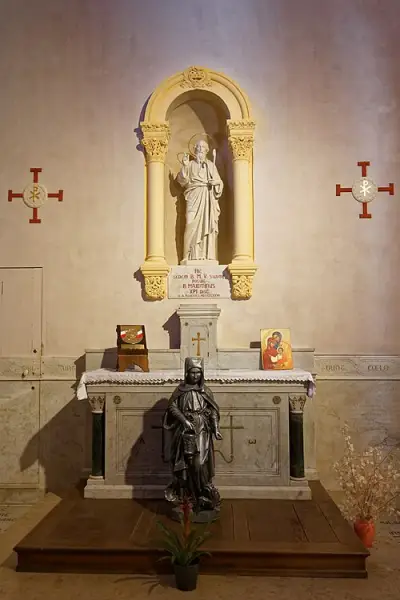
Beneath the romance the ascertainable outline is meagre. Louis Duchesne demonstrated that making Maximinus the first bishop of Aix was a late development: the linkage with the life of the Magdalene was the invention of monks of Vézelay, devised near the midpoint of the eleventh century at an abbey that claimed to hold her relics. A bishop of Aix in the fourth or fifth century is all that Maximinus may have been, and even that much cannot be confirmed, for the ancient episcopal catalogues of the city omit him entirely. Dom Basil Watkins dismissed the tale of the voyage to France in Mary Magdalen's company as historically worthless. Yet the devotional geography the story called into being endures: the pilgrimage shrine of Sainte-Baume high on its hillside, the great basilica at Saint-Maximin-la-Sainte-Baume over the sarcophagi, and the statue of the saint in Aix's church of Notre-Dame de la Seds, where the city's supposed first shepherd still keeps watch over his flock. Critics may dismantle the legend, but they have never dismantled the shrines; the cave on the mountain and the basilica in the plain still draw their pilgrims, and the saint of Aix keeps his feast among them.
§ Legend
Timeline
- 42
Said to have been set adrift by anti-Christian Jews with Lazarus, Martha and Mary, reaching Provence by miracle.
§ Legend
- 1050
Monks of Vézelay devised the legend linking him to Mary Magdalene, around the middle of the eleventh century.
§ Legend
- 24 Nov 1900
Pope Leo XIII confirmed his cult, counting him among Niketius of Besançon and his 10 Companions.
§ Legend
The Record
- Major works
- First chapel on the site of Aix Cathedral, by tradition
- Symbols
- bishop giving the last sacraments to Mary Magdalene·in a boat with Mary Magdalene, Martha and Lazarus·elderly bishop with mitre and staff
- Canonization
- Canonized by confirmation of his cult on 24 November 1900 by Pope Leo XIII
Prayer
Bibliography
Show 6 sources
- Goyau, Georges. "Archdiocese of Aix." The Catholic Encyclopedia, Vol. 1. New York: Robert Appleton Company, 1907
- Odden, Per Einar. "Den hellige Maximin av Aix (d. 46?)". Den katolske kirke
- Butler, Alban. "St. Maximinus, First Archbishop of Aix, Confessor". The Lives of the Saints, Vol. VI: June, 1866
- "The History Of Aix Cathedral In France". Cathedrale Aix
- Delaney, John J. Dictionary of Saints. Random House Publishing Group, 2005, p. 425. ISBN 9780385515207
- Watkins OSB, Basil. The Book of Saints: A Comprehensive Biographical Dictionary. Bloomsbury Publishing, 2015, p. 514. ISBN 9780567664150
Profile text adapted from the Wikipedia article, licensed CC BY-SA 4.0.
Pray with this saint every day
Save St. Maximinus of Aix to your favorites, read the full profile, and get feast-day reminders in the Saints app.
Get the Saints AppFree on the App Store for iPhone and iPad