
c. 1272–1285 – 1365/1380·Feast January 13
St. Maximos of Kafsokalyvia
Hesychast Hermit and Hut-Burner of Athos
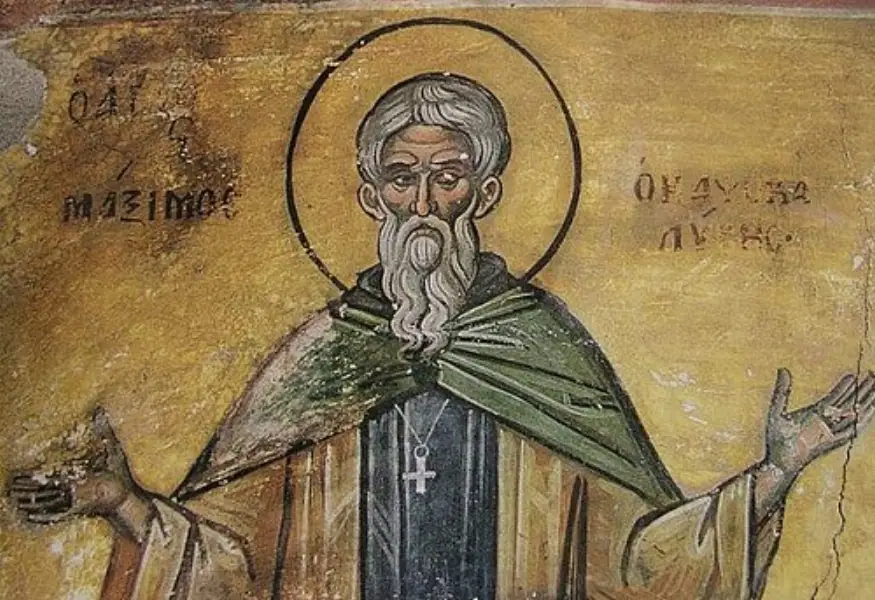
Overview
Maximos of Kafsokalyvia — 'of the burning hut' — was a hesychast of the Holy Mountain whose refusal to keep any fixed dwelling became proverbial. Born Manuel to a distinguished family of Lampsacus on the Hellespont, at some date between 1272 and 1285, he shared his meals and garments with beggars while still a boy and slipped away from a marriage his parents had arranged when he was seventeen, choosing the monastic habit on Mount Ganos. Left without an elder, he passed a year in Constantinople as a holy fool before settling at the Great Lavra on Athos. Three appearances of the Mother of God urged him to the mountain's summit and then into a decade of drifting among rude shelters, every one of which he set alight when he departed — the habit that gave him his name. An encounter with Gregory of Sinai closed his wandering days and held him in one hut for fourteen years more. Emperors sought him out around 1350, and a single greeting from him foretold Patriarch Callistus' death. He died on Athos in 1365 or 1380, laid in a grave of his own digging; his counsel on prayer entered the Philokalia, and four biographers recorded his life.
The Complete Life
The Noble Boy of Lampsacus
Maximos entered the world as Manuel, child of an aristocratic house in Lampsacus, the town on the Hellespont, at some point within the years 1272 to 1285. Theophanes of Vatopedi, who later wrote his life, preserves the lineaments of his boyhood. From his earliest days he was drawn to the Mother of God, and the otherworldliness that would rule his whole existence showed itself in his habit of passing his meals and his garments to beggars. His parents imagined a different future and betrothed their son at the age of seventeen. Manuel had designs of his own. He quitted the paternal roof for Mount Ganos, put himself under the direction of an aged monk there, and at about the same time took up the austerities that would mark him for life — the bare ground for a bed, vigils that consumed the night, and long fasting. Monastic houses of Thrace also knew him: he passed a stretch as a monk at Mount Papikion, acquiring the discipline of the region's monasteries before the world beyond them had ever heard his name.
§ Biography
Holy Fool and Monk of the Lavra
Death deprived him of his spiritual father, and Maximos answered by going to Constantinople, where he passed a year in the strangest school of humility the ascetic tradition knows: that of the holy fool. Lodged in the gateway of a celebrated church, he feigned madness and let the passers-by mock him, hiding his sanctity beneath a theatrical wreckage of wits. From the capital he moved on to the Great Lavra on Athos and took his place among its brethren. While he was there the three visions came that turned his life aside. The Mother of God bade him climb to the very top of the Holy Mountain. Twice he postponed obedience; the third appearance left him no excuse, and he scaled the peak, where after three days she came to him again and told him to stay on Athos. With that command his decade of wandering began, roaming the mountain's uninhabited slopes in search of a solitude that would never be quite enough. The discipline was deliberate. In the eyes of the desert writers, the holy fool's disguise guarded him from the deadliest of temptations, the admiration of other men, and Constantinople offered no fitter arena for it than the crowded gateway of a great church. What he learned there he carried with him to Athos.
§ Biography
The Burning Huts
From those years of drifting he took his name. He passed most of the period as a hermit in shelters of the crudest kind, relocating whenever a place seemed to be losing its savagery. One garment clothed him; wild nuts and berries fed him; and whenever he abandoned a hut he put it to the torch — the practice from which the title 'Hut-Burner' stuck to him. The burning shelter became the badge of a man resolved that not even the recollection of comfort should hold him. The itinerant phase closed when Gregory of Sinai, the celebrated master of the Jesus prayer, crossed his path; after that meeting Maximos abandoned the nomadic life and kept to a single hut for a further fourteen years. On the Mountain he ranked among Gregory's intimates, and his own fame accumulated: a saintly counsellor, admired for ascetic severity, credited with reading hearts, foretelling events, curing the sick and driving out demons. Report even had him lifted in the air and changing seawater into drinkable freshness. Contemporaries read the drifting years as one long lesson: that the monk's true dwelling is not made with hands, and that every settlement, however austere, remains one night's fire away from freedom.
§ Biography
Prophecy Before Emperors and Patriarchs
Two episodes display the sanctity his age perceived in him. Around 1350, John VI Kantakouzenos and John V Palaiologos, emperors of the Romans, travelled in person to see the monk of the burning huts — measure enough of how widely his renown had spread. Callistus I, patriarch of Constantinople, who had lived twenty-eight years on Athos as monk and disciple of Gregory of Sinai, met Maximos while crossing the Mountain en route for Serbia. The hermit's greeting sounded like a joke: the old man, he said, would never set eyes on his old lady again. Only afterwards did listeners grasp the prophecy, for Callistus would die in Serbia without ever returning to the capital he had so named. Then the hermit sang him on his road with the words "Blessed are the blameless in the way", the funeral verse of Psalm 118. Beneath the banter lay unbroken prayer. His instruction on prayer and ascesis was thought worthy of a place in the Philokalia beside the great doctors of the hesychast way, and seekers climbed the slopes to ask his judgement on their souls.
§ Biography
Within Earshot of the Bells
Age brought a last exchange of shelters. He handed his hut over to Niphon Kausokalybites — the disciple who would himself one day write his teacher's life — and shifted nearer the Great Lavra so that its bells might reach his ears. The man who had set fire to every roof he owned would finish his course within hearing of the monastery's psalmody. On his own instructions he was interred in a grave that he had dug for himself. His death came on Athos in 1365, though certain accounts prefer 1380. A man who had courted anonymity all his days nonetheless became the subject of four vitae: Theophanes of Vatopedi composed the Life of Maximos, Niphon wrote another, and Makarios Makres and Ioannikios Kochylas added two more in the following generations — proof enough that the Mountain could not forget the hermit who tried so hard to leave nothing behind him. The arrangement was characteristic. To the end he treated shelter as a loan rather than a possession, surrendering the last of it so that a younger ascetic might take up the watch. The grave he dug with his own hands long before it was needed completed the pattern of a life that reserved nothing for itself.
§ Biography
Feast on the Holy Mountain
Each 13 January the Eastern Orthodox Church keeps the feast of Maximos of Kafsokalyvia, a date that falls on the 26th of the month by the revised calendar. No decree of canonization stands behind his cult; it rests where the cults of the Mountain's great ascetics rest — on the witness of his disciples, on biographies written while memory of him was fresh, and on the enduring reverence of the monastic commonwealth for the man whose blazing huts once dotted its heights. The skete of Kapsokalyvia, still inhabited by hermits on Athos, carries his nickname as its very name, a living settlement descended from the solitude he made illustrious. Orthodox spirituality of the fourteenth century remembers him among the hesychast fathers, and his instruction on prayer and the ascetic combat continues to circulate in the Philokalia, read by all who long to pray with the mind in the heart. Feast days on the Holy Mountain are not conferred; they grow. A hermit's name enters the calendars because monks have prayed at his tomb and told his stories in the refectory, and by that organic process the Hut-Burner passed into the company of the venerated.
§ Biography
The Skete That Carries His Name
He founded nothing, yet Athos itself preserves him. The skete of Kapsokalyvia takes its name from his nickname, and the line of hut-dwelling anchorites he inspired ran on after him, Niphon of Kafsokalyvia his own disciple among them. Four vitae attest the grip his figure gained on Byzantine imagination: one (MS BHG 1236z) from the pen of the hieromonk Niphon of Athos, another (MS BHG 1237) composed by Theophanes of Vatopedi, superior of the monastery there, and two further lives by Makarios Makres (c. 1382/3–1431) and by Ioannikios Kochylas, set down around the year 1400. Through the Philokalia his guidance in prayer travelled far beyond the Holy Mountain, binding him to the broader currents of hesychasm and of Christian mysticism in his era. The aristocrat's child from Lampsacus who ended as the Hut-Burner stands in Orthodox memory as living proof that nothing — neither ancient lineage, nor marriage, nor even a roof against the rain — may be retained by the man who follows Christ. No saint of his century left so slight a footprint and so deep an impression: shelters that burned, writings that remained, and a name that the geography of Athos has kept for six hundred years and more.
§ Hagiographies
Timeline
- 1350
Received visits from the Byzantine emperors John VI Kantakouzenos and John V Palaiologos.
§ Biography
- 1365
Died on Mount Athos; some accounts give the year 1380 instead.
§ Biography
- 1400
Ioannikios Kochylas composed a life of Maximos, around this year.
§ Hagiographies
In Their Own Words
This old man will never see his old lady again.
Blessed are the blameless in the way
The Record
- Major works
- Writings on prayer and asceticism preserved in the Philokalia
- Canonization
- No formal canonization is recorded; venerated in the Eastern Orthodox Church since his death
Prayer
Bibliography
Show 7 sources
- Efthymiadis, Stephanos (2011). The Ashgate Research Companion to Byzantine Hagiography: Periods and Places. Ashgate Publishing, Ltd. ISBN 978-0-7546-5033-1
- Greenfield, Richard P. H.; Talbot, Alice-Mary Maffry (2016). Holy Men of Mount Athos. Dumbarton Oaks Medieval Library, Vol. 40. Harvard University Press. ISBN 978-0-674-08876-4
- Gothóni, René; Speake, Graham (2008). The Monastic Magnet: Roads to and from Mount Athos. Peter Lang. ISBN 978-3-03911-337-8
- Cavallo, Guglielmo (1997). The Byzantines. University of Chicago Press. p. 38. ISBN 0226097927
- Speake, Graham (2014). Mount Athos: renewal in paradise. ISBN 978-960-7120-34-2
- Skoubourdis, Anna (2020). The Philokalia of the Holy Neptic Fathers, Volume 5. ISBN 979-8-7096-9499-6
- "Venerable Callistus Xanthopoulos of Mount Athos". Orthodox Church in America, 2021-11-22
Profile text adapted from the Wikipedia article, licensed CC BY-SA 4.0.
Pray with this saint every day
Save St. Maximos of Kafsokalyvia to your favorites, read the full profile, and get feast-day reminders in the Saints app.
Get the Saints AppFree on the App Store for iPhone and iPad