
died c. 385·Feast May 25
St. Maximus of Évreux
Missionary bishop and martyr of Normandy
Overview
Maximus of Évreux, called Saint Mauxe in the country around his shrine, died about the year 385 and is honored as a saint in both the Catholic and the Eastern Orthodox communions. The legend of his life makes him a native of Brescia and the second bishop of Évreux, sent to Gaul to carry on the work of Taurinus, the see's first bishop. With his brother Venerandus or Victorinus, who served as his deacon, he first tried to win converts among the barbarian armies and, meeting failure there, was dispatched by Pope Damasus I to preach in Gaul. The brothers traveled north with two priests, Mark and Etherius, through Auxerre, Sens, and Paris to Évreux, where Maximus took up the bishop's chair. At Acquigny the pair were seized, by pagans or Arians according to the differing accounts, and beheaded. Mark and Etherius escaped to bury them; Etherius afterward became bishop of Évreux in his turn. Maximus is the patron of Vernon in the Eure, and his relics, burned in the wars of religion, were long invoked there against drought.
The Complete Life
Brothers from Brescia
The tradition of Maximus begins not in Normandy but in northern Italy, for the legend makes him and his brother natives of Brescia. The two were bound to each other in Orders as well as in blood: Maximus bore the office of bishop, and his brother, called Venerandus or Vénérand in some recensions and Victorinus in others, ministered as his deacon. Such pairs of brothers in holy Orders were a familiar pattern of the early missionary church, and this one set out together upon the hardest assignment of the age, the conversion of the barbarian armies that were remaking the West. The attempt did not succeed. Preaching among the soldiers of the invasions, the brothers failed to make the converts they sought, and the record of that failure is itself precious, an acknowledgment that the spread of the gospel moved by closed doors as well as open ones. Their work, however, had not gone unnoticed in Rome, and a new mission was about to be given them in a gentler field. The sources that keep him never claim a writing, a foundation, or a documented miracle for him; the whole of his claim on memory rests on the office he bore and the death he died, and that proved enough to carry his name from Brescia to the Norman countryside.
§ Legend
Sent by Damasus to Gaul
Pope Damasus I sent the brothers westward with a new commission: to preach in Gaul and to continue the work of Saint Taurinus, the first bishop of Évreux, whose see had been planted in the days of the persecutions. Two priests, Mark and Etherius, were given them as companions on the road. The little company made its way through the heart of Gaul, passing by way of Auxerre, Sens, and Paris, before reaching Évreux, where Maximus assumed the government of the see as its second bishop. The chronology here is tangled in the sources, for the years sometimes assigned to his episcopate, 411 to 440, sit badly beside the traditional date of his martyrdom about 385, and the legend plainly carries material from more than one age. Whatever the true order of events, the shape of the mission is clear: an Italian bishop and his deacon brother, sent by the pope himself, strengthening the chain of churches that reached from Rome through the river towns of Gaul to the Norman frontier. Every stage of that itinerary can still be traced, and the route itself shows how the faith traveled: from the papal city by way of the river towns of the Seine basin, parish by parish, until the missionaries stood where Taurinus had stood before them.
§ Legend
Martyrdom at Acquigny
The mission ended a short distance from the episcopal city, at Acquigny on the Iton. There the brothers were captured, and the sources differ on the character of their captors, named sometimes as pagans and sometimes as Arians; either way, the hatred that seized them was the hatred of those who would not receive the preaching they carried. Both were beheaded. Mark and Etherius, the two priests who had traveled with them, escaped the violence, and it fell to them to gather the bodies of their masters and give them burial. The survivors did not leave the field for good: Etherius, the tradition records, later succeeded to the bishopric of Évreux himself, so that the blood of the martyrs passed directly into the succession of the see they had served. The heads of the two brothers remained at Acquigny, where a church of the Benedictines was eventually raised above their tomb, and there, in the chapel and the parish memory of the village, the pastoral journey that began in Brescia came to its resting place. The brevity of the account is its own kind of testimony: martyrdom needed no elaboration, and the brothers' silence at the block passed whole into the memory of the place that kept them.
§ Legend
Relics, Droughts, and a Tomb in the Forest
The cult of Maximus and his brother grew rich in the Norman soil. Around the year 960 a man named Amalbert rediscovered the relics and undertook to carry them off, leaving behind only the heads of the two saints; but as he crossed the Seine close by Fontenelle Abbey sickness struck him down; the journey stopped there, and the remains stayed at the monastery, where a chapel raised by Richard I of Normandy gave them a home. There the relics remained until the wars of religion, when the Huguenots burned them. The heads stayed at Acquigny; when the Benedictine church above the tomb decayed, the relics were moved to the parish church and set beneath the high altar. The people of the region learned to beg the saints for rain: their relics were carried in invocation against drought in 1559, again in 1615, and once more in 1726, on that last occasion following the head of Saint Swithun, the great weather-saint of England. At Vernon, in the forest of Bizy, a monument is still shown as the tomb of Maximus, bearing the inscription recording its restoration by the Duchess of Orleans in 1816, with a carved figure of the saint carrying his bishop's crozier on its southern face.
§ Veneration
Timeline
- 385
Maximus suffered martyrdom by beheading at Acquigny, together with his brother, around this date.
§ Legend
- 411
Some sources give this year as the start of his episcopate at Évreux, though the date conflicts with the traditional martyrdom.
§ Legend
- 960
A man named Amalbert rediscovered the relics of Maximus and Victorinus around this time.
§ Veneration
- 1559
The saints' relics were carried in procession and invoked against drought.
§ Veneration
- 1615
The relics were again carried in intercession against drought.
§ Veneration
- 1726
The invocation against drought was repeated, with the relics carried after the head of Saint Swithun.
§ Veneration
- 1816
The supposed tomb of Maximus in the forest of Bizy at Vernon was restored by the Duchess of Orleans.
§ Veneration
In Their Own Words
This monument of piety was restored by the Duchess of Orleans. 1816.
The Record
- Patron of
- Vernon, Eure·invoked against drought
- Symbols
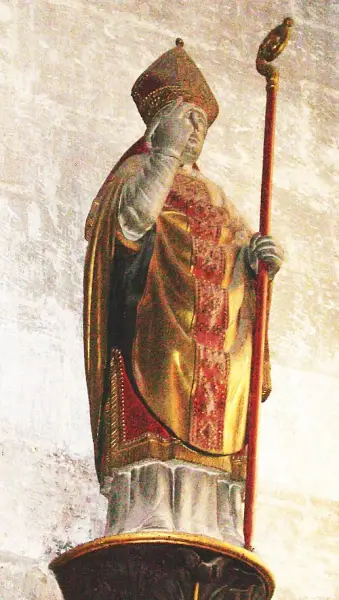
- Depicted as a bishop carrying a crozier
- Canonization
- Pre-congregation martyr, venerated since late antiquity
Prayer
Bibliography
Show 3 sources
- Catholic Encyclopedia (1912), "Evreux" Retrieved 2012-03-04.
- St. Maximus & Victorinus - Catholic Online
- Saint of the Day, May 25 at SaintPatrickDC.org. Retrieved 2012-03-04.
Profile text adapted from the Wikipedia article, licensed CC BY-SA 4.0.
Pray with this saint every day
Save St. Maximus of Évreux to your favorites, read the full profile, and get feast-day reminders in the Saints app.
Get the Saints AppFree on the App Store for iPhone and iPad